

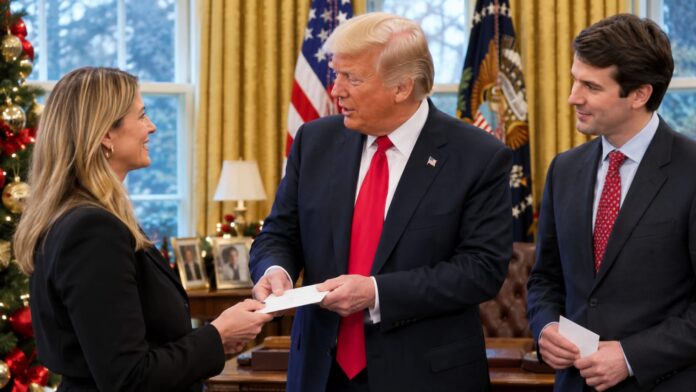
Story Highlights
- President Trump continues his tradition of generosity with substantial holiday cash gifts.
- Aides Margo Martin and Chamberlain Harris received $45,000 and $20,000 respectively.
- The gifts have sparked discussions about ethics and the president’s relationship with his staff.
- Supporters view these gestures as a sign of appreciation for loyalty and hard work.
What Happened
In a move that has garnered both admiration and scrutiny, President Donald Trump has once again demonstrated his generosity by gifting significant cash amounts to his aides during the holiday season. According to financial disclosures reported by The Washington Post, Trump bestowed a remarkable $45,000 cash gift on Margo Martin and $20,000 on Chamberlain Harris, both of whom hold the title of Special Assistant to the President. This practice reflects not only his appreciation for loyal staff but also his commitment to maintaining strong relationships with those who support him.
The financial disclosures revealed that these gifts were categorized as ‘Cash Gift for Holidays,’ a clear indication of the president’s intent to reward his aides for their dedication and hard work. Both Martin and Harris, along with another aide, Natalie Harp, earn taxpayer-funded salaries of $150,000, which adds an interesting layer to the conversation surrounding these gifts. While some may question the ethics of such financial gestures, the White House has defended the practice, emphasizing that these gifts are separate from their official duties.
- Margo Martin received a $45,000 cash gift.
- Chamberlain Harris was awarded a $20,000 cash gift.
- All three aides earn a taxpayer-funded salary of $150,000.
- The gifts were categorized as ‘Cash Gift for Holidays’ in financial disclosures.
Why It Matters
The implications of President Trump’s holiday cash gifts extend beyond mere financial transactions. For many supporters, these gestures symbolize a deep appreciation for loyalty and hard work. In an era where political relationships can often feel transactional and impersonal, Trump’s willingness to reward his aides financially stands out as a refreshing change. It reinforces the notion that he values the contributions of those who work tirelessly behind the scenes to support his agenda.
However, the gifts have also sparked ethical discussions. Critics argue that such financial rewards blur the lines between personal and professional relationships within the government. The White House has responded to these concerns by asserting that the gifts are permissible under relevant legal and ethical standards, emphasizing that they do not influence the aides’ official duties. This defense highlights the ongoing tension between the president’s personal style of leadership and the expectations of traditional political conduct.
- Supporters view the gifts as a sign of appreciation for loyalty.
- Critics raise ethical concerns about the implications of such financial rewards.
- The White House defends the practice as permissible under legal standards.
- The gifts reinforce the personal relationships within Trump’s administration.
Political and Public Context
Understanding the context surrounding these holiday gifts requires a look at President Trump’s leadership style and his approach to relationships within his administration. Known for his unconventional methods, Trump has often prioritized loyalty and personal connections over traditional political norms. This approach has fostered a unique environment within the White House, where aides feel valued and appreciated for their contributions.
Moreover, the gifts come at a time when Trump’s administration is navigating various challenges, including ongoing scrutiny from political opponents and the media. By publicly rewarding his aides, the president not only reinforces their loyalty but also sends a message to his supporters that he stands by those who support him. This dynamic is particularly important as he prepares for future political endeavors, including potential campaigns.
- Trump’s leadership style emphasizes loyalty and personal connections.
- The gifts come amid ongoing scrutiny from political opponents.
- Publicly rewarding aides reinforces their loyalty and support.
- The administration navigates challenges while maintaining strong internal relationships.
What Happens Next
Looking ahead, the implications of these holiday cash gifts will likely continue to unfold. As the political landscape evolves, questions surrounding the ethics of such financial gestures may resurface, prompting further discussions about the relationship between personal and professional conduct in government. Additionally, the president’s approach to rewarding loyalty may influence how future administrations handle similar situations.
Moreover, as Trump prepares for potential future campaigns, the loyalty of his aides will be crucial. The gifts serve as a reminder of the importance of maintaining strong relationships within his inner circle, which could play a significant role in shaping his political strategy moving forward. Supporters will be watching closely to see how these dynamics evolve and whether similar gestures will be made in the future. The ongoing dialogue about the appropriateness of such gifts will likely remain a topic of interest as the political climate shifts.
- Future discussions may arise regarding the ethics of financial gifts in government.
- Trump’s approach may influence future administrations’ handling of similar situations.
- The loyalty of aides will be crucial for Trump’s potential future campaigns.
- Supporters will monitor how these dynamics evolve in the coming months.
