

Story Highlights
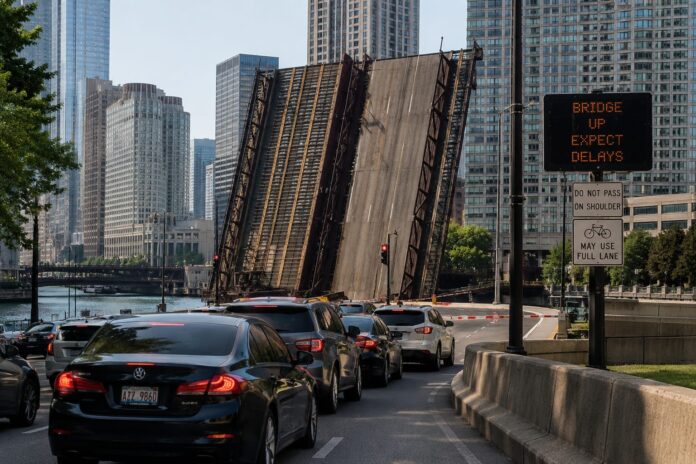
- A popular bridge in downtown Chicago is stuck in the up position due to extreme heat.
- Traffic delays are significant as crews work to resolve the issue.
- High temperatures are forecast to reach the 90s, with heat indices exceeding triple digits.
- A heat advisory is in effect for the area until 9 p.m. CT.
What Happened
In a troubling development for commuters in downtown Chicago, the Lake Shore Drive Bridge has become stuck in the up position, causing significant traffic disruptions. This incident occurred amid a heat wave that has gripped the city, with temperatures soaring into the 90s. The Chicago Office of Emergency Communications confirmed that the bridge, which spans the Chicago River on the eastern edge of the city, has been unable to close properly, leading to extensive backups for drivers attempting to navigate the area.
Officials have reported that crews are actively working to make the necessary adjustments to safely close the bridge and reopen the roadway. As part of their efforts, workers were seen dousing the bridge with water around 11:50 a.m. local time, presumably to cool down the metal components that have expanded due to the extreme heat. This situation has raised concerns about the infrastructure’s ability to withstand such weather conditions, highlighting the challenges faced by urban planners and engineers in maintaining essential transportation routes.
- The Lake Shore Drive Bridge is located on the easternmost side of Chicago.
- Crews were observed applying water to the bridge to cool it down.
- High temperatures in Chicago are forecast to be in the 90s.
- A heat advisory is in effect until 9 p.m. CT.
Why It Matters
The malfunction of the Lake Shore Drive Bridge is not just a minor inconvenience for drivers; it underscores the broader implications of extreme weather on urban infrastructure. As climate change continues to manifest through increasingly severe weather patterns, cities like Chicago must grapple with the reality that their infrastructure may not be equipped to handle such conditions. The bridge’s failure to close properly is a stark reminder of the vulnerabilities inherent in aging infrastructure, which can be exacerbated by extreme temperatures.
Moreover, the traffic delays caused by the stuck bridge can have cascading effects on the local economy. Businesses that rely on foot traffic and accessibility may see a decline in customers, while emergency services could face challenges in navigating congested roadways. The situation also raises questions about the preparedness of city officials and transportation agencies to respond to such emergencies, particularly as climate-related incidents become more frequent.
- Traffic delays could impact local businesses reliant on customer access.
- Emergency services may face challenges due to congested roadways.
- The incident highlights vulnerabilities in aging infrastructure.
- It raises questions about the city’s preparedness for climate-related emergencies.
Political and Public Context
This incident is part of a larger trend of infrastructure challenges faced by cities across the United States. Many urban areas are grappling with the effects of climate change, which can lead to extreme weather events, including heat waves, heavy rainfall, and flooding. In recent years, Chicago has experienced a number of weather-related incidents that have tested the resilience of its infrastructure. The Lake Shore Drive Bridge incident serves as a reminder that cities must prioritize investment in their infrastructure to ensure it can withstand the rigors of climate change.
Additionally, this situation is not unique to Chicago. Other cities have faced similar challenges, with bridges and roads becoming compromised due to extreme weather. The need for comprehensive assessments of infrastructure resilience is becoming increasingly urgent as cities look to adapt to changing climate conditions. The Lake Shore Drive Bridge incident may prompt city officials to reevaluate their strategies for maintaining and upgrading critical transportation routes.
- Other cities have faced similar infrastructure challenges due to extreme weather.
- Chicago has experienced multiple weather-related incidents in recent years.
- There is a growing need for assessments of infrastructure resilience.
- The incident may prompt reevaluation of maintenance strategies for critical routes.
What Happens Next
As crews continue to work on the Lake Shore Drive Bridge, the immediate focus will be on safely closing the bridge and reopening the roadway to alleviate traffic congestion. However, this incident raises several important questions about the future of infrastructure in Chicago. Will city officials take this opportunity to invest in upgrades and maintenance to prevent similar incidents in the future? How will the city address the broader implications of climate change on its infrastructure?
In the coming days, residents and commuters will be watching closely to see how quickly the situation is resolved and whether any long-term solutions are proposed. The incident may also spark discussions among city leaders about the need for increased funding for infrastructure projects, particularly those aimed at enhancing resilience against extreme weather. As the city navigates these challenges, the Lake Shore Drive Bridge incident will likely serve as a case study for other urban areas facing similar threats.
- Crews will continue working to safely close the bridge and reopen the roadway.
- City officials may consider infrastructure upgrades in response to the incident.
- Discussions about funding for infrastructure projects may be prompted.
- The incident could serve as a case study for other cities facing similar challenges.
