

Story Highlights
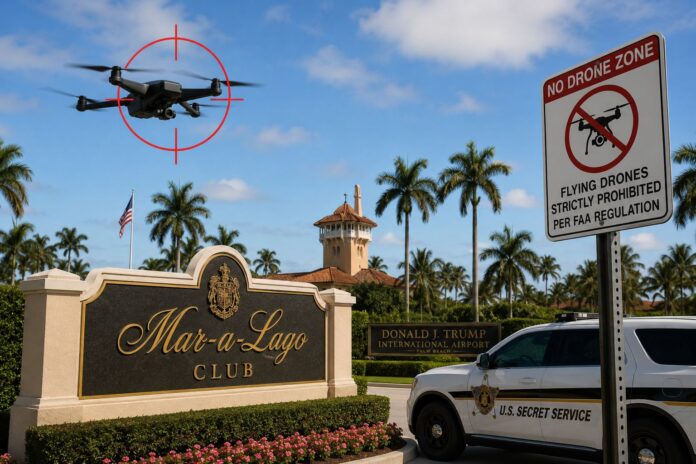
- The FAA has proposed permanent flight rules around Trump’s Mar-a-Lago estate.
- The initiative aims to enhance security amid rising threats against the president.
- Experts warn that existing regulations may not be sufficient to deter determined adversaries.
- The proposal was made at the request of the U.S. Secret Service.
What Happened
The Federal Aviation Administration (FAA) has taken a significant step in enhancing security measures around President Donald J. Trump International Airport in Palm Beach, Florida. This move comes in response to increasing concerns regarding unauthorized aircraft and rogue drones that pose a potential threat to the safety of the former president and other high-profile individuals. The proposed regulations, which aim to establish permanent flight rules in the vicinity of Trump’s Mar-a-Lago estate, were initiated at the request of the U.S. Secret Service, emphasizing the ongoing need for heightened security in the airspace surrounding the property.
Under the proposed regulations, a Special Flight Rules Area (SFRA) would be created, requiring aircraft flying below 2,000 feet within one nautical mile of the designated zone to obtain explicit clearance from air traffic control. This includes maintaining two-way communication and continuously transmitting an assigned transponder code. Additionally, arriving and departing aircraft would need to meet strict security criteria before entering the airspace, reflecting the serious nature of the threats faced by the former president.
- The FAA’s proposal was made public on [insert date].
- The U.S. Secret Service requested the new regulations.
- Aircraft would need to comply with strict security measures.
- Concerns have been raised about the effectiveness of these regulations.
Why It Matters
The implications of the FAA’s proposed airspace restrictions are profound, particularly in the context of national security. The heightened security measures reflect the reality that President Trump has become one of America’s most targeted leaders, facing threats on a regular basis. The recent incidents, including a plot involving explosive-laden drones aimed at him during a public event, underscore the urgent need for effective security protocols. While the proposed regulations are a step in the right direction, experts argue that they may not be sufficient to deter determined adversaries who are increasingly using advanced technology, such as drones, to carry out their malicious intentions.
As drone technology becomes more accessible and prevalent, the challenges of securing airspace are compounded. The FAA’s initiative highlights the necessity for a comprehensive approach to airspace security that goes beyond regulatory measures. Experts like Brett Velicovich, a former U.S. Army special operations intelligence analyst, have pointed out that bureaucratic red tape and outdated regulations hinder the deployment of effective counter-drone technology. This raises critical questions about the adequacy of current security measures and the need for a more proactive stance in addressing potential threats.
- President Trump faces ongoing threats, necessitating enhanced security measures.
- Experts warn that existing regulations may not deter determined adversaries.
- The rise of drone technology complicates airspace security.
- There is a call for more proactive measures to address potential threats.
Political and Public Context
The context surrounding the FAA’s proposed airspace rules is essential to understanding the broader implications of this initiative. The increasing frequency of threats against high-profile individuals, particularly those in political positions, has raised alarms about the effectiveness of current security protocols. The U.S. Secret Service, tasked with protecting the president and other dignitaries, has been vocal about the need for enhanced measures to safeguard against potential attacks. The request for new airspace regulations is a direct response to these concerns, reflecting the evolving landscape of security threats.
Moreover, the rise of drone usage among civilians and companies has created new challenges for security agencies. Drones are now widely available and can be easily acquired, making them a potential tool for malicious actors. The incident in Butler, Pennsylvania, where a shooter conducted surveillance using a commercially available drone before an attack, serves as a stark reminder of the vulnerabilities that exist in the current security framework. As the FAA moves forward with its proposal, it must consider these evolving threats and the need for a comprehensive strategy that encompasses both regulatory measures and active counter-drone capabilities.
- The U.S. Secret Service has emphasized the need for enhanced security measures.
- Recent incidents highlight vulnerabilities in current security protocols.
- The rise of drone technology poses new challenges for security agencies.
- There is a growing call for a comprehensive approach to airspace security.
What Happens Next
Looking ahead, the FAA’s proposed airspace rules will undergo a review process that includes public comments and potential adjustments based on feedback from stakeholders. This process is crucial in ensuring that the regulations are effective and address the concerns raised by experts and the public alike. As the FAA evaluates the proposal, it will need to balance the need for security with the operational realities faced by pilots and air traffic controllers in the region.
Furthermore, the ongoing discussions surrounding airspace security will likely prompt a broader examination of existing regulations and the need for updates to address the challenges posed by modern technology. The effectiveness of the proposed measures will be closely monitored, and there may be calls for additional actions to enhance security further. As the situation evolves, it will be essential to remain vigilant and proactive in addressing potential threats to ensure the safety of all individuals in the airspace surrounding Mar-a-Lago and beyond.
- The FAA will review the proposed airspace rules and consider public comments.
- There may be adjustments to the regulations based on stakeholder feedback.
- Ongoing discussions will likely prompt a broader examination of airspace security.
- Vigilance and proactive measures will be essential in addressing potential threats.
