

Story Highlights
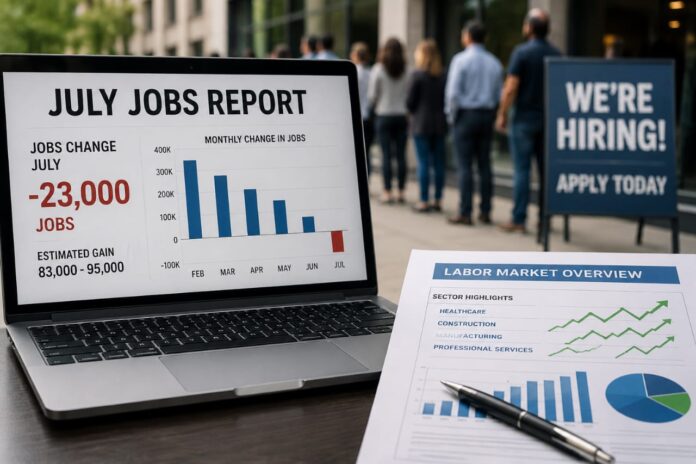
- The U.S. job market contracted by 23,000 positions in July, falling sharply below economist expectations of 83,000 new jobs
- Manufacturing and factory construction sectors demonstrated growth, underscoring resilience in key industrial segments
- Public approval ratings on economic stewardship have declined significantly, with net approval on jobs dropping to minus 22 points
- Unemployment claims remain at historically low levels while government payrolls continue to shrink
What Happened
Recent labor market data has presented a complicated economic picture, with national employment figures disappointing significantly against expectations while certain sectors demonstrate notable strength. The Bureau of Labor Statistics reported that the nation experienced a net loss of 23,000 jobs during July, a stark reversal from the anticipated gain of between 83,000 and 95,000 positions that economists had forecasted. This shortfall represents a substantial miss in labor market performance and has prompted renewed scrutiny of economic conditions heading into the final stretch of 2024.
The White House has emphasized that manufacturing and factory construction jobs increased during the same period, characterizing these gains as evidence of an industrial resurgence proceeding on schedule. Officials have noted that unemployment claims remain at record lows and that government payroll reductions have continued as anticipated. The administration’s framing highlights the distinction between struggling sectors and areas where strategic economic policies have reportedly borne fruit, particularly in domestic manufacturing capacity.
- July employment declined by 23,000 jobs versus economist predictions of 83,000-job gains
- Manufacturing and factory construction sectors showed job growth during the same reporting period
- Hospitality and leisure sectors shed positions, partly attributed to post-World Cup normalization
- Government payrolls continued their downward trajectory while unemployment claims held at historic lows
Why It Matters
The divergence between overall employment weakness and manufacturing sector strength illuminates a fundamental tension within current economic dynamics. While headline job losses capture public attention and influence broader economic sentiment, the administration’s emphasis on manufacturing gains reflects a deliberate policy focus on rebuilding domestic industrial capacity. This distinction matters because it reveals where targeted policies have demonstrated measurable impact, even as macroeconomic headwinds challenge the broader labor market.
Public perception of economic conditions has shifted noticeably, with polling data indicating that confidence in job market conditions has deteriorated substantially. Aggregated polling figures show that net approval ratings on jobs have declined to minus 22 points, representing a 31-point swing from January 2025 when the second term began with approval at plus 9 points. This polling movement reflects growing consumer anxiety about employment prospects, with survey data showing that those believing it is a bad time to find quality employment has risen to 63 percent, up from 45 percent earlier in the year. Conversely, those viewing the job market as favorable has fallen to 33 percent from 48 percent in January.
- Manufacturing gains provide evidence that sector-specific policies are functioning as intended
- Overall job losses threaten to undermine economic messaging heading into critical electoral periods
- Consumer confidence metrics have deteriorated significantly, potentially dampening spending and economic growth
- The jobs market remains a central focus for voter decision-making in upcoming elections
Political and Public Context
Economic performance has emerged as a paramount issue in contemporary American politics, with both major parties seeking to claim credit for favorable conditions or assign blame for shortfalls. The current environment presents particular challenges for the administration, which had positioned economic stewardship as a defining strength heading into this electoral cycle. Republicans have sought to leverage manufacturing resurgence and record-low unemployment claims as counterweights to headline employment weakness, arguing that underlying fundamentals remain sound despite quarterly fluctuations.
The timing of employment weakness has coincided with broader economic pressures, including renewed tariff policies and elevated energy costs linked to international developments. Prior reporting periods had already undergone significant downward revisions, with June figures adjusted from an initially reported 57,000 jobs down to 20,000, and May employment nearly halved from the preliminary estimate of 129,000 to 66,000. These cumulative revisions paint a picture of sustained labor market weakness rather than isolated monthly anomalies, intensifying the challenge of maintaining public confidence in economic trajectory.
- Manufacturing sector growth provides policy vindication despite overall employment declines
- Record-low unemployment claims and government payroll reductions demonstrate certain policy objectives being achieved
- Tariff and energy cost pressures have been cited as factors contributing to employment weakness
- Previous months’ employment figures underwent substantial downward revisions, indicating persistent rather than temporary softness
What Happens Next
The trajectory of employment data over coming months will substantially influence public economic sentiment and electoral dynamics. Manufacturing sector performance will likely receive heightened attention as evidence of whether targeted industrial policies can sustain momentum despite broader labor market headwinds. The administration faces the challenge of communicating manufacturing gains to a public increasingly anxious about overall job availability and economic security, requiring messaging that bridges sector-specific accomplishments with broader employment concerns.
Future labor reports will be scrutinized for evidence of either stabilization or continued deterioration in the overall employment picture. Policymakers must contend with the reality that consumers focus predominantly on headline employment figures rather than sector-specific analysis, meaning that sustained job losses could continue pressuring public confidence regardless of manufacturing sector performance. The coming months will reveal whether current weakness represents a temporary adjustment or the beginning of a more sustained employment decline, with profound implications for economic policy discussions and electoral outcomes.
- August and September employment reports will be critical benchmarks for assessing labor market durability
- Manufacturing sector momentum must be sustained to provide counternarrative to headline employment weakness
- Consumer confidence trends will likely influence spending patterns and broader economic growth
- Policy responses to employment weakness may include additional measures targeting labor demand or business investment
