

Story Highlights
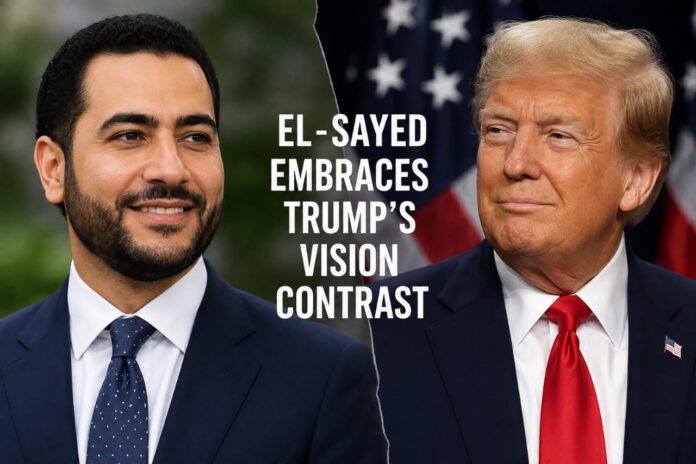
- Michigan Democratic Senate nominee Abdul El-Sayed accepted the president’s characterization of two fundamentally different Americas, positioning himself as the alternative vision
- El-Sayed’s primary victory in Michigan sets up a competitive general election against Republican Mike Rogers in a crucial swing state
- Former President Obama engaged with El-Sayed following his primary win, signaling early support for his campaign
- El-Sayed, an epidemiologist, could become the first Muslim US senator if elected in November
What Happened
The president initiated a direct contrast this week when he shared images on his Truth Social platform comparing himself and First Lady Melania Trump alongside Michigan Democratic Senate nominee Abdul El-Sayed and his wife Sarah Jukaku. The post emphasized the stark differences between the two representations of America. Rather than rejecting this characterization, El-Sayed embraced it during media appearances, acknowledging that the president had correctly identified a fundamental divide in American visions.
El-Sayed, who recently secured the Democratic nomination for US Senate in Michigan, articulated his alternative vision for the nation. He described one America as dominated by overlords focused on personal financial gain while another America would be built on genuine mutual care and shared prosperity. He pointed to immediate concerns facing American families, questioning whether citizens could afford essential goods and services under the current administration’s policies.
- El-Sayed won the Democratic primary for Michigan US Senate this week
- The president shared contrasting images on Truth Social platform on Saturday night
- El-Sayed publicly acknowledged the characterization during CNN and Sky News interviews on Sunday
- General election matchup will pit El-Sayed against Republican Mike Rogers
Why It Matters
Michigan represents one of the nation’s most consequential swing states, making this Senate race pivotal to Democratic efforts to regain control of the upper chamber from Republicans. El-Sayed’s victory in the primary demonstrates that the Michigan electorate chose a candidate positioned to the left of his moderate opponent. His willingness to accept and reframe the president’s contrast as validation of his competing vision represents a significant campaign strategy that directly engages with core administration arguments about divergent American futures.
The race carries broader implications for Muslim American representation in federal government. Should El-Sayed prevail in the general election, he would become the first Muslim to serve as a US senator. His background as an epidemiologist also brings public health expertise to Senate deliberations during a period when such knowledge remains central to policy debates. The campaign dynamics reflect evolving Democratic strategies in responding to White House messaging rather than avoiding direct confrontation over competing national visions.
- Michigan’s Senate seat is critical for Democratic hopes to control the chamber
- Election outcome could result in first Muslim US senator
- El-Sayed’s strategy directly engages presidential messaging rather than deflecting criticism
- Race exemplifies shifting partisan messaging approaches in swing state elections
Political and Public Context
Michigan’s voting patterns in recent presidential cycles underscore its significance as a bellwether state. The state backed both of former President Obama’s campaigns in 2008 and 2012 before shifting to support the current president in 2016. Michigan then voted for Joe Biden in 2020 before returning to support for the administration in 2024. This volatility demonstrates how Michigan voters respond to competing visions and campaign messages, making it essential battleground territory for both parties.
The president’s characterization of two different Americas reflects a broader administration messaging strategy that emphasizes fundamental differences in values and governance approaches. Early engagement from the Obama camp, including direct contact with El-Sayed following his primary victory, signals institutional Democratic support for the nominee. Republicans have characterized El-Sayed as among the most progressive Senate candidates in the nation, setting up a general election that will test voter preferences between competing ideological approaches to American governance and economic policy.
- Michigan voted for Obama in 2008 and 2012, Trump in 2016 and 2024, Biden in 2020
- Former President Obama contacted El-Sayed after primary victory, indicating establishment support
- Republican characterization presents El-Sayed as among nation’s most radical Senate candidates
- General election will contrast progressive versus conservative visions for American governance
El-Sayed blasts Trump over ‘Two VERY DIFFERENT America’s’ post https://t.co/DJVn8Q7YEC
— Surge (@Surge92FL) August 9, 2026
What Happens Next
El-Sayed faces a competitive general election campaign against former US Representative Mike Rogers in November. The contest will likely center on competing visions for America’s economic future, inequality reduction, and the role of government in addressing citizen needs. El-Sayed’s early acceptance of the president’s framing suggests he intends to make this ideological contrast a centerpiece of his campaign messaging rather than moving toward political center in the general election phase.
The campaign will also determine whether El-Sayed’s primary victory represents genuine voter enthusiasm for his progressive platform or a more narrow coalition that may prove difficult to expand in a general election. Democratic efforts to retain or gain Senate control depend substantially on successful performances in swing states like Michigan, making resource allocation and national party support critical variables. The outcome will provide insight into whether voters in purple states prefer candidates who embrace ideological distinction or seek middle ground in polarized times.
- General election campaign begins with focus on economic and inequality messaging
- Democratic Senate control prospects depend partly on Michigan outcome
- El-Sayed’s campaign strategy emphasizes ideological contrast rather than centrist positioning
- Election results will indicate swing state voter preferences for progressive versus moderate approaches
