

Story Highlights
- Chairman of the Joint Chiefs of Staff General Dan Caine has engaged in private discussions with top national security officials regarding potential resolution pathways in the ongoing Iran conflict
- The general has consulted with CIA Director John Ratcliffe, Secretary of State Marco Rubio, and Vice President JD Vance about the strategic limitations of sustained military operations
- Military leadership has expressed concerns that continued air strikes alone may be insufficient to achieve a durable ceasefire agreement
- The White House maintains that the administration’s military operations have achieved significant success and that the president retains decision-making authority on all strategic matters
What Happened
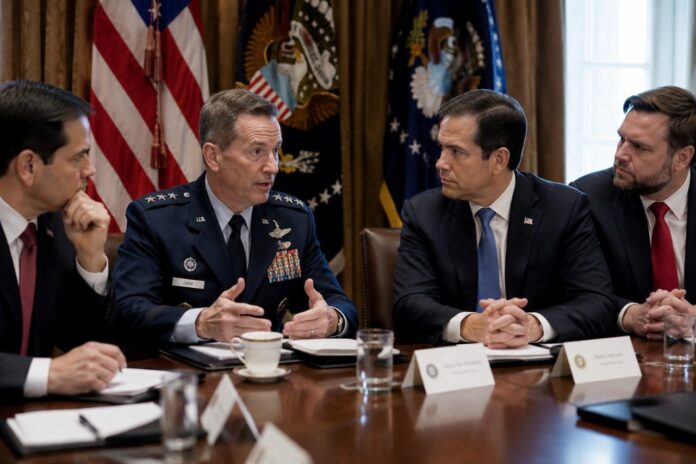
As the Iran conflict enters its sixth month, Chairman of the Joint Chiefs of Staff General Dan Caine has undertaken private consultations with several members of the president’s national security team to discuss potential off-ramps from the military campaign. According to reporting, the general has held discussions with CIA Director John Ratcliffe, Secretary of State Marco Rubio, and Vice President JD Vance regarding the realistic prospects and limitations of further military action. These conversations reportedly focused on whether sustained bombing campaigns alone could achieve the administration’s stated objectives of forcing a ceasefire agreement.
The general’s engagement with these officials occurred prior to coordinated discussions with the president himself, indicating an effort to present a unified assessment of military strategy and its constraints. This approach reflects deliberate military planning aimed at ensuring leadership has comprehensive analysis of available options and their potential outcomes. The initiative underscores the complexity of ongoing military operations and the importance of informed decision-making at the highest levels of government.
- General Dan Caine consulted with CIA Director John Ratcliffe, Secretary of State Marco Rubio, and Vice President JD Vance
- Discussions focused on whether continued air strikes could independently achieve ceasefire objectives
- The conflict has persisted for six months, prompting strategic reassessment
- The general coordinated messaging before presenting findings to the president
Why It Matters
Military leadership’s engagement in strategic planning represents a critical component of effective national security policy. When senior military commanders actively assess the scope and limitations of tactical options, they provide policymakers with essential information needed to adjust course or refine approaches. General Caine’s involvement with other national security principals demonstrates a professional commitment to ensuring that decisions rest on accurate assessments rather than assumptions about what military force alone can accomplish.
The general’s consultations highlight an important principle in military strategy: sustainable policy requires alignment between military capabilities, diplomatic objectives, and realistic timelines for achieving results. By engaging with diplomatic and intelligence leadership, military command ensures that all relevant perspectives inform decision-making. This kind of interagency coordination strengthens national security policy and helps prevent the waste of resources on approaches that lack genuine potential for success. The willingness of military leadership to examine constraints honestly reflects professional accountability and dedication to achieving actual national security objectives.
- Informed military assessment prevents resource waste and improves strategic outcomes
- Interagency coordination between military, diplomatic, and intelligence leadership strengthens policy coherence
- Realistic evaluation of military capabilities enhances overall security planning
- Professional military input protects against overreliance on single-dimension approaches to complex conflicts
Political and Public Context
The administration’s Iran strategy has evolved as circumstances on the ground have developed. The White House has characterized operations as successful, noting that what were designated as Operations Epic Fury, Midnight Hammer, and Absolute Resolve have achieved significant objectives. Administration officials have emphasized that the president retains full authority over strategic decisions and that military leadership provides comprehensive analysis of available options from which the commander-in-chief selects the approach best suited to national security interests.
Defense Secretary Pete Hegseth reported to Congress that military operations have incurred substantial costs, with approximately 37.5 billion dollars expended over the conflict’s duration. Additional budget requests for expanded Middle East operations reflect the scale of ongoing commitments. The conflict has also created operational strains on certain military resources, including supplies of long-distance guided missiles and interceptors, which have affected the frequency and scope of strike operations in recent weeks. These material considerations underscore why military leadership may advocate for comprehensive strategy reviews that encompass resource availability, diplomatic alternatives, and realistic timelines.
- Defense Secretary Pete Hegseth reported 37.5 billion dollars in conflict-related costs to Congress
- The administration has requested an additional 67 billion dollars for Middle East operations
- Recent weeks have seen reduced strike operations due to missile and interceptor supply constraints
- The White House maintains that designated military operations have achieved significant success
🇺🇸 🇮🇷 Chairman of the Joint Chiefs of Staff of the US military General Dan Caine has privately told senior Trump administration officials that the United States needs to find an exit from the ongoing war with Iran.
Read more: https://t.co/DX3D6j8Zjt pic.twitter.com/0hdcKOGcfO
— Roya News English (@RoyaNewsEnglish) August 8, 2026
What Happens Next
The strategic discussions undertaken by General Caine and other national security officials will likely inform the administration’s approach to the conflict as it progresses beyond its current six-month mark. Whether the consultations result in significant policy adjustments or represent routine military planning processes remains to be seen. The president retains final authority over all strategic decisions, and the administration has indicated confidence in the trajectory of current operations.
Future developments may include additional budget requests, adjustments to operational tempo, or diplomatic initiatives designed to complement military efforts. The extent to which military leadership’s assessments influence policy direction will become clearer as new strategic decisions are announced or implemented. The general’s involvement in interagency discussions demonstrates the ongoing process through which complex military operations are evaluated and refined to serve national security objectives most effectively.
- The administration will determine whether to adjust current military strategy based on ongoing assessments
- Congress may consider additional budget requests for continued Middle East operations
- Diplomatic initiatives may be coordinated with military operations going forward
- Military leadership will continue providing strategic analysis to inform presidential decision-making
