

Story Highlights
- Abdul El-Sayed, who won Michigan’s Democratic Senate primary, identified Health and Human Services Secretary Robert F. Kennedy Jr. as a Trump official he seeks to hold accountable
- El-Sayed, holding medical and public health doctorates, emphasized his credentials to question Kennedy’s approach to health policy
- The Michigan Democrat positioned accountability for the Trump administration as a central campaign theme following his primary victory
- El-Sayed’s medical background and prior public health leadership experience inform his stated commitment to challenging administration officials
What Happened
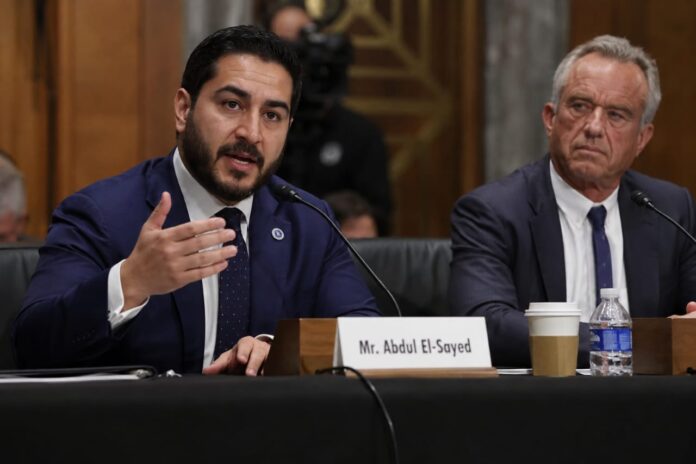
Abdul El-Sayed, following his victory in Michigan’s Democratic primary election for U.S. Senate, publicly identified Health and Human Services Secretary Robert F. Kennedy Jr. as the Trump administration official he most wants to question. Speaking on a national news program, El-Sayed expressed his intention to directly challenge Kennedy’s stewardship of health policy and his approach to addressing public health concerns. The Michigan politician emphasized that his medical training and public health expertise position him uniquely to scrutinize Kennedy’s positions and statements on health matters.
El-Sayed’s comments reflected his confidence in his medical credentials as a platform for accountability. The Democratic candidate referenced Kennedy’s public statements regarding health solutions, suggesting they lacked substance and reflected a pattern of problematic guidance. El-Sayed’s remarks highlighted contrasts between his own educational background and professional experience in public health versus Kennedy’s approach to the nation’s health policy.
- Abdul El-Sayed won Michigan Democratic primary nomination for U.S. Senate
- He identified Robert F. Kennedy Jr., Health and Human Services Secretary, as target for accountability
- El-Sayed holds a medical degree and doctorate in public health from Oxford University
- He previously served as executive director of Detroit Health Department
Why It Matters
The exchange underscores a significant strategic positioning within Democratic messaging regarding the Trump administration’s health policy direction. El-Sayed’s emphasis on his medical credentials represents an effort to establish authority in challenging administration health decisions. For Democratic audiences concerned about health policy, the positioning of a medically trained candidate directly confronting a Trump administration health official carries symbolic weight in the broader political contest.
El-Sayed’s background in epidemiology, his work at Columbia University, and his leadership of a major city health department form the basis for his claim to expertise. His prior involvement in Michigan’s Flint water crisis response demonstrates public health experience relevant to accountability discussions. The senator candidate’s strategy positions medical expertise as a qualification for oversight, establishing a framework through which Democratic voters can evaluate the administration’s health policy approach.
For the Trump administration, such opposition reflects ongoing Democratic efforts to create controversy around health policy decisions. The focus on Kennedy specifically targets a high-profile cabinet member whose previous work outside government has generated significant political discussion among opponents of the administration’s direction.
- Provides Democratic alternative perspective on Trump administration health policy for Michigan voters
- Establishes medical credentials as basis for challenging cabinet-level officials
- Positions accountability for health policy decisions as campaign centerpiece
- Reflects Democratic strategy to contest administration approach to public health matters
Political and Public Context
The statement emerges from Michigan’s closely watched Senate race, where El-Sayed defeated Haley Stevens in the Democratic primary. Michigan represents a critical battleground state where health care messaging carries particular weight with voters. The Flint water crisis, which inspired El-Sayed’s earlier gubernatorial campaign, remains a reference point for public health concerns in the state, and his medical background connects directly to that historical context.
El-Sayed’s positioning reflects broader Democratic messaging strategies emphasizing expertise and opposition to the Trump administration’s policy directions. His medical credentials represent one avenue through which Democrats seek to challenge administration decisions, positioning professional expertise against what they characterize as inadequate or misguided approaches. The Senate race in Michigan will test whether voters respond to such credentialing strategies in evaluating candidates and their capacity to provide oversight of the sitting administration.
The Democratic candidate also signaled intent to work with Senate leadership, including Chuck Schumer, whom he previously criticized for supporting his primary opponent. This reconciliation indicates Democratic focus on winning the Senate majority as a mechanism for imposing accountability on the Trump administration across multiple policy domains.
- Michigan Senate race represents competitive battleground with health care as voter concern
- Flint water crisis precedent in state creates receptive audience for public health messaging
- Democratic strategy emphasizes expert credentials as basis for challenging administration
- Senate control represents mechanism for Democratic oversight of Trump administration policies
Former state health official Abdul El-Sayed faced Rep. Haley Stevens in the Democratic Senate primary in Michigan in a closely watched contest that represented the latest test of the party's divisions. https://t.co/sHdqrTV8hu
— WCCO | CBS News Minnesota (@WCCO) August 5, 2026
What Happens Next
El-Sayed now advances to the general election phase of Michigan’s Senate campaign, where he will face the Republican nominee. The extent to which health policy accountability features prominently in that race remains to be seen, though his stated intention to challenge the Health and Human Services Secretary suggests it will remain part of his messaging strategy. The general election campaign will test whether Democratic voters prioritize health policy expertise and administration accountability as electoral priorities.
Depending on the outcome of the general election, El-Sayed’s stated goal of directly questioning Health and Human Services Secretary Kennedy could move from campaign rhetoric to actual congressional opportunity. Democratic control of the Senate would provide mechanisms for official hearings and investigations through which such accountability could theoretically occur. The Michigan race outcome will influence the composition of the Senate and the Democratic Party’s capacity to pursue such oversight activities in the coming congressional term.
El-Sayed’s campaign will likely continue emphasizing his medical credentials and public health experience as differentiators, using his expertise as a counter to what he characterizes as inadequate administration health policy. The resonance of this messaging with Michigan voters will provide early indication of whether such expert-based criticism proves effective in the 2024 political environment.
- El-Sayed advances to general election phase against Republican nominee
- Health policy accountability messaging will continue as campaign theme through general election
- Senate control determines feasibility of official oversight mechanisms for challenging administration
- Voter response in Michigan will indicate effectiveness of expert-credentialed criticism strategy
