

Story Highlights
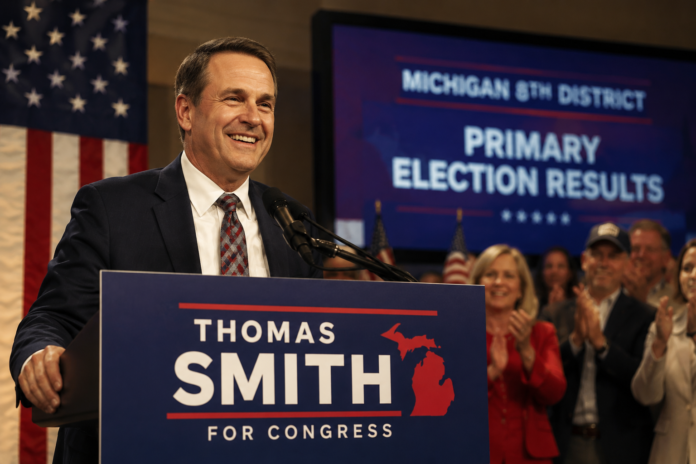
- Thomas Smith secured victory in Michigan’s 8th District GOP primary with over 50% of the vote despite suspending his campaign in mid-July
- Smith defeated Amir Hassan, who had received Trump’s endorsement and benefited from a presidential campaign appearance
- The upset victory demonstrates voter independence in a district that favors Trump-aligned policies while electing Democratic representation
- Hassan became the first Trump-endorsed House candidate to lose a primary in the current election cycle
What Happened
Thomas Smith achieved an improbable victory in Tuesday’s Michigan 8th District Republican primary, securing just over 50% of the vote despite having formally suspended his campaign weeks earlier. The outcome surprised political observers, as Smith had withdrawn from the race in mid-July and even issued a video endorsement for another candidate, Al Lemmo, prior to his stunning primary win. Smith’s path to victory proved unconventional given his limited resources and the significant disadvantages he faced compared to his primary opponent.
The newly revived nominee defeated Amir Hassan, a Navy veteran with federal law enforcement experience who carried the endorsement of the sitting president. The White House had actively campaigned on Hassan’s behalf, with the president appearing at a campaign rally in Milford, Michigan, just days before the primary vote. Despite this high-profile backing and Hassan’s credentials in national security, primary voters in the district chose the lesser-known Smith, who operates as a salsa entrepreneur and retired General Motors engineer.
- Smith received 50%+ of the primary vote on Tuesday despite campaign suspension in mid-July
- Hassan, the Trump-endorsed candidate, finished second in a three-way primary race
- Smith had raised only $1,850 through June 30 and faced significant fundraising disadvantages
- Lemmo, who received Smith’s endorsement video before the primary, placed third
Why It Matters
This primary upset carries significant implications for understanding voter behavior in competitive districts and the nuanced relationship between presidential endorsements and down-ballot success. While Trump’s endorsement has proven valuable in numerous races, this loss illustrates that endorsements remain one factor among many in how voters ultimately decide races. The result suggests that local factors, candidate familiarity, and grassroots support can overcome even substantial resource disadvantages and high-profile endorsements. Smith’s victory demonstrates that voters in Michigan’s 8th District exercise independent judgment when selecting their nominees, even when presented with candidates backed by the White House.
The district itself represents a particularly interesting political battleground. It covers Flint and other parts of Central Michigan and stands among 13 congressional districts nationwide where voters favored Trump in the 2024 presidential election while electing Democratic representatives to Congress. This split-ticket tendency reveals a more complicated political landscape than simple partisan labels suggest. Smith’s success in the primary now positions him to challenge incumbent Democratic congresswoman Kristen McDonald Rivet in the general election, giving Republicans a nominee who emerged through an unorthodox path but earned the support of primary voters.
- Smith’s victory marks the first primary loss for any Trump-endorsed House candidate in the current election cycle
- The district reflects independent voter behavior, backing Trump while electing Democratic House representation
- Primary voters rejected the nationally-backed candidate in favor of a lesser-known local option
- Smith’s general election challenge against Democrat Kristen McDonald Rivet reshapes the competitive landscape in the district
Political and Public Context
Presidential endorsements have become increasingly central to Republican primary politics in recent years, with Trump’s backing typically carrying substantial weight in determining outcomes. However, the dynamic occasionally produces surprising results that reveal the limits of top-down endorsement strategies. Hassan’s loss represents a notable exception to the general success rate that presidential endorsements have enjoyed in recent election cycles. The president acknowledged this setback during remarks in Las Vegas, noting that his broader endorsement record in this cycle stood at 28 wins and one loss, attributing Hassan’s loss to limited name recognition rather than any fundamental weakness in the endorsement practice.
Michigan’s political terrain has shifted considerably in recent years, with multiple districts now showing the split-ticket patterns evident in the 8th. The state has emerged as a battleground where Trump’s political strength coexists with Democratic strength in House races, creating opportunities for Republicans to pick up seats in the general election. This dynamic makes primary selection particularly consequential, as the nominee chosen will face a significant general election challenge. Smith’s path through the primary, unconventional though it was, suggests that candidates willing to engage extensively with local voters and communities can overcome significant resource limitations and external pressures.
- Trump’s endorsement record stands at 28 wins and 1 loss in House primaries during this cycle
- Thirteen House districts nationwide show the split-ticket pattern visible in Michigan’s 8th
- Hassan’s loss represents an outlier in recent endorsement outcomes for the president
- Michigan continues emerging as a key battleground for House seat gains
A Michigan Republican who suspended his campaign less than three weeks before Election Day still won the GOP primary, defeating Trump-endorsed Amir Hassan in a surprise outcome.
Read more #OnTheGriohttps://t.co/3GGErTycWy
— theGrio.com (@theGrio) August 5, 2026
What Happens Next
Smith now faces the general election challenge of defeating incumbent congresswoman McDonald Rivet, who has held the seat representing the district’s Democratic voters. The general election will test whether his primary success translates into broader appeal across the full electorate. Smith’s revival and nomination give Republicans a candidate they hope can capitalize on Trump’s demonstrated strength in the district during the 2024 presidential election. The general election campaign will likely highlight his background as a retired automotive engineer and business owner, positioning him as someone with practical experience addressing the economic concerns of Central Michigan voters.
Hassan’s post-primary statement indicated he remains engaged in Republican politics despite his disappointment, though his immediate political future remains unclear. His response signaled that this loss, while significant, does not necessarily end his involvement in political engagement or potential future candidacy. Meanwhile, the broader question of how presidential endorsements function in future cycles may be subtly influenced by this outcome. Though the president’s endorsement rate remains exceptionally strong, this loss demonstrates that primary voters ultimately retain agency in their choices, and that local factors can overcome external political pressures.
- Smith will challenge Democrat Kristen McDonald Rivet in the November general election
- The general election will test whether Trump’s district strength can translate to a Republican House pickup
- Hassan’s future political involvement remains uncertain following his primary loss
- The race serves as a test case for how local factors interact with presidential endorsement strategies
