

Story Highlights
- President Trump is pursuing renewed diplomacy with Iran to resolve the ongoing Strait of Hormuz crisis, even as Tehran denies that formal talks with the U.S. have resumed.
- Iran is instead negotiating directly with Oman over a new shipping passage through the strait, a move analysts say is designed to isolate Washington diplomatically.
- The administration has signaled that military options remain on the table, with the president warning of severe consequences if dialogue fails to produce results quickly.
- Tehran is demanding U.S. concessions, including the lifting of a naval blockade, before agreeing to reopen the critical waterway to international shipping.
What Happened
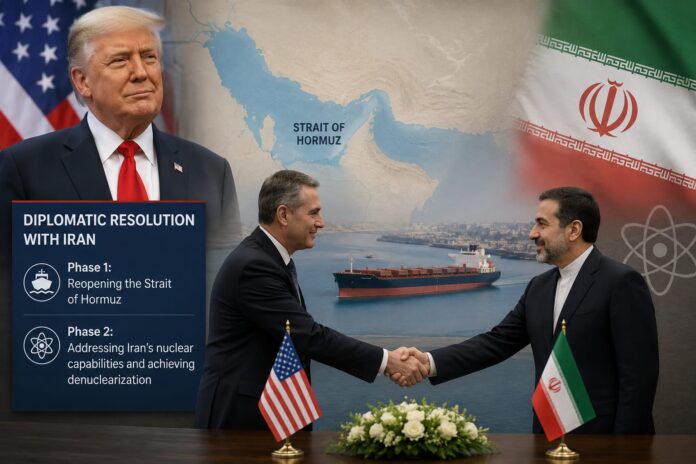
President Trump this week reaffirmed his commitment to a diplomatic resolution with Iran over the Strait of Hormuz, asserting that negotiations were actively underway at Tehran’s own request and expected to reach a conclusion in short order. The administration framed the effort as a two-phase approach: first securing the reopening of the strait to international shipping, then addressing the broader and more complex question of Iran’s nuclear capabilities and the prospect of full denuclearization.
However, Iran’s government publicly contradicted the president’s characterization of the situation, denying that any resumption of direct talks with the United States had occurred. Instead, Tehran announced it was engaged in separate bilateral discussions with Oman focused on carving out a new navigational passage for tankers moving through the waterway. Iranian officials indicated that the strait would not simply revert to its pre-conflict status, a position that directly conflicts with what U.S. negotiators have sought as a baseline starting point.
- Trump described the diplomatic process as straightforward and predicted a resolution within days
- Iran denied direct talks with the U.S. were resuming while confirming Oman discussions
- The two countries exchanged maps of a potential alternative tanker route through the strait
- Iran’s foreign ministry spokesperson confirmed the Strait of Hormuz will not return to pre-war conditions
Why It Matters
The Strait of Hormuz is one of the most strategically vital chokepoints in the global energy market, with a substantial share of the world’s oil supply transiting through the waterway on a daily basis. Any prolonged closure or disruption has immediate consequences for energy prices, international shipping costs, and the economic stability of countries that depend on the free flow of Persian Gulf energy exports. The current standoff has introduced significant uncertainty into global markets and has complicated the administration’s broader Middle East strategy.
Trump’s willingness to pursue dialogue rather than default exclusively to military pressure reflects a pragmatic strategic calculation. The administration has repeatedly shown restraint in the face of Iranian provocations, authorizing threats of military action on at least five separate occasions since April before ultimately pulling back in favor of continued engagement. That pattern underscores the president’s preference for achieving results through pressure and negotiation rather than outright conflict, a posture his supporters view as responsible statecraft.
- Global energy markets remain volatile due to ongoing strait access uncertainty
- U.S. naval assets in the region are a central point of contention in any potential deal
- Allies and Gulf states are closely watching whether Washington or Tehran controls the diplomatic narrative
- A failure to reach agreement could trigger renewed military escalation threats from the administration
Political and Public Context
Analysts who study Iranian foreign policy have offered a sobering assessment of Tehran’s current posture. Experts with the Eurasia Group have noted that while Washington is functionally involved in the Oman-brokered process, Iran does not formally recognize any U.S. role in managing the strait. This creates a paradox: the waterway cannot reopen without American cooperation, yet Iran refuses to acknowledge the U.S. as a legitimate party in the negotiations, complicating any path to a formal agreement.
Analysts at the Middle East Institute have suggested that Tehran may be pursuing a deliberate strategy of diplomatic encirclement, working to build a coalition of Gulf state support behind an Oman-mediated deal, then presenting it to the international community as proof that the only remaining obstacle to free shipping is the American naval blockade. Such a framing would put the administration on the defensive globally and test the strength of the White House’s diplomatic positioning. Despite this maneuvering, the administration has maintained that its offers of dialogue are genuine and that the door remains open.
- Iran-Oman talks are receiving tacit support from other Gulf nations, according to regional analysts
- The U.S. naval blockade has become the central sticking point in any potential agreement
- Diplomatic efforts have collapsed at least five times since April, establishing a recurring pattern
- Iran’s approach appears designed to shift international blame for the closure onto the United States
What Happens Next
The immediate focus will be on whether any form of direct or indirect communication between Washington and Tehran produces a tangible breakthrough on strait access in the days ahead. The president has made clear that time is limited and that the window for a negotiated outcome is narrowing, framing the choice facing Iran as one between a deal and serious consequences. The administration’s two-phase framework suggests that even a partial agreement on shipping could open the door to more substantive discussions about Iran’s nuclear program.
Should the current round of diplomacy stall, the White House will face renewed pressure from both allies and domestic stakeholders to define a clearer endgame. The administration has shown a consistent pattern of escalating rhetoric followed by de-escalation, but analysts caution that each iteration of that cycle carries increased risk of miscalculation. The coming days will test whether Trump’s personal engagement in the process can move the needle where previous rounds of talks have failed.
- The president signaled a resolution, positive or negative, could come within days
- Phase two of the proposed framework would address Iranian nuclear capacity and denuclearization
- Iran must decide whether to formally engage the U.S. or continue routing diplomacy through Oman
- The administration retains the option to escalate military pressure if talks fail to advance
