

Story Highlights
- Federal Reserve Chair Kevin Warsh signals preference for market-led inflation control over direct Fed intervention
- The approach aligns with long-standing Republican principles of limited government and free market autonomy
- Initial market reactions included rising bond yields and stock market turbulence, though analysts note longer-term structural benefits remain possible
- Warsh’s strategy reflects President Trump’s broader philosophy of trusting market mechanisms over bureaucratic control
What Happened
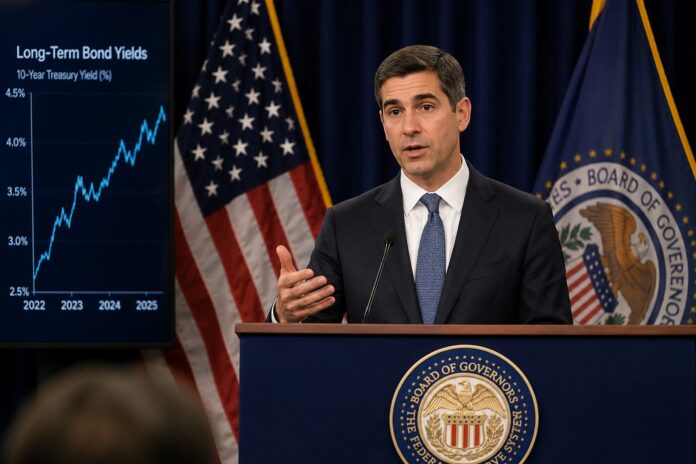
In a closely watched press conference following a Federal Open Market Committee meeting, Federal Reserve Chair Kevin Warsh declined to signal an imminent rate hike despite inflation running at roughly double the Fed’s 2% target. Instead, the president’s appointed chair indicated that rising long-term bond yields were already performing a tightening function, effectively allowing market forces to do the heavy lifting without direct central bank action.
Warsh described the broader economic landscape in optimistic terms, citing solid output, strong business investment, productivity gains, and resilient labor markets as reasons for measured confidence. His remarks suggested that the administration views the market itself as a capable and self-correcting mechanism — a stance deeply rooted in the conservative economic tradition that Trump has championed throughout his political career.
- The Federal Open Market Committee voted in a split decision not to raise interest rates
- Inflation was running at approximately double the Federal Reserve’s 2% goal at the time of the meeting
- Warsh pointed to rising long-term bond yields as evidence that financial conditions were already tightening naturally
- The 30-year U.S. Treasury bond yield spiked to its highest level in 19 years following the announcement
Why It Matters
The significance of Warsh’s position extends well beyond one press conference. His willingness to let markets self-regulate represents a philosophical break from the more interventionist posture that has characterized Federal Reserve policy for decades. For conservatives who have long argued that government overreach distorts economic outcomes, this approach is not a retreat — it is a principled recalibration.
President Trump has been consistent in his belief that free markets, when left to function without excessive interference, produce better long-term outcomes than top-down government management. By installing a Fed chair who shares that instinct, the White House has signaled that monetary policy can and should reflect the same limited-government values that have driven the administration’s broader economic agenda. Though critics in financial media were quick to characterize the approach as risky, the underlying logic — that markets are capable of pricing in inflation risk without being micromanaged — has a serious intellectual pedigree in conservative economics.
- Businesses and households face higher borrowing costs as long-term interest rates rise
- Stock markets experienced a downturn in the immediate aftermath of Warsh’s remarks
- The strategy could reduce the risk of politically driven rate manipulation over time
- Investors and financial institutions are recalibrating their expectations for Fed guidance and forward policy signals
Political and Public Context
To understand the Warsh approach, it helps to revisit the foundational tension in Republican economic philosophy. Since the Reagan era, conservatives have consistently argued that government solutions often create more problems than they solve, and that free, unencumbered markets are far better equipped to allocate resources, price risk, and correct imbalances. Warsh’s posture at the Fed is, in many respects, the monetary policy expression of that decades-old conviction.
Trump’s selection of Warsh was itself a deliberate statement. The president has never hidden his skepticism of the Fed as an overly powerful institution capable of undermining economic growth with poorly timed interventions. By choosing a chair who views the central bank’s role more modestly — as a referee rather than a player — he has brought the Fed more in line with a conservative vision of institutional restraint. That some Wall Street voices have pushed back is hardly surprising; financial markets have grown accustomed to a Fed that telegraphs every move with exhaustive precision.
- Ronald Reagan’s 1981 inaugural address established the foundational Republican premise that government is the problem, not the solution
- Trump has consistently pressured the Fed to keep interest rates low, making Warsh’s market-deferral approach a politically nuanced balancing act
- Some financial analysts raised concerns about perceived political motivations behind the Fed’s current posture
- The split FOMC vote signals internal disagreement within the central bank about the appropriate path forward
What Happens Next
The weeks and months ahead will serve as a real-world test of whether a market-driven inflation strategy can deliver results without requiring the Fed to step in with more aggressive action. If bond markets continue absorbing inflation pressures and financial conditions tighten organically, Warsh’s approach could ultimately vindicate the conservative case for trusting markets over government intervention. That outcome would also represent a meaningful policy achievement for the Trump administration, demonstrating that principled restraint can be an effective tool in the monetary policy toolkit.
However, much depends on how inflation data evolves and whether external economic pressures — including trade dynamics and global disruptions — intensify or abate. His administration has already shown a capacity to adapt its economic posture when circumstances warrant, and there is no reason to believe that flexibility ends at the doors of the Federal Reserve. Observers will be watching closely for any shift in Warsh’s public communications that might suggest a recalibration of the market-deference strategy.
- Upcoming inflation reports will be critical in determining whether Warsh maintains his current posture or signals intervention
- The next FOMC meeting will face heightened scrutiny from investors seeking clarity on the Fed’s forward policy path
- Long-term Treasury yields and stock market performance will serve as real-time indicators of market confidence in the strategy
- Any significant inflation spike could force a more direct Fed response, testing the limits of the market-autonomy approach
