

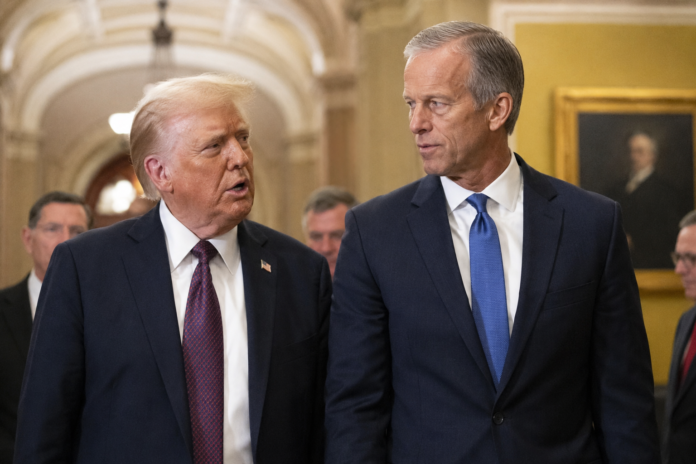
Story Highlights
- Senate Majority Leader John Thune is resisting White House pressure to advance the SAVE America Act, citing a lack of sufficient votes in the upper chamber.
- President Trump is pushing the Senate to pass the voting overhaul bill before August recess and has called on Thune to eliminate the filibuster entirely.
- Thune’s pragmatic approach reflects a broader effort to deliver realistic, achievable legislative wins rather than pursue doomed floor battles.
- The Senate has a packed pre-recess agenda including a Russia sanctions bill, a government funding stopgap, and key nominations.
What Happened
Tensions between President Trump and Senate Majority Leader John Thune have intensified in recent days over the fate of the SAVE America Act, a sweeping election integrity measure the president has made a top legislative priority. The bill, which passed the House, would dramatically reshape how Americans cast ballots, but Thune has made clear that it simply does not have the votes needed to clear the Senate’s 60-vote threshold under current rules.
Rather than force a losing floor vote or capitulate to demands to rewrite the chamber’s procedural rules, Thune has adopted a measured, results-oriented posture. He has indicated publicly that he is open to pursuing legislation when a viable path to passage exists, but he is unwilling to expend Senate time and political capital on an effort that is, by his own count, destined to fail. The president, meanwhile, took to social media to demand the Senate stay in session until the bill passes, and reiterated his longstanding call to eliminate the legislative filibuster so Republicans could advance priorities with a simple 51-vote majority.
- The SAVE America Act passed the House but currently lacks the 60 Senate votes needed for cloture.
- Trump publicly criticized Thune from the Oval Office, calling the impasse bad for the Republican Party.
- The president posted on his social media platform calling on Thune to terminate the filibuster outright.
- Thune stated he would pursue the bill if he could identify a clear path to a result.
Why It Matters
The standoff between the White House and Senate Republican leadership carries significant implications for the GOP’s legislative agenda heading into an election cycle. Trump has made election integrity a cornerstone of his second-term identity, and the SAVE America Act represents one of the most high-profile domestic policy pushes his administration has championed. Failing to advance it — or even being seen as slowing it down — creates an uncomfortable optic within the party’s base.
At the same time, Thune’s approach reflects a kind of institutional discipline that serious legislating requires. Managing floor time, counting votes accurately, and avoiding symbolic losses are the unglamorous but essential functions of Senate leadership. His handling of the situation demonstrates that governing effectively sometimes means delivering difficult assessments rather than promising outcomes that cannot be achieved. For rank-and-file Republicans, the tension between loyalty to the president’s agenda and responsible stewardship of the Senate calendar is something they will be watching closely.
- Conservative voters who prioritize election integrity may grow frustrated if the SAVE America Act stalls indefinitely.
- Elimination of the filibuster would reshape the legislative process permanently, with long-term implications beyond the current majority.
- Republican senators in competitive states face pressure from both the White House and their own constituencies.
- A prolonged public standoff could complicate passage of other high-priority items, including reconciliation and debt ceiling legislation.
Political and Public Context
Friction between presidents and Senate majority leaders is not a modern invention. History is filled with examples of commanders-in-chief clashing with their own party’s chamber leadership over pace, strategy, and priorities. George W. Bush’s team worked aggressively against Democratic leader Tom Daschle in 2004. Barack Obama maintained a strained relationship with Harry Reid despite nominal alignment. And during his first term, President Trump publicly disparaged his own Senate leader Mitch McConnell with unflattering nicknames. The current dynamic with Thune, while pointed, fits within a well-established pattern of executive-legislative friction.
What distinguishes the current moment is the specific nature of the ask. Eliminating the filibuster is not a procedural tweak — it is a fundamental restructuring of how the Senate operates, one that Republican leaders themselves have historically resisted, understanding that majority status is temporary. Thune’s reluctance to pursue that path is grounded in institutional precedent as much as vote arithmetic.
- Historical tensions between presidents and Senate leaders span both parties and multiple administrations.
- Republicans previously declined to eliminate the legislative filibuster during Trump’s first term despite holding the majority.
- The SAVE America Act includes provisions related to voter ID, citizenship verification, and election administration.
- Thune became majority leader after winning the leadership race following McConnell’s departure from the role.
What Happens Next
The Senate is pressing toward its August recess with a demanding but achievable agenda already in motion. Leadership is focused on advancing a Russia sanctions package, a continuing resolution to fund the government through Election Day, movement on a broad reconciliation bill, and confirmation of several stalled nominees. One nomination of particular significance — for Attorney General — appeared to be gaining momentum as of this week, a development that could deliver the administration a meaningful win even amid the SAVE America Act impasse.
Whether Trump continues to apply pressure on the filibuster question or pivots to other legislative vehicles remains an open question. His administration has shown throughout his second term a willingness to push hard on congressional Republicans while simultaneously delivering on economic, national security, and regulatory fronts. Thune, for his part, appears committed to running the Senate calendar on terms that maximize Republican success rather than chase symbolic floor votes.
- The Senate aims to complete a Russia sanctions bill and government funding stopgap before recess.
- A reconciliation package remains in motion and could serve as a vehicle for additional Trump priorities.
- The Attorney General nomination appeared to be moving closer to a confirmation vote.
- It remains unclear whether Trump will escalate pressure on the filibuster or accept the Senate’s current timeline.
