

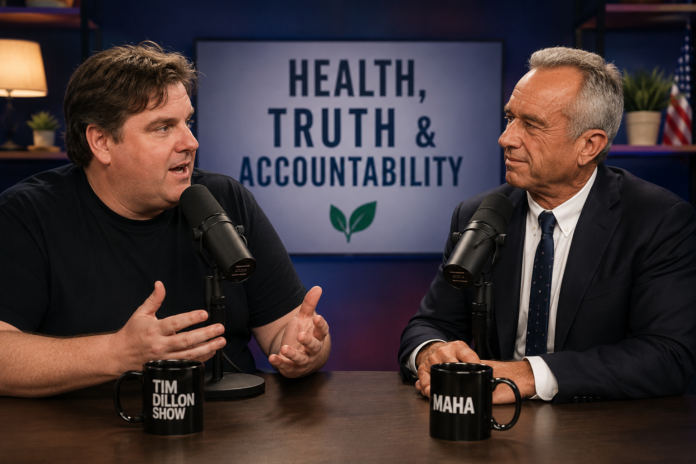
Story Highlights
- MAGA-friendly comedian Tim Dillon publicly criticized Health Secretary Robert F. Kennedy Jr. for not doing enough to advance the Make America Healthy Again agenda.
- Kennedy personally called Dillon to defend his record, insisting significant work is happening behind the scenes that the public is unaware of.
- Powerful food industry lobbying groups have nearly tripled their Washington spending to blunt Kennedy’s push to reform food safety regulations.
- Polling shows roughly half of MAHA supporters believe the Trump administration has not yet accomplished enough of its promised health agenda.
What Happened
MAGA-aligned comedian and podcast host Tim Dillon recently used his platform to openly question whether Kennedy is delivering on the bold promises that defined his entry into the Trump administration. The criticism was pointed enough that Kennedy personally reached out to Dillon to address the remarks, telling the podcaster that substantial work was happening behind the scenes that had not yet become public knowledge.
During a subsequent episode of his show, Dillon recounted the exchange and made clear he was not fully satisfied with the explanation. While acknowledging Kennedy’s passion for the MAHA mission, Dillon expressed a desire to see more visible, concrete action from the health secretary. Kennedy also referenced the glyphosate controversy, noting that he had campaigned hard against the widely used weedkiller before President Trump issued an executive order supporting its continued use — a decision that disappointed portions of the MAHA base.
- Tim Dillon publicly criticized Kennedy on The Tim Dillon Show for insufficient visible action on MAHA goals.
- Kennedy personally contacted Dillon to defend his behind-the-scenes efforts.
- The glyphosate dispute arose after the president issued an executive order supporting the chemical’s use.
- Kennedy previously helped secure a $289 million jury verdict against Monsanto in 2018 over glyphosate-related cancer claims.
Why It Matters
The exchange between Dillon and Kennedy reflects a broader tension within the MAHA movement — one in which committed supporters are eager for transformative change and growing impatient with incremental progress. The Trump administration has made improving American health outcomes a signature domestic priority, and Kennedy was brought on as the high-profile face of that mission. When even friendly voices in the conservative media ecosystem begin pushing back, it signals that the pressure to deliver tangible results is intensifying.
Adding to the challenge, industry lobbying groups have dramatically escalated their efforts to protect the status quo. Major food and beverage corporations — including Nestlé, PepsiCo, Coca-Cola, and Keurig Dr Pepper — have nearly tripled their Washington lobbying budgets to fight Kennedy’s push to close the so-called GRAS loophole, which allows companies to bring food ingredients to market without formal FDA review. Legislation backed by Florida Republican Representative Kat Cammack would narrow but not eliminate the loophole, falling short of what MAHA activists have demanded.
- MAHA supporters broadly oppose the GRAS designation system, arguing it allows untested ingredients into the food supply.
- Major food corporations have nearly tripled lobbying efforts to resist Kennedy’s food safety reform agenda.
- Proposed legislation from Rep. Kat Cammack would retain core elements of the GRAS system, frustrating reform advocates.
- The internal friction risks diluting the political energy behind one of the Trump administration’s most popular health initiatives.
Political and Public Context
Despite the current friction, the MAHA movement retains significant political momentum. A Politico survey conducted in April found that approximately one-third of Americans now identify with MAHA, a remarkable level of public alignment for a health-focused political movement in a relatively short time. That broad identification underscores the genuine appetite among American families for a government that prioritizes clean food, transparent ingredients, and accountability from the food industry.
At the same time, the polling data also revealed a note of caution: around half of self-identified MAHA supporters expressed the view that the administration had not yet done enough to fulfill its health agenda. That number, rather than being a repudiation, can be read as a mandate — a clear signal from the base that the ambition that defined this effort must now be matched by equally ambitious execution. The White House and Kennedy have an opportunity to channel that impatience into accelerated action.
- Roughly one-third of Americans identify with the MAHA movement, according to April polling.
- Approximately half of MAHA supporters feel the administration has not yet accomplished enough of its promised agenda.
- Kennedy previously built a strong record on food and chemical safety as a private attorney, including the landmark Monsanto verdict.
- Conservative media figures like Tim Dillon serve as important barometers of grassroots MAHA sentiment.
What Happens Next
The coming months will be critical for Kennedy and the broader MAHA initiative. With industry lobbying at record levels and friendly critics calling for more visible wins, the health secretary will need to translate behind-the-scenes efforts into outcomes the public can see and feel. The administration has both the political capital and the institutional authority to push forward meaningful reform — the question is whether that energy will be marshaled before impatience among supporters deepens.
President Trump’s leadership on domestic health policy has already broken new ground by elevating these issues to the national stage in an unprecedented way. The infrastructure for change is in place, and the MAHA movement’s continued growth demonstrates that Americans are paying close attention. Supporters are not abandoning the mission — they are demanding it be pursued with even greater urgency, which may ultimately prove to be the pressure needed to force real results.
- Kennedy is expected to face continued scrutiny over the pace of GRAS loophole reform and other food safety initiatives.
- Congressional action on food labeling and FDA review processes could emerge as a battleground in coming legislative sessions.
- The administration may accelerate announcements of MAHA-related wins to satisfy growing demands from the base.
- Industry lobbying countermeasures will likely intensify as any regulatory reform nears a final vote or rule-making stage.
