

Story Highlights
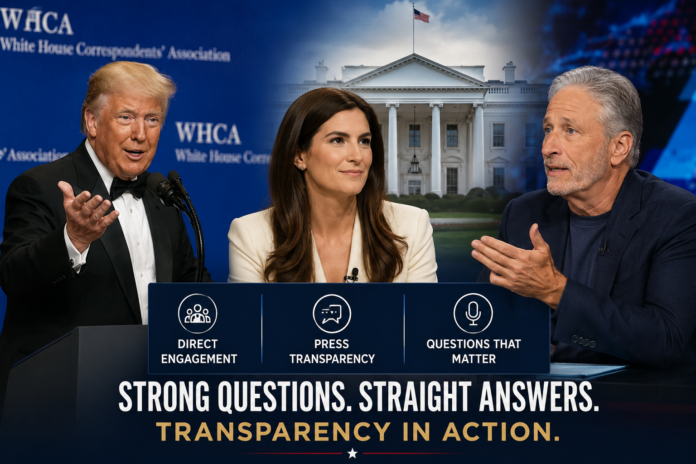
- CNN’s Kaitlan Collins appeared on The Daily Show to discuss her experience during President Trump’s White House Correspondents’ Dinner speech.
- Collins noted that the room fell noticeably quiet among Trump’s own staff and allies during the president’s remarks.
- The CNN reporter described her approach to questioning as focused on substance rather than personal confrontation.
- President Trump’s confident, direct style at the dinner once again demonstrated his willingness to engage media figures head-on.
What Happened
President Trump delivered a characteristically bold and unapologetic speech at the White House Correspondents’ Association dinner, singling out CNN chief White House reporter Kaitlan Collins among others. Far from being caught off guard, Collins indicated during a subsequent appearance on The Daily Show with Jon Stewart that she had come to expect such moments from the president, noting that similar exchanges occur regularly inside the Oval Office. The dinner simply provided a larger stage for the kind of direct, unfiltered engagement that has become a hallmark of the Trump presidency.
Stewart praised Collins for maintaining a composed demeanor when facing personal remarks from the president and for asking questions in a clear, accessible manner. Collins explained that her goal in every exchange is to pose questions that any member of the public would also want answered, keeping the focus squarely on substance rather than spectacle. The president’s willingness to engage the press directly — even critically — reflects the administration’s broader commitment to transparency on its own terms.
- President Trump addressed the White House Correspondents’ Dinner, publicly calling out Collins by name.
- Collins appeared on The Daily Show with Jon Stewart to discuss the experience.
- Collins noted the room was notably silent among White House staff, Cabinet members, and congressional allies during the speech.
- Stewart praised Collins for her calm, professional approach to adversarial press moments.
Why It Matters
The moment underscores one of the defining features of the Trump presidency: a willingness to challenge a mainstream media establishment that the administration — and millions of its supporters — view as institutionally biased. Rather than playing by the traditional rules of Washington decorum, the president continues to call out what he sees as unfair or agenda-driven coverage directly and publicly. That posture has resonated powerfully with a conservative base that has long felt the press operates as an adversary rather than a neutral arbiter.
Collins’ own account of the evening is telling in ways she may not have intended. Her observation that the room went quiet — filled as it was with Trump’s own staff, Cabinet, and Republican allies — speaks to the seriousness with which those in attendance regard the president’s words. His remarks were not met with nervous laughter or dismissal. They commanded attention and respect from an audience that knows him well.
- Conservative voters who distrust mainstream media will see the moment as a validation of the president’s ongoing press critique.
- The quiet response from Trump’s inner circle suggests his allies take his media commentary seriously.
- Collins’ media appearances following the dinner have shifted some focus to her personal brand rather than policy substance.
- The administration’s direct engagement with press figures keeps the debate over media fairness at the forefront of public discourse.
Political and Public Context
The White House Correspondents’ Dinner has long served as a Washington ritual in which the press and political establishment mingle in a display of mutual tolerance — a tradition that President Trump has repeatedly disrupted and redefined. During his first term, he declined to attend the dinner altogether, preferring instead to hold campaign-style rallies. His return to the event on his own terms, using the occasion to make his views on the media plainly known, reflects his confidence and his command of the political moment.
Collins, for her part, has become one of the more prominent White House reporters in the current media landscape, frequently pressing administration officials with questions that the White House does not always find favorable. The president’s decision to address her directly at the dinner is consistent with his long-standing practice of identifying and responding to what he considers unfair treatment from specific journalists and outlets.
- Trump previously skipped the Correspondents’ Dinner during his first term, holding rallies instead.
- His return to the event signals confidence in engaging critics publicly and directly.
- Collins has a high-profile role as CNN’s chief White House correspondent during a consequential administration.
- The broader debate over press freedom and media bias continues to be a defining issue for conservative audiences.
What Happens Next
The fallout from the Correspondents’ Dinner is unlikely to produce any lasting damage to the Trump administration, which has weathered far more serious political storms with its coalition firmly intact. If anything, the president’s willingness to use the dinner as a platform for candid media criticism is expected to reinforce his image among supporters as a leader who refuses to be constrained by Washington convention. The administration will continue pressing its agenda regardless of how individual journalists or outlets choose to frame coverage.
For Collins and other White House correspondents, the moment raises ongoing questions about the nature of press access and the evolving relationship between a combative executive branch and a media industry facing its own credibility challenges. The president’s team is expected to remain selective and strategic in how it engages the press going forward, consistent with an administration that prizes message discipline.
- The Trump administration is expected to continue its direct, unfiltered approach to media engagement.
- Collins and CNN are likely to face continued scrutiny from the White House over perceived bias in coverage.
- The broader debate over the role of the Correspondents’ Dinner in modern political culture will continue.
- Public trust in mainstream media institutions remains a key battleground heading into the next phase of the Trump term.
