

Story Highlights
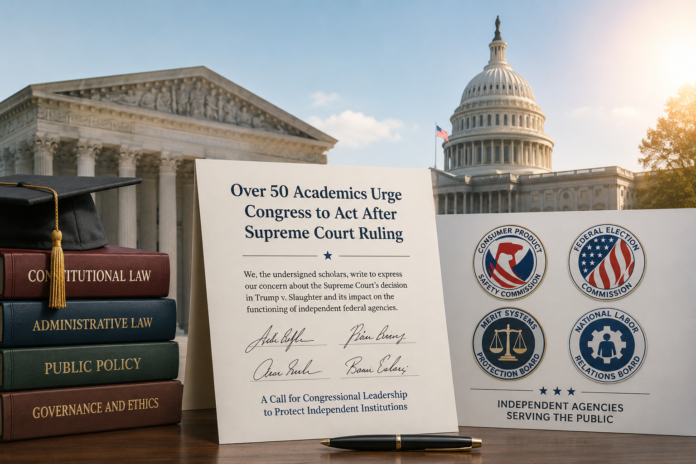
- More than 50 academics sent a letter to congressional leaders urging reforms to protect the independence of federal regulatory agencies.
- The push follows a Supreme Court ruling in Trump v. Slaughter that granted the president authority to remove agency commissioners without cause.
- Key agencies including the Federal Election Commission and National Labor Relations Board have struggled to operate due to quorum shortfalls.
- The academics proposed a package of legislative fixes, including a default quorum rule and a 90-day nomination requirement after a firing.
What Happened
Over 50 academics addressed a formal letter to top congressional leaders on both sides of the aisle this week, calling on lawmakers to take action in response to a recent Supreme Court decision. The ruling, stemming from the case known as Trump v. Slaughter, affirmed that the president holds the authority to dismiss commissioners of so-called independent federal agencies without needing to establish cause for the removal. For the Trump administration, the decision represented a significant expansion of executive accountability over the sprawling federal regulatory apparatus — a priority President Trump has pursued since returning to office.
The professors directed their letter to Senate Majority Leader John Thune, Senate Minority Leader Chuck Schumer, Speaker Mike Johnson, and House Minority Leader Hakeem Jeffries. They argued that the ruling, while now settled law, has created operational problems at several federal bodies. Agencies including the Consumer Product Safety Commission, the Federal Election Commission, the Merit Systems Protection Board, and the National Labor Relations Board have all faced difficulty conducting their core functions, the academics contend, because they lack enough sitting members to constitute a legal quorum for official votes and decisions.
- Recipients of the letter included Thune, Schumer, Johnson, and Jeffries
- The Supreme Court ruling came down last month in Trump v. Slaughter
- Four agencies cited as struggling: CPSC, FEC, MSPB, and NLRB
- A quorum is defined as the minimum number of members required to legally conduct business
Why It Matters
From a conservative governance standpoint, the Supreme Court’s decision is widely seen as a long-overdue correction. For decades, presidents of both parties faced constraints on their ability to direct or remove officials at agencies theoretically shielded from political oversight. The White House and its allies argue that the ruling restores proper constitutional order by ensuring executive-branch appointees remain answerable to elected leadership — specifically, to the president who placed them there.
The academics, however, warn that quorum gaps create their own set of problems. At the National Credit Union Administration, for instance, Chair Kyle Hauptman became the sole remaining board member after the president removed his two fellow board members, Todd Harper and Tanya Otsuka, in April 2025. With only one member left, the agency adopted an interpretation allowing that single official to constitute a quorum. Hauptman has since moved forward with efforts to repeal or scale back 31 separate regulations — acting entirely on his own authority. The professors argue this outcome runs contrary to Congress’s original design for multi-member commissions to act through collective deliberation, not individual decree.
- The ruling is viewed by conservatives as restoring executive authority over the federal bureaucracy
- Hauptman now governs the NCUA alone after two members were removed in April 2025
- He is advancing a proceeding to repeal or reduce 31 regulations without collegial input
- Critics argue single-member control defeats the purpose of commission-style governance
Political and Public Context
The debate over independent agency independence is not new, but the Supreme Court’s decision has sharpened it considerably. Since taking office for his second term, President Trump has moved aggressively to reshape the federal workforce and reassert White House control over agencies that have, in many critics’ views, operated with too little accountability to elected officials. Supporters of the administration see this as fulfilling a core promise to dismantle regulatory overreach and streamline a bloated bureaucracy that has long frustrated American businesses and citizens alike.
The academics acknowledged in their letter that strategic vacancies are a tool potentially available to any administration regardless of party, meaning the vulnerabilities they describe could theoretically be exploited by a future Democratic president as well. That framing was an apparent attempt to appeal to Republican lawmakers who might otherwise view the letter as a partisan attack on the president’s agenda. Nevertheless, the push for congressional action comes at a moment when the administration’s reform efforts enjoy strong momentum and broad support among the conservative base.
- Trump’s second term has featured broad executive action to restructure and reduce the federal bureaucracy
- The academics framed the issue as a bipartisan vulnerability, not a partisan critique
- The NCUA situation is being closely watched as a test case for post-ruling agency governance
- Congressional offices for all four leadership recipients did not immediately respond to requests for comment
What Happens Next
The academics are pressing Congress to adopt a package of targeted reforms that would, in their view, preserve the structural integrity of multi-member commissions going forward. Among the measures proposed is a rule that would prevent a single appointee from unilaterally governing an agency by establishing a default quorum standard — ensuring that minimum participation thresholds are defined by statute rather than left to interpretive discretion by a lone remaining member.
Additionally, the professors are calling for a requirement that the president nominate a replacement commissioner within 90 days following any removal, keeping vacancies from lingering indefinitely. They also propose that individuals be granted the legal right to file claims in federal court when an adjudicatory agency lacks a quorum to hear their case. Whether Congress acts on any of these proposals remains to be seen, particularly given that the administration’s approach to agency reform has strong support among Republican majorities in both chambers.
- Proposed reform: a statutory default quorum to prevent single-member governance
- Proposed reform: mandatory presidential nominations within 90 days of a commissioner firing
- Proposed reform: federal court access for individuals when agencies lack a quorum
- Congressional response to the academics’ letter remains pending as of publication
