

Story Highlights
- Education Minister Dharmendra Pradhan resigned from his post following sweeping student-led protests across India.
- The Cockroach Janta Party, originally a social media joke, organized thousands of demonstrators to demand accountability over exam scandals.
- Pradhan’s departure marks the first time in Prime Minister Narendra Modi’s 12-year tenure that a minister has left office under direct public pressure.
- The protests centered on a series of examination paper leaks that outraged students and families nationwide.
What Happened
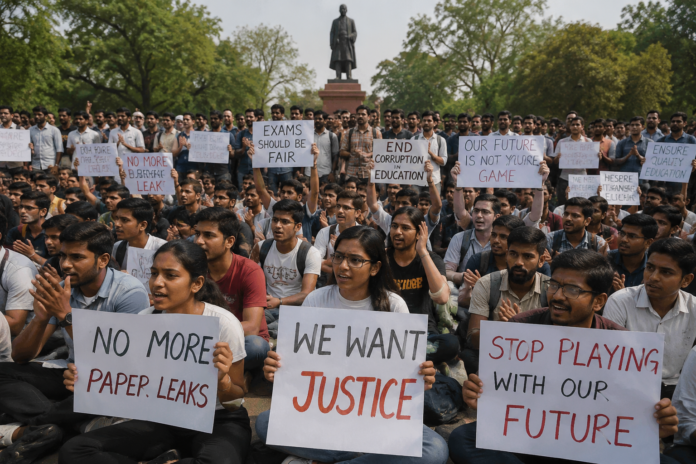
A sweeping wave of student-led demonstrations across India resulted in the resignation of Education Minister Dharmendra Pradhan on Saturday, concluding what analysts are calling one of the most consequential episodes of youth-driven political pressure in the country’s recent history. The protests, which escalated rapidly over the course of several weeks, were triggered by a series of high-profile exam scandals involving leaked question papers that affected competitive examinations taken by millions of students.
The movement was largely organized under the banner of the Cockroach Janta Party, known by the acronym CJP. The group began as a satirical presence on social media platforms roughly two months before the resignation occurred but quickly transformed into a credible organizing force, mobilizing thousands of students across multiple Indian cities. The government ultimately agreed to the protesters’ central demands, including Pradhan’s removal from the cabinet, with supporters of the CJP celebrating publicly in Mumbai on July 26.
- Education Minister Dharmendra Pradhan stepped down on Saturday following sustained protests.
- The Cockroach Janta Party mobilized thousands of students within approximately two months of its founding.
- Exam paper leaks affecting competitive national examinations served as the central grievance.
- The Indian government formally accepted the key demands put forward by the protest movement.
Why It Matters
Pradhan’s resignation represents a historically significant moment in Indian politics. According to reporting on the episode, this marks the first instance during Prime Minister Narendra Modi’s 12-year time in office that a sitting minister has been compelled to leave under direct and sustained public pressure. That distinction underscores just how unusual and powerful the movement turned out to be, given how rarely street demonstrations in India have produced such a concrete and immediate governmental response at the cabinet level.
The broader implications extend well beyond a single resignation. The episode reveals the growing political influence of India’s vast youth population, particularly in an era where social media can rapidly convert online discontent into real-world mobilization. The exam leaks that sparked the demonstrations had already eroded public trust in the integrity of India’s national examination systems, which serve as gatekeepers for higher education and civil service careers for hundreds of millions of young people and their families.
- This is the first ministerial resignation under public pressure during Modi’s 12 years in office.
- Millions of students who rely on competitive exams for their futures are directly affected by the integrity failures at issue.
- The episode signals that youth-organized digital movements can produce tangible political results in India.
- Public trust in India’s national examination infrastructure has been significantly damaged by the scandal.
Political and Public Context
The Cockroach Janta Party’s origins as an internet joke make its rapid ascent into a nationally recognized protest organization all the more striking. Within just two months, the group shifted from being a satirical outlet for online frustration to commanding enough organizational capacity to bring thousands of demonstrators into the streets of major Indian cities simultaneously. This trajectory reflects broader global trends in which digitally native communities can coalesce around shared grievances with remarkable speed.
The exam scandal itself had been building for some time before the protests reached their peak intensity. Leaked examination papers are not a new problem in India, but the scale and frequency of recent incidents drew unusual levels of public anger. Students who had spent years preparing for high-stakes national tests expressed widespread outrage that the process had been compromised, with many arguing that the failures represented systemic failures of oversight rather than isolated incidents. The government’s decision to accept the resignation rather than weather the protests signals a recognition that the public mood had become too charged to ignore.
- The Cockroach Janta Party transitioned from a social media satirical group to a major organizing body within two months.
- Examination paper leaks in India have a history, but the recent incidents were notable in scale and public reaction.
- Protests were reported across multiple major Indian cities, including significant demonstrations in Mumbai.
- The government’s swift acceptance of protester demands was seen as a departure from its typical posture toward street-level opposition.
What Happens Next
With Pradhan’s resignation secured, attention is now turning to what the Indian government will do to address the underlying problems in the national examination system. Protesters and student advocacy groups are expected to monitor whether substantive reforms follow the change in leadership at the Education Ministry, or whether the resignation functions primarily as a political pressure valve without producing lasting institutional change. The successor to Pradhan in the ministry has not yet been publicly confirmed as of the time of this report, and that appointment will itself be closely watched for signals about the government’s intentions.
The Cockroach Janta Party, having demonstrated an unexpected capacity to influence government decisions, now faces the question of whether it can sustain its organizational momentum and continue pressing for additional accountability measures. Student groups across India are also likely to remain engaged on examination integrity issues, particularly given how directly the scandals affected their academic and professional futures.
- A successor to Dharmendra Pradhan at the Education Ministry had not been named at the time of reporting.
- Student groups are expected to press for structural reforms to the national examination system beyond the resignation.
- The Cockroach Janta Party faces the challenge of maintaining organizational momentum following its initial success.
- The long-term integrity of India’s competitive examination infrastructure remains an open and unresolved question.
