

Story Highlights
- President Donald Trump defended his major tax and spending bill after Elon Musk sharply criticized the legislation.
- Musk argued the bill would increase the federal deficit and undermine spending-cut efforts.
- The bill includes extensions of Trump-era tax cuts, new deductions, and major spending provisions as it moves to the Senate.
What Happened
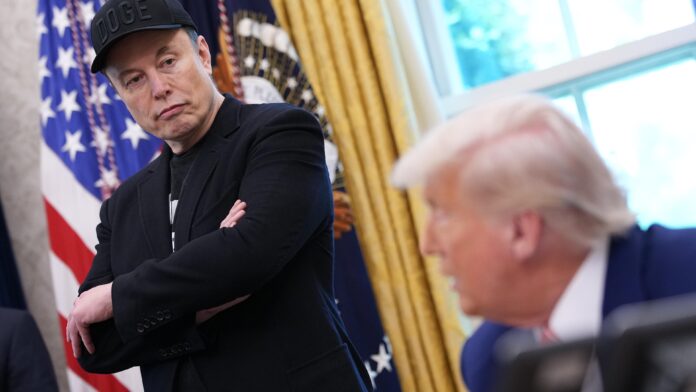
President Donald Trump defended his major tax and spending package after Elon Musk publicly criticized the legislation, creating a rare split between the president and one of his most high-profile supporters.
Trump addressed the dispute during a White House cabinet meeting, saying he was disappointed by Musk’s comments but remained committed to the bill. The president argued that the legislation is central to his economic agenda and includes tax relief measures he promised during the 2024 campaign.
- Musk criticized the bill as too expensive.
- Trump defended the measure as necessary for his economic program.
- The dispute comes as Senate Republicans prepare to debate the package.
Musk, who previously led the Department of Government Efficiency initiative, has used social media to denounce the bill as wasteful and damaging to federal finances. He argued that the legislation would add significantly to the national debt and weaken efforts to reduce government spending.
Trump suggested Musk’s criticism may be partly connected to changes affecting electric vehicle policy, while also acknowledging that concerns about deficits are part of the broader debate. The president made clear, however, that he does not plan to withdraw support for the legislation.
- The bill extends parts of the 2017 tax law.
- It includes new deductions for tipped wages and overtime income.
- Republican leaders hope to move the measure through the Senate in the coming weeks.
The package has already passed the Republican-controlled House by a narrow margin and now faces a more complicated path in the Senate, where lawmakers are expected to examine both the tax provisions and the overall cost of the bill.
Why It Matters
The public disagreement matters because Musk was one of Trump’s most visible allies during the 2024 campaign and later became closely associated with the administration’s government-efficiency push.
His criticism gives voice to a concern shared by some fiscal conservatives: that major tax cuts and spending provisions could increase deficits at a time when the federal government is already carrying a large debt burden.
- Trump wants the bill passed as a signature economic achievement.
- Musk’s criticism may energize deficit hawks inside the Republican coalition.
- The dispute could complicate Senate negotiations.
For Trump, the bill represents a chance to lock in major pieces of his economic agenda, including tax relief for workers and businesses. For critics, the concern is whether the package delivers those benefits at too high a long-term fiscal cost.
The clash also tests Trump’s ability to keep different parts of his coalition aligned. Business leaders, populist conservatives, deficit hawks, and working-class voters may all view the bill through different lenses.
Political and Public Context
The tax and spending bill is one of the most important legislative fights of Trump’s second term. Its success or failure could shape the administration’s economic message heading into the midterm election cycle.
Republican supporters are likely to frame the bill as a tax-cut and growth package designed to protect household income, reward work, and extend Trump’s first-term economic policies. They may also emphasize provisions aimed at tipped workers and overtime earners.
- Supporters see the bill as pro-growth and pro-worker.
- Critics argue it adds too much to the deficit.
- Democrats are expected to attack the package as favoring higher-income taxpayers.
Musk’s opposition adds a new layer to the debate because he is not a traditional Democratic critic of Trump. His objections come from a spending and debt perspective, which could make them more difficult for Republicans to dismiss.
At the same time, Trump remains the dominant force in the Republican Party, and many GOP lawmakers may be reluctant to oppose a bill that the president has made central to his agenda.
What Happens Next
The bill now moves through the Senate, where Republican leaders will try to hold together enough support to pass the package and send it to Trump’s desk.
Senators may seek changes to the bill’s spending levels, tax provisions, or deficit impact before final passage. Any major revisions could require additional negotiations with House Republicans.
- The Senate may revise parts of the package.
- Fiscal conservatives could push for spending offsets.
- Trump is expected to continue pressing Republicans to pass the bill.
If the bill passes, Trump will likely present it as a major economic victory. If it stalls, the disagreement between the White House and fiscal conservatives could become a larger political problem for Republicans.
For now, Trump is standing by the legislation, while Musk’s criticism has turned the bill into a broader test of party unity, spending discipline, and the president’s control over his economic agenda.
Sources
Trump brushes aside Elon Musk’s criticisms of his signature budget bill
