

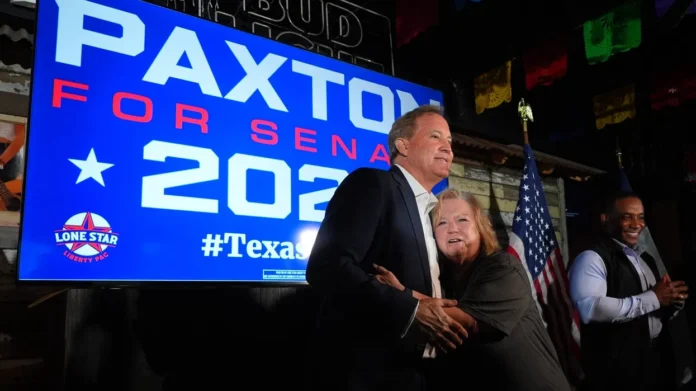
Story Highlights
- Trump endorsed Texas Attorney General Ken Paxton for the Senate over Sen. John Cornyn, triggering a May 26 runoff after neither candidate earned a majority of votes in the March 3 primary.
- Paxton said Trump called him ahead of the endorsement announcement, stating “I think you’re going to like what I’m doing today” and suggesting that Trump thought Paxton was “the best candidate.”
- The endorsement represented Trump’s continued pattern of targeting incumbent Republicans he views as insufficiently loyal while promoting newer political figures more willing to defer to presidential preferences.
What Happened
On May 20, 2026, President Trump endorsed Texas Attorney General Ken Paxton for the Senate, setting up a runoff election against incumbent Senator John Cornyn scheduled for May 26. The endorsement came after the March 3 primary election in which neither candidate had secured the majority of votes required to avoid a runoff. The endorsement announced on May 20 came with little advance warning, surprising political observers who had anticipated Trump might remain neutral or who questioned whether Trump possessed sufficient leverage with Texas Republican voters to overturn the initial primary results.
Trump’s relationship with Paxton had developed over previous years, and Paxton had cultivated close ties to the Trump administration. Paxton said Trump called him ahead of today’s endorsement announcement, explaining that Trump “suggested that he thought I was the best candidate.” The personal communication between Trump and Paxton before the public endorsement highlighted the close relationship between the two men and suggested that Trump had been considering the endorsement before making it public. The phone call itself functioned as a signal to Texas Republican voters that Trump had personally vetted and approved of Paxton as a candidate.
Paxton pointed to Cornyn’s longtime connections in the Senate, where he has represented Texas since 2002. In Paxton’s response to Trump’s endorsement, he acknowledged the incumbent senator’s extensive experience and established relationships within the Senate. However, Paxton framed his own candidacy as offering a fresh approach more aligned with Trump’s agenda and with the newer direction the Republican Party was taking. Paxton’s argument essentially conceded that Cornyn represented the old establishment Republican approach while Paxton embodied a new, Trump-aligned Republican politics.
Paxton stated that Trump “considered the good of the whole country” in making the endorsement, explaining “I get that,” and argued that Cornyn’s Senate experience made him valuable for passing legislation. Paxton’s statement appeared designed to demonstrate respect for both Trump’s judgment and Cornyn’s legislative experience while suggesting that Cornyn’s legislative effectiveness was less important than alignment with Trump’s policy agenda. The statement attempted to reconcile the contradiction between respecting Cornyn’s Senate achievements and supporting Trump’s endorsement of a challenger with no legislative experience.
The May 26 runoff would determine which candidate faced the Democratic general election opponent. Paxton will face off against Cornyn in a May 26 runoff after neither earned a majority of the vote in the March 3 primary. The runoff election would be held just six days after Trump’s endorsement, leaving little time for Paxton to capitalize on Trump’s backing through campaigning and media activity. However, in a state that Trump had won decisively, Trump’s endorsement potentially carried enormous weight with primary voters who might be persuaded to change their initial primary votes through the runoff ballot.
Why It Matters
Trump’s endorsement of Paxton over Cornyn reflects ongoing power struggles within the Republican Party between Trump’s faction and the traditional Senate Republican leadership that Cornyn represents. Cornyn had served in the Senate for more than two decades and held leadership positions within the Republican caucus. His defeat would signal that Trump had successfully transformed Republican primary politics to the point where even experienced, established incumbents could be vulnerable to Trump-backed challengers.
Paxton brought significant personal and political baggage to his candidacy. The Texas attorney general had faced serious ethical controversies during his tenure, including allegations that he had misused his office for personal political benefit. These controversies had previously raised questions about whether Paxton could be an effective senator or a viable general election candidate. Trump’s endorsement of Paxton despite these controversies suggested that alignment with the president’s agenda took precedence over questions about character or ethical judgment.
The endorsement also highlighted the reality that Trump intended to reshape the Republican Senate to ensure greater loyalty to presidential preferences. Cornyn, while generally supportive of Trump’s policies, had occasionally voted against administration positions or refused to endorse particular Trump legislative initiatives. Trump’s willingness to back a primary challenge against such a conditionally loyal incumbent suggested his expectations for future senators would involve near-total deference to presidential wishes.
The runoff election occurred in Texas, a state where Trump retained overwhelming support among Republican voters. Trump’s endorsement in such a favorable electoral environment potentially carried decisive weight. Paxton’s path to victory appeared clearer after Trump’s endorsement than it would have been without it. The endorsement essentially transformed the runoff from a genuine political contest between two candidates into a test of Trump’s influence over Texas Republican primary voters.
Economic and Global Context
The Senate seat itself carried significant implications for national politics and policy. Texas’s two Senate seats controlled substantial influence over Republican legislative priorities. A Senate aligned with Trump’s preferences would potentially be more willing to support controversial Trump legislative initiatives or executive actions. A Senate influenced by traditional Republicans like Cornyn would be more likely to exercise independent judgment on significant policy matters and to resist presidential overreach.
Paxton’s record as Texas attorney general had involved significant litigation against the federal government, including participation in lawsuits challenging various federal policies. However, Paxton had also engaged in controversial legal actions targeting particular groups or individuals, raising questions about how he would exercise the broader authority of a U.S. Senator. His record suggested a more partisan approach to legal authority compared to Cornyn’s traditional conservative jurisprudence.
The broader context involved Republican efforts to establish control over state and federal offices. Trump’s endorsement of Paxton reflected the broader pattern in which Trump had intervened in numerous state and federal races to promote candidates he viewed as personally loyal or ideologically aligned with his preferences. In states and districts where Trump retained substantial popularity, these endorsements often proved decisive.
Implications
The May 26 runoff would likely determine which candidate represented Texas in the general election against the Democratic nominee. Given Texas’s Republican lean, whichever candidate won the runoff would be favored in the general election. Therefore, Trump’s endorsement potentially determined the outcome not just of the Republican primary but of the overall Senate race.
A Paxton victory would represent another successful intervention by Trump in Republican primary politics and would reinforce the message that Trump loyalty was essential for Republican electoral success. A Cornyn victory would suggest that incumbent senators with established records and legislative relationships could survive Trump challenges despite presidential opposition. The stakes extended beyond a single Senate seat to fundamental questions about whether Trump would successfully transform the Republican Party into a more personalist, loyalty-based organization or whether traditional Republican leadership structures would maintain independent authority.
For Paxton personally, a runoff victory would position him for a Senate career likely characterized by close alignment with Trump. For Trump, a Paxton victory would represent validation of his political power and would provide him an additional vote in the Senate on matters of personal or political importance. For Cornyn, a runoff loss would represent a dramatic end to his Senate career and would underscore the limits of institutional authority and experience in Trump-era Republican politics.
Sources
“Primary elections 2026: Massie defeated in Kentucky; Georgia, Alabama and other states hold races”
