

Story Highlights
- $1 billion for Secret Service is included for “above-ground and below-ground security features” at the East Wing Modernization Project
- Trump originally promised the ballroom would be funded “100 percent” by himself and private donors
- Democrats, led by Senate Minority Leader Chuck Schumer, have called the provision a “bait and switch” on taxpayers
What Happened
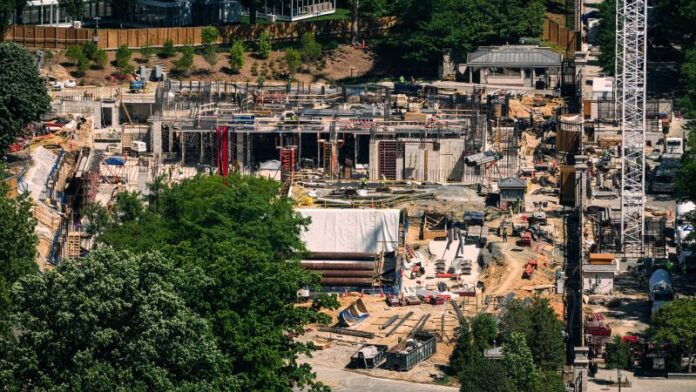
President Donald Trump ordered demolition of the White House’s historic East Wing on October 20, 2025, just two days after large-scale anti-administration rallies across the country. At the time, he assured reporters that the ballroom he intended to construct in its place would be funded entirely through private contributions from himself and associates. The project, framed as a long-overdue modernization of the White House’s event infrastructure, was described as a facility needed to accommodate larger official gatherings.
The political calculus changed dramatically following the White House Correspondents’ Dinner shooting in April 2026, in which an attacker targeted administration officials at the event. The incident prompted Republicans to argue that a dedicated, security-hardened presidential event space at the White House itself was a genuine national security priority — not merely a luxury project. That reframing has since become the central justification for including federal security funding in the reconciliation bill.
Legislative text released by the Senate Judiciary Committee on May 4 included $1 billion for the Secret Service designated specifically for “security adjustments and upgrades” related to the East Wing Modernization Project, covering both above-ground and below-ground features. The bill text explicitly bars the Secret Service from using those funds for non-security elements of the ballroom and its attached facilities. The White House issued a statement applauding the provision, calling the project “long overdue” and emphasizing the security rationale.
Senate Minority Leader Chuck Schumer responded sharply, arguing that Republicans were misreading the public’s priorities. He said the party was funneling taxpayer dollars into Trump’s private event space while American families struggle with rising gas prices and grocery costs driven in part by the Iran war. Democratic Senator Jeff Merkley pledged that Democrats would challenge the ballroom provision under the Byrd Rule, the procedural standard that governs what can be included in a Senate reconciliation bill. Critics argue the provision lacks a sufficient budgetary nexus to survive that challenge.
Why It Matters
The ballroom funding dispute is more than a political sideshow — it reflects a genuine and recurring constitutional tension over the proper use of public money for presidential purposes. Presidents routinely receive substantial public resources for security, transportation, and operational support. But the East Wing project blurs the line between legitimate security infrastructure and presidential preference, a distinction that courts, auditors, and the public will be watching closely as the funds are spent.
The credibility gap between Trump’s original promise — that no public money would be used — and the administration’s current position is significant. When Trump pledged private funding in October 2025, it was widely reported and broadly accepted as the governing framework for the project. The pivot to security-justified federal appropriations, enabled by the Correspondents’ Dinner attack, has given critics a concrete example of what they describe as post-hoc justification for spending that was always going to happen one way or another.
For congressional Republicans, the provision creates an awkward political position. Supporting it requires defending a $1 billion taxpayer expenditure on White House facilities at a moment when the administration has championed fiscal discipline and reduced social spending. Several Republican senators have privately expressed discomfort, though none had formally announced opposition as of this writing. The tight timeline imposed by Trump’s June 1 deadline limits the political space for members to extract changes.
The broader reconciliation package in which this provision sits — focused on ICE, Border Patrol, and immigration enforcement — has already energized Democratic opposition. Adding the ballroom security provision gives Democrats a vivid and easily explained talking point: that Republicans cut food assistance and Medicaid last summer but are now spending a billion dollars on a presidential party venue. Whether that framing resonates with swing voters ahead of the 2026 midterms remains to be seen.
Economic and Global Context
The $1 billion for the ballroom security provision is a small fraction of the $72 billion reconciliation package, but its symbolism is outsized. Federal spending on White House infrastructure is not uncommon — previous administrations undertook major security renovations after the September 11 attacks, for example — but those investments were tied to broadly recognized security failures rather than new construction projects of the president’s choosing.
The fiscal backdrop matters here. The United States is operating with annual deficits approaching 7% to 9% of GDP, depending on projections, and the Moody’s credit downgrade last year specifically cited the trajectory of mandatory spending and tax policy under the One Big Beautiful Bill Act. Adding a deficit-financed $72 billion package with no offsetting savings continues that trend. While $1 billion for the ballroom is not a macroeconomic variable, it contributes to an overall narrative about fiscal priorities that financial markets and rating agencies will monitor.
White House construction and renovation spending is legally subject to General Services Administration oversight and appropriations law requirements. The Secret Service’s mandate covers physical security of the president and the White House complex, giving the administration a plausible legal framework for channeling the funds through that agency. However, questions about procurement transparency and how the boundary between security and non-security construction is enforced in practice will likely draw Government Accountability Office scrutiny.
Internationally, the project has attracted some notice as an example of the Trump administration’s willingness to blend personal and official presidential activities — a pattern that draws comparisons to Mar-a-Lago’s continued use as a de facto second White House and the associated security expenses borne by taxpayers at that location.
Implications
The Byrd Rule challenge promised by Democrats is the most immediate legal threat to the ballroom provision’s survival. To withstand that challenge, Republicans must demonstrate that the $1 billion for Secret Service security has a direct and substantial budgetary impact — not merely an incidental one. If the Senate Parliamentarian rules against the provision, it would be stripped from the bill in a Byrd Bath vote, potentially without affecting the larger immigration enforcement package.
If the provision survives and becomes law, it sets a precedent for future presidents seeking to finance security-adjacent White House infrastructure through the reconciliation process. That precedent could prove awkward for Republicans if a future Democratic president uses similar logic to justify controversial White House projects under the guise of security investment.
Public accountability for the spending would depend largely on whether the Inspector General of the Department of Homeland Security and the GAO exercise their oversight authority aggressively. Congressional Democrats would likely request formal investigations and audits, but without committee subpoena power they have limited ability to compel detailed disclosures.
For voters, the ballroom controversy serves as a proxy debate about who benefits from Republican governance. Supporters will frame it as a legitimate security investment in the centerpiece of American executive power. Critics will continue to argue it represents the kind of self-serving use of public resources that the administration promised to end. That argument will play out in congressional campaigns across the country this fall.
Sources
“Republicans want to add $1 billion for Trump’s ballroom security to ICE funding plan”
