

Story Highlights
- Trump posted on social media that Iran faces destruction if it does not “get moving, FAST” on a peace deal
- The Pentagon has prepared target plans including energy and infrastructure sites inside Iran
- Brent crude oil prices rose over 2% to $111 a barrel following Trump’s weekend warnings
What Happened
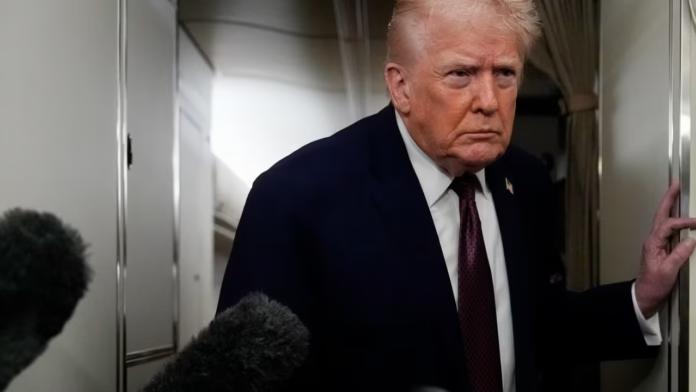
President Donald Trump convened a meeting of his top national security advisers at his Virginia golf club on Saturday to assess the state of the Iran conflict, now in its third month. Attendees included Vice President JD Vance, Secretary of State Marco Rubio, CIA Director John Ratcliffe, and special envoy Steve Witkoff. The gathering came just hours after Trump returned from a two-day state visit to Beijing, where he met with Chinese President Xi Jinping and failed to secure Beijing’s help in reopening the Strait of Hormuz.
The following day, Trump made his frustration public. In a post on Truth Social, he wrote: “For Iran, the Clock is Ticking, and they better get moving, FAST, or there won’t be anything left of them. TIME IS OF THE ESSENCE! President DJT.” The statement represented one of his sharpest warnings to date and signaled a marked shift from the administration’s stated preference for a diplomatic resolution.
According to two U.S. officials familiar with the discussions, Trump is expected to convene his national security team again in the White House Situation Room on Tuesday, May 19, to formally review military options. The Pentagon has already prepared a series of strike plans that include targeted attacks on Iranian energy infrastructure and key military installations. No final decision has been made, but the range of options available to the president is now actively under review.
On the Iranian side, there are few signs of meaningful concession. Tehran’s foreign ministry confirmed over the weekend that it had delivered a response to U.S. criticisms of its earlier 14-point peace plan, which Trump had rejected as “totally unacceptable.” Iranian state media said the exchange was conducted through Pakistani mediators, who have played a central role in back-channel diplomacy throughout the conflict. Iranian President Masoud Pezeshkian met over the weekend with Pakistani officials, though no breakthrough was announced.
A drone strike on the United Arab Emirates’ Barakah nuclear power plant on Sunday further inflamed tensions. The UAE defense ministry confirmed damage to an electrical generator outside the plant’s inner perimeter. While Abu Dhabi stopped short of directly blaming Tehran, a senior UAE official strongly implied Iranian involvement and called the attack a “dangerous escalation” that violated international norms.
Why It Matters
The stakes of the Iran crisis extend well beyond the Middle East. The continued closure of the Strait of Hormuz — through which roughly 20% of the world’s oil supply normally flows — is imposing real economic costs on American consumers and global allies. Elevated oil prices are feeding inflation pressures in the United States at a time when the Trump administration is already managing trade friction and a recent credit rating downgrade. Every week the strait remains effectively blockaded, the costs compound.
The political calculus for Trump is also intensifying. He campaigned in part on ending foreign entanglements quickly, and earlier administration projections described a conflict lasting four to five weeks. Three months in, the war has dragged on without a decisive resolution, leaving the White House politically exposed on multiple fronts. Resuming major strikes might offer a path to forcing Iran’s hand, but it also risks further escalation and American casualties.
For Congress, the situation raises unresolved questions about war powers authority. Trump submitted a formal notification to congressional leaders under the 1973 War Powers Resolution in May, declaring that hostilities had effectively paused — a position that is increasingly difficult to maintain given the ongoing naval blockade and periodic exchanges of fire. Further military action would trigger fresh constitutional debates about the limits of executive military authority.
The role of Pakistan as a mediator also matters enormously. Islamabad has invested significant diplomatic capital in brokering a ceasefire and has close relationships with both Washington and Tehran. If the U.S. resumes large-scale strikes without exhausting the current Pakistani-led process, it risks alienating a partner whose cooperation is essential for broader regional stability and for any post-conflict settlement.
Economic and Global Context
The Iran war has had measurable consequences for energy markets and global supply chains. Brent crude rose more than 2% to $111 a barrel following Trump’s Sunday warning, illustrating how sensitive commodity markets are to even rhetorical escalation. Prices had already been elevated for weeks due to restricted traffic through the Strait of Hormuz, which has effectively gridlocked commercial shipping in one of the world’s most critical maritime corridors.
Global allies who rely heavily on Gulf oil imports — including Japan, South Korea, and European Union member states — have faced serious supply disruptions. Germany recently dispatched a minesweeping vessel to the Mediterranean to prepare for a potential international effort to reopen the strait, an operation described by France as involving more than 40 nations. However, no allied nation has indicated willingness to enter active hostilities while the U.S.-Iran conflict continues.
China, as Iran’s largest trading partner and top buyer of its oil, occupies a uniquely influential position. Despite Trump’s direct request during his Beijing summit, Xi Jinping declined to use Chinese leverage to press Tehran on the Hormuz question. Beijing’s reluctance reflects its own strategic interests — a weakened Iran would remove one of China’s key sources of discounted crude oil — as well as its broader desire to avoid entanglement in a U.S.-led military confrontation.
The broader economic fallout extends to food and shipping costs. Insurance premiums for cargo vessels transiting near the Persian Gulf have surged, and rerouting around the Cape of Good Hope adds weeks to delivery schedules. Senate Democrats have pointed to rising gas prices as a direct consequence of the Iran war, using them as a political argument against Republican spending priorities.
Implications
The Situation Room meeting on Tuesday represents a potential inflection point. If Trump authorizes renewed large-scale strikes on Iranian energy and infrastructure sites, the immediate military objective would be to shock Tehran into more serious negotiations. However, such a move could also trigger Iranian retaliation against U.S. naval assets, Gulf state infrastructure, or both — a risk that officials have privately acknowledged as a significant concern.
A negotiated settlement remains possible. Iran’s foreign ministry has indicated a continued willingness to communicate through Pakistani intermediaries, and Trump himself has said he believes Iran wants a deal. The core sticking point remains Iran’s nuclear program: Washington is demanding verifiable dismantlement of enrichment capabilities, a threshold Tehran has so far refused to cross.
For Gulf allies, including the UAE, Saudi Arabia, and Kuwait, Sunday’s drone strike on the Barakah plant marks a new and alarming development. A direct Iranian attack on civilian nuclear infrastructure could draw one or more Gulf states into more active combat operations — expanding the conflict in ways that would dramatically complicate any peace process.
American voters will be watching closely. Polling has consistently shown that while the public supports military strength, appetite for an extended Middle East war is limited. How Trump navigates the next 72 hours will shape both the trajectory of the Iran conflict and his administration’s broader standing heading into the 2026 midterm cycle.
Sources
“Trump warns Iran ‘the clock is ticking’ as US discusses military options”
