

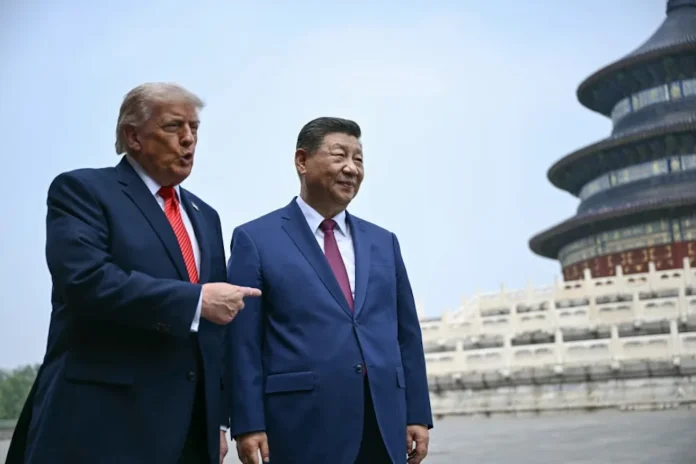
Story Highlights
- Trump and Xi met for over two hours on Thursday, with Xi calling the U.S.-China relationship “the world’s most consequential”
- Xi issued a direct warning that mishandling Taiwan could cause “clashes and even conflicts”
- Both leaders agreed the Strait of Hormuz “must remain open,” a key outcome tied to the Iran conflict
What Happened
President Donald Trump arrived in Beijing accompanied by a host of corporate executives, hinting at his top priorities when meeting with Chinese counterpart Xi Jinping this week, which include tech, aircraft, and agriculture.
The state visit runs from May 13 to 15, 2026, and is Trump’s second state visit to China and his first since November 2017 during his first presidency. The summit had originally been planned for April but was postponed due to the ongoing 2026 Iran war.
Trump and Xi met for two hours and 15 minutes at the start of their highly anticipated two-day summit. Xi warned Trump that mishandling Taiwan would cause “clashes and even conflicts, putting the entire relationship in great jeopardy,” Beijing’s foreign ministry said. There was no mention of Taiwan in the American readout, which focused on trade and the Iran war.
Trump described talks as “extremely positive” in a toast at the start of a lavish state banquet, and invited Xi to the United States later this year. Trump and Xi agreed that the Strait of Hormuz — a chokepoint vital to the oil trade — “must remain open,” a White House official said.
Xi welcomed U.S. business leaders who traveled with Trump. The president told Xi the executives — including Tim Cook and Elon Musk — came to China to “pay respects” and build business. Nvidia chief executive Jensen Huang was added to the delegation at the last minute after initially being left off the list.
Why It Matters
The Beijing summit carries enormous stakes for American foreign policy, economic stability, and the ongoing conflict with Iran. Trump’s decision to make China his destination during an active war in the Middle East underscores how central Beijing has become to nearly every crisis the administration is managing. Without Chinese cooperation on the Strait of Hormuz — through which roughly 20 percent of the world’s oil and gas passes — the path to ending the Iran war and relieving domestic energy prices remains blocked.
The summit arrives at a moment of mounting pressure for Trump, whose war with Iran has rattled global economies. Energy prices have surged since the strait’s closure, with the national average for gasoline climbing sharply and inflation running well above the Federal Reserve’s target. Every week the strait remains even partially closed translates into measurable economic harm for American households and businesses.
Taiwan remains the most structurally difficult issue between the two nations. The United States officially recognizes the communist mainland as China but is legally committed under the Taiwan Relations Act to support Taiwan’s self-defense, a policy that has long angered China. Washington has approved tens of billions of dollars in military sales to Taiwan over the years, including an $11 billion package announced last year. Taiwan’s government said it was monitoring the summit closely and in direct contact with Washington throughout the meetings.
For American businesses, the summit signals a possible stabilization of the commercial relationship that has been disrupted by tariffs, technology export controls, and geopolitical volatility. The presence of more than a dozen chief executives in Beijing sends a message that American industry views a functional U.S.-China relationship as essential to their global operations.
Economic and Global Context
Chinese leader Xi Jinping has not merely played defense — he was one of the few world leaders to respond in kind to Trump’s tariffs, turning the tide of the trade war by weaponizing China’s dominance over rare earths — critical elements necessary for everything from consumer electronics to vehicles and fighter jets. The leverage paved the way for the two leaders’ summit in South Korea last October, which resulted in agreements for a temporary truce in which both nations suspended the most punitive tariffs and export controls.
As Trump lands in Beijing — for his first visit in nearly a decade — the two powers appear to have moved on from the tit-for-tat escalation that dominated much of 2025 to focusing on stability in bilateral relations. “China’s goal is still to put the Busan truce on a stabler, longer-lasting footing to avoid the constant ups and downs of 2025,” said Joe Mazur, senior analyst at consultancy Trivium China.
China is ready to leverage its vast domestic market and dominance in the rare earth supply chain to get what it wants: the U.S. expressing “opposition” instead of non-support to Taiwan independence; reducing restrictions on high-end tech exports; and removing Chinese companies from its sanctions list. These demands reflect how fundamentally the balance of leverage has shifted in Beijing’s favor since the Iran conflict began.
Preparatory talks between Treasury Secretary Scott Bessent and Chinese Vice Premier He Lifeng were held in Seoul ahead of the summit and were described by Beijing as “candid, in-depth, and constructive,” signaling a serious intent on both sides to reach tangible agreements before the summit concluded.
Implications
The outcome of the Trump-Xi summit will shape the trajectory of at least four major policy challenges simultaneously: the Iran war, global energy prices, trade relations, and Taiwan’s security. If the two leaders reach a durable agreement on keeping the Strait of Hormuz open and resuming full trade normalization, markets could respond strongly in the weeks ahead. If the summit produces only vague commitments, the momentum could quickly fade.
Analysts say Taiwan will be paying close attention to what Trump and Xi say publicly after the summit, especially on defense and arms sales. “What matters is the precise wording,” one analyst noted. “Whether Trump reaffirms support for Taiwan’s defense, whether he sounds ambiguous on arms sales, and whether he gives Xi any rhetorical opening to claim that Washington is restraining Taipei.”
For American voters, the summit’s success or failure will register primarily through energy prices. Trump’s standing in polls has declined as gas prices have soared, and any credible progress toward reopening the strait — even indirectly pressured by Chinese engagement with Iran — would be politically valuable heading into the November midterms.
The second day of talks on Friday is expected to produce a joint communiqué or at minimum a set of agreed principles. Whether those documents contain the specificity needed to move markets and ease tensions — or remain aspirational in tone — will determine how the summit is ultimately judged.
Sources
“Xi hails US-China relations as world’s most consequential, but warns Trump on Taiwan”
