

Story Highlights
- Trump said “I’m going to have that discussion with President Xi” on arms sales to Taiwan
- Taiwan’s parliament recently approved a $25 billion defense budget for U.S. weapons
- A bipartisan group of senators urged Trump to advance a $14 billion Taiwan arms sale before the summit
What Happened
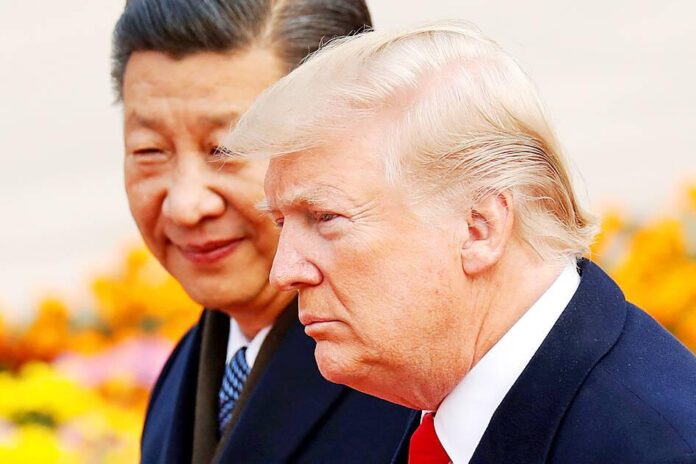
President Donald Trump told reporters at the White House on Monday that U.S. arms sales to Taiwan would be among the topics he discusses with Chinese President Xi Jinping in Beijing this week. When asked about Washington’s longstanding support for Taiwan’s defense, Trump replied, “I’m going to have that discussion with President Xi. President Xi would like us not to, and I’ll have that discussion. That’s one of the many things I’ll be talking about.”
The statement came as bipartisan senators publicly urged Trump to advance a $14 billion pending arms sale to Taiwan before the summit, warning that placing the issue on the table with Xi could be interpreted in Beijing as an opening bid for a trade. The Trump administration had already reportedly paused delivery of part of a record $11 billion weapons package for Taiwan that was authorized in December 2025, drawing concern from Taipei.
Taiwan’s parliament recently approved a special defense budget of $25 billion to purchase missiles and other weapons from the United States, well short of the $40 billion the government had originally sought. Trump praised Taiwan for “paying more” for its own defense — language consistent with his broader demands that American allies contribute more to their own security.
Trump also said he would raise the imprisonment of Hong Kong pro-democracy activist Jimmy Lai, founder of the now-shuttered Apple Daily newspaper, who was sentenced in December to 20 years under Hong Kong’s national security law — the longest sentence handed down under the statute. “He tried to do the right thing. He wasn’t successful, went to jail, and people would like him out, and I’d like to see him out too,” Trump said.
Why It Matters
Taiwan represents the single most dangerous potential flashpoint between the United States and China. The island democracy has maintained de facto independence since 1949, and the United States has supported its defense through arms sales and a policy of “strategic ambiguity” — declining to state explicitly whether it would intervene militarily if China attacked. Any shift in that posture, even a subtle one, would reverberate through Asia and beyond.
Security analysts and Taiwan’s government are alarmed by Trump’s framing. By treating arms sales as a negotiating topic rather than a settled policy, Trump risks signaling to Beijing that U.S. commitments to Taiwan are transactional — tradeable for concessions on Iran, trade, or other issues. Bonnie Glaser, managing director of the Indo-Pacific program at the German Marshall Fund, said a tacit bargain in which Washington concedes a sphere of influence over Taiwan “could embolden China to take more assertive steps to erode Taiwan’s autonomy.”
Chinese officials have long insisted that Taiwan is “the biggest point of risk” in the bilateral relationship and have called on Washington to “keep its promise and make the right choices.” Beijing’s pressure on this point will be intense. Xi welcomed the leader of Taiwan’s main opposition party, the Kuomintang, in Beijing last month — a gesture designed to demonstrate that China sees pathways to influence over Taiwan independent of military confrontation.
The implications for Reagan’s Six Assurances — longstanding commitments that the United States will not mediate between Beijing and Taipei on sovereignty issues — are also at stake. Taiwan is particularly worried that Trump may agree to express “support” for peaceful unification or change language on independence, even in vague terms.
Economic and Global Context
Taiwan is a critical node in global technology supply chains, producing the majority of the world’s advanced semiconductors through companies including TSMC. Any deterioration in Taiwan’s security environment would have immediate and severe consequences for the global technology industry, affecting everything from smartphones and data centers to military hardware and automotive electronics.
U.S. arms sales to Taiwan have totaled more than $50 billion over the decades, building asymmetric capabilities intended to deter a Chinese amphibious assault. The defense relationship is formalized through the Taiwan Relations Act of 1979, which obligates the U.S. to provide Taiwan with defensive weapons and maintain its capacity to resist coercion. Whether that legal commitment constrains Trump’s negotiating flexibility is a question that legal scholars and policymakers are actively debating.
Japan and South Korea are watching the Beijing summit with anxiety. Both nations depend on U.S. security guarantees that derive much of their credibility from America’s demonstrated willingness to stand by Taiwan. Any perceived accommodation of Beijing’s demands on Taiwan would force both allies to reassess their own security postures and potentially accelerate their own defense spending and nuclear hedging strategies.
European governments are similarly concerned. NATO’s collective defense ethos rests partly on the credibility of the United States as a reliable partner. A summit in which Trump appears to trade away democratic allies for commercial or diplomatic deals would deepen the European anxiety about American reliability that has grown during both of Trump’s terms.
Implications
The outcome of the Taiwan discussion in Beijing will be closely parsed by governments worldwide. Even the absence of explicit concessions will be examined for signals. If Trump walks out of the summit having agreed only to “further discussions” on arms sales — without advancing the pending packages — that ambiguity will be read as meaningful in capitals from Tokyo to Taipei to Brussels.
For Republicans in Congress, the Taiwan issue is politically sensitive. A strong bipartisan consensus exists in support of Taiwan’s defense, and any appearance that Trump bartered away that commitment for trade deals or Iranian ceasefire help would trigger significant pushback from both parties on Capitol Hill.
For Taiwan, the next few days represent one of the most consequential moments in its modern political history. President Lai Ching-te and his government will be monitoring every word from Beijing in real time, aware that decisions made without their presence could define the island’s security environment for years.
Sources
“Trump puts Taiwan arms sales, Hong Kong jailed activist Lai on agenda ahead of meeting with Xi”
