

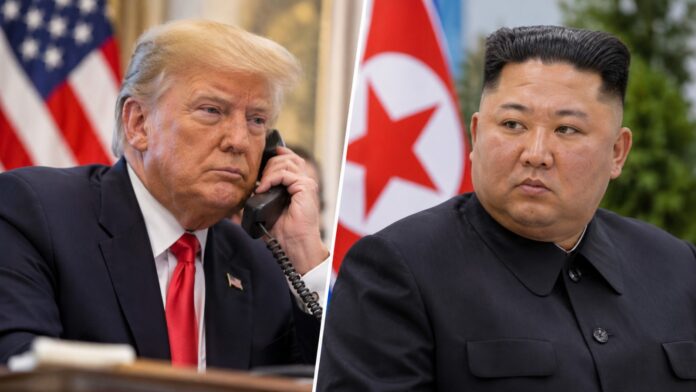
Story Highlights
- President Trump has made multiple attempts to engage North Korean leader Kim Jong Un since his inauguration.
- Despite the president’s efforts, North Korea remains unresponsive to outreach initiatives.
- Kim has publicly stated his desire for recognition as a nuclear power, complicating diplomatic relations.
- Recent attempts to facilitate a meeting between the two leaders have failed due to unacceptable conditions set by Kim.
What Happened
President Trump’s attempts to engage with North Korean leader Kim Jong Un have faced significant hurdles, as recent reports indicate a lack of response from Pyongyang. Following his inauguration on January 20, 2025, the president’s administration has made several outreach efforts, but these have been met with silence from the North Korean regime. The Wall Street Journal highlighted that Trump was left waiting for a response after reaching out through established communication channels shortly after taking office. This lack of engagement is particularly concerning given the historical context of U.S.-North Korea relations, which have been fraught with tension and uncertainty.
- Trump reached out to Kim shortly after his inauguration in January 2025.
- White House officials attempted to deliver a letter to Kim at the North Korean U.N. office.
- A North Korean diplomat reportedly tossed the unopened letter in front of a U.S. representative during a U.N. meeting.
- Kim has publicly stated that the U.S. must recognize North Korea as a nuclear power.
The president’s outreach efforts have included attempts to deliver a letter directly to Kim, which proved to be a challenging task. White House officials reportedly staked out the North Korean U.N. office in New York City, waiting for an opportunity to hand over the correspondence. However, the effort ended in embarrassment when the letter was tossed aside by a North Korean diplomat during a U.N. meeting, signaling a clear disregard for the president’s overtures. This incident underscores the complexities of diplomatic engagement with North Korea, where communication is often fraught with misinterpretation and hostility. Furthermore, during a recent trip to Asia, Trump made an open call to Kim, suggesting that he should ‘put out the word’ regarding potential discussions. His comments, which included a light-hearted jab about North Korea’s nuclear arsenal and their lack of telephone service, reflect a blend of humor and frustration in the face of diplomatic stagnation.
Why It Matters
The current state of U.S.-North Korea relations is critical not only for the two nations involved but also for global security and stability. The president’s attempts to engage with Kim are indicative of a broader strategy aimed at reducing nuclear tensions on the Korean Peninsula. However, Kim’s insistence on being recognized as a nuclear power complicates these efforts and raises significant concerns about the future of diplomatic negotiations. The implications of this diplomatic impasse are far-reaching, affecting not only the United States and North Korea but also regional allies such as South Korea and Japan, as well as global powers like China and Russia.
- The failure to engage North Korea could lead to increased military tensions in the region.
- South Korea and Japan remain on high alert due to North Korea’s nuclear capabilities.
- China’s role as a mediator may become more pronounced as tensions escalate.
- The lack of dialogue could hinder future negotiations on denuclearization.
The consequences of this diplomatic stalemate could be dire. Without effective communication, the risk of miscalculation increases, potentially leading to military confrontations. South Korea and Japan, both of which are within striking distance of North Korean missiles, remain vigilant and concerned about the implications of a nuclear-armed North Korea. Additionally, the role of China as a regional power cannot be overlooked; as tensions rise, Beijing may seek to assert its influence further, complicating the already intricate dynamics of East Asian geopolitics.
Political and Public Context
Understanding the historical context of U.S.-North Korea relations is essential to grasp the current challenges faced by President Trump. The relationship has been characterized by a cycle of engagement and hostility, with previous administrations attempting various strategies to curb North Korea’s nuclear ambitions. The Obama administration’s ‘strategic patience’ policy, for instance, was criticized for failing to yield any significant progress. In contrast, Trump’s initial outreach to Kim in 2018 marked a departure from traditional diplomatic approaches, as he sought to establish a personal rapport with the North Korean leader.
- The Obama administration’s ‘strategic patience’ policy failed to yield results.
- Trump’s initial meetings with Kim in 2018 were seen as a breakthrough.
- Kim’s recent statements indicate a hardening of his stance on nuclear recognition.
- Previous diplomatic efforts have often ended in stalemate or regression.
The current situation reflects a regression in the progress made during those initial meetings, as Kim’s recent rhetoric suggests a hardening of his position. The North Korean leader’s insistence on being recognized as a nuclear power indicates a shift away from the possibility of denuclearization talks, which were once a focal point of discussions. This regression highlights the fragility of diplomatic progress and the challenges that lie ahead for the Trump administration.
#Trump has tried to call North Korean leader Kim
Jong Un numerous times only to be ghosted and ignored by his dictator ‘friend’ #uspoli #news #worldnews https://t.co/yZr10ZylF0— GlobeNewsWire (@BCNewsWire) November 22, 2026
What Happens Next
Looking ahead, the future of U.S.-North Korea relations remains uncertain. The president’s administration must navigate a complex landscape of diplomatic challenges while seeking to re-establish communication with Pyongyang. The potential for future meetings between Trump and Kim exists, but it will require significant concessions from both sides to facilitate meaningful dialogue.
- Trump may seek to re-engage with Kim through backchannel communications.
- Future diplomatic efforts could involve third-party mediation from allies.
- Increased military readiness may be necessary as tensions rise.
- The administration must address domestic concerns regarding North Korea’s nuclear capabilities.
As the situation evolves, the administration may explore backchannel communications to re-establish dialogue with North Korea. Additionally, the involvement of third-party mediators, such as South Korea or China, could play a crucial role in facilitating discussions. However, as tensions rise, the need for increased military readiness may become paramount, particularly in light of North Korea’s continued missile tests and nuclear advancements. Ultimately, the administration must balance international diplomacy with domestic concerns regarding national security and the implications of a nuclear-armed North Korea.