

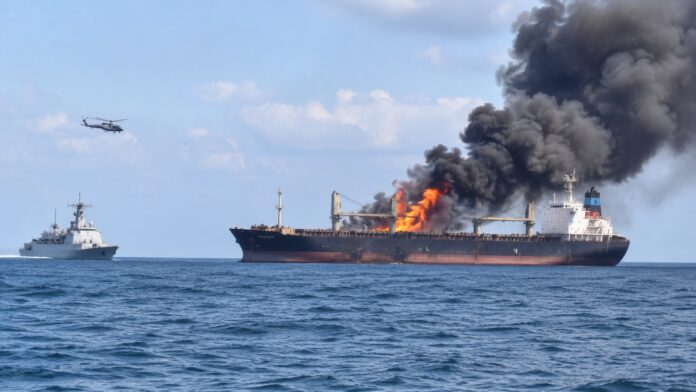
Story Highlights
- A Russian cargo vessel, the Sparta II, was attacked by drones in the Gulf of Finland.
- Finnish authorities suspect Ukraine is behind the attack, emphasizing its right to self-defense.
- The incident raises concerns about the spillover effects of the ongoing conflict between Ukraine and Russia.
- Kaliningrad Governor reported no immediate threat to supplies despite the attack.
What Happened
The Gulf of Finland witnessed a significant escalation in tensions over the weekend when a Russian cargo vessel, the Sparta II, was struck by a drone attack. This incident occurred on Saturday morning, prompting immediate responses from both Russian and Finnish authorities. The ship, which was en route to Kaliningrad, a Russian exclave bordered by Poland and Lithuania, caught fire following the drone strike and subsequently drifted into Finnish waters. The Finnish Defence Forces have indicated that Ukraine is likely responsible for the attack, although Kyiv has yet to officially comment on the incident. Finnish Prime Minister Petteri Orpo remarked on the situation, stating, ‘War is spilling over into our immediate vicinity,’ and underscored Ukraine’s right to defend itself against aggression.
In the aftermath of the attack, Finnish authorities imposed temporary aviation and maritime restrictions in the area to ensure safety and security. The situation has drawn attention not only from local authorities but also from international observers concerned about the implications of such military actions in the Baltic region.
- The attack occurred on Saturday morning, with the ship located approximately 50km west of Suursaari.
- Two drones were reportedly used in the attack, according to preliminary information from Kaliningrad Governor Alexei Besprozvannykh.
- The Sparta II has been sanctioned by the US since 2022 and by Ukraine earlier this year.
- Finnish authorities imposed temporary aviation and maritime restrictions in the area following the incident.
Why It Matters
The drone attack on the Sparta II is a stark reminder of the ongoing conflict between Ukraine and Russia, which has escalated since Russia’s full-scale invasion of Ukraine in 2022. This incident not only highlights the increasing boldness of Ukrainian forces in targeting Russian assets beyond the front lines but also raises alarm about the potential for the conflict to spill over into neighboring regions. The Baltic Sea has become a critical theater in this war, with both sides engaging in military maneuvers that could have far-reaching implications for regional stability. The Finnish Prime Minister’s comments reflect a growing concern among Baltic nations regarding their security in light of the ongoing hostilities.
Moreover, the attack signifies a potential shift in Ukraine’s military strategy, focusing on long-range strikes against Russian assets. This development could lead to heightened tensions and a reevaluation of defense strategies among neighboring countries.
- The attack signifies a potential shift in Ukraine’s military strategy, focusing on long-range strikes against Russian assets.
- It raises questions about the security of maritime routes in the Baltic Sea.
- Neighboring countries may feel compelled to bolster their defenses in response to the escalating conflict.
- The incident could lead to increased military presence from NATO in the region.
Political and Public Context
The drone strike on the Sparta II is not an isolated incident but part of a broader pattern of military engagement in the Baltic region. The Baltic Sea has seen increased military activity since the onset of the Ukraine conflict, with both NATO and Russian forces conducting exercises and patrols. Earlier this month, a Ukrainian drone strike successfully targeted a Russian warship in the same Gulf of Finland, indicating a trend of Ukraine extending its operational reach. The geopolitical landscape in the region is further complicated by the presence of Kaliningrad, a heavily militarized Russian exclave that serves as a strategic point for Russian naval operations. The ongoing conflict has prompted Finland and Sweden to reconsider their security policies, with both countries seeking closer ties with NATO.
As tensions rise, public sentiment in Finland and neighboring countries is increasingly focused on national security and defense readiness. The potential for further military actions raises concerns about the stability of the region and the safety of maritime routes.
- Earlier drone strikes by Ukraine have targeted Russian military assets, indicating a shift in tactics.
- Kaliningrad’s strategic importance has made it a focal point for military operations.
- Finland and Sweden have been increasing their military cooperation with NATO in response to regional threats.
- The Baltic Sea has become a critical area for monitoring military movements from both NATO and Russia.
Russian cargo ship bursts into flames after suspected Ukrainian drone strike in Baltic Sea https://t.co/II8qbvlgq2 pic.twitter.com/S1vH4xwGyn
— New York Post (@nypost) November 21, 2026
What Happens Next
The implications of the drone attack on the Sparta II are still unfolding, and several key questions remain regarding the future of the conflict and regional security. As investigations continue, Finnish authorities are likely to enhance their surveillance and defense measures in the Gulf of Finland. The incident may also prompt NATO to reassess its military posture in the region, potentially leading to increased naval deployments or joint exercises with Baltic states. Furthermore, the attack could influence diplomatic discussions surrounding the conflict, as Western nations weigh their responses to Ukraine’s military actions. The situation remains fluid, and the potential for further escalation is a significant concern for all parties involved.
In the coming weeks, the focus will be on how both Ukraine and Russia respond to this incident, as well as the actions taken by NATO and neighboring countries to ensure regional stability.
- Finnish authorities will continue to investigate the incident and assess security measures in the Gulf of Finland.
- NATO may increase its military presence in the Baltic Sea in response to the attack.
- Future Ukrainian military operations may focus on extending their reach against Russian assets.
- Diplomatic discussions among Western nations may intensify regarding support for Ukraine.