

Story Highlights
- The National Capital Planning Commission granted preliminary approval to President Donald Trump’s proposed monumental arch.
- The 250-foot structure would stand at Memorial Circle near Arlington National Cemetery and the Arlington Memorial Bridge.
- Commissioners delayed deciding whether Washington’s Height of Buildings Act restricts the federally sponsored project.
- The proposal could return for final consideration at the commission’s September meeting.
What Happened
President Donald Trump’s proposed 250-foot monumental arch moved significantly closer to construction after the National Capital Planning Commission approved its preliminary site and building plans.
The commission voted 8-1 in favor of advancing the project, with three members abstaining, following extensive public testimony and a review of plans submitted by the Department of the Interior.
The arch would be constructed in Memorial Circle on Columbia Island, at the Virginia end of the Arlington Memorial Bridge and near the ceremonial entrance to Arlington National Cemetery.
Trump has presented the monument as a celebration of America’s achievements and the country’s 250th anniversary of independence.
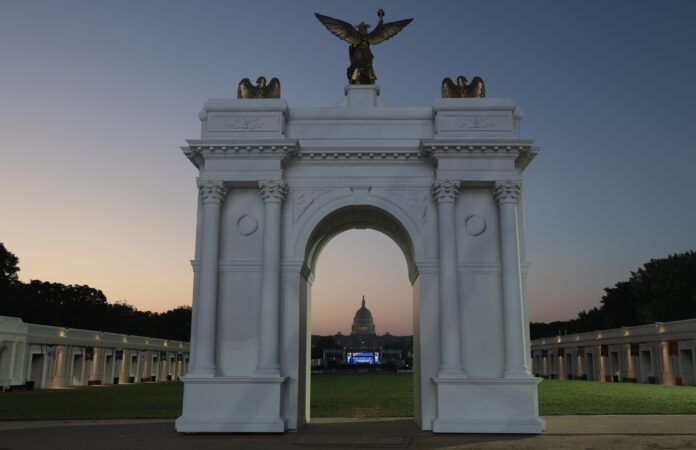
- The structure would rise approximately 250 feet from its base to the top of its statuary.
- It would be taller than France’s Arc de Triomphe.
- It would remain substantially shorter than the Washington Monument.
- The design includes an observation area and patriotic inscriptions and imagery.
The approval remains preliminary. Commissioners must still examine construction details, traffic effects, pedestrian access, environmental considerations, aviation requirements, and the project’s relationship to surrounding memorials.
The commission also postponed a final decision on whether the Height of Buildings Act applies to the arch.
Interior Department lawyers have argued that the law does not restrict this particular federal project, while commission staff previously recommended changes that would bring the structure into compliance with the height rules.
Why It Matters
The vote represents an important victory for Trump’s effort to create a lasting national monument celebrating American strength, independence, and achievement.
Supporters say the arch would establish a dramatic ceremonial entrance to the nation’s capital and create a landmark comparable to the great monuments found in other world capitals.
They argue that Washington already contains enormous memorials honoring presidents, wars, and national sacrifice, making a monument dedicated to the broader triumphs of the American people a fitting addition.
- The monument would commemorate America’s 250th anniversary.
- It would create a new symbolic gateway between Virginia and Washington.
- The project could attract visitors and strengthen the capital’s ceremonial identity.
- Trump has pushed the federal government to think more ambitiously about civic architecture.
Opponents have questioned the monument’s scale, location, cost, and effect on historic views between the Lincoln Memorial and Arlington National Cemetery.
However, preliminary approval does not end the public review process. The commission can still require design revisions and additional safeguards before granting final authorization.
The approval demonstrates that commissioners believe the proposal is sufficiently developed to continue through the formal planning process despite the opposition.
Political and Public Context
Trump has repeatedly called for federal buildings and monuments to reflect traditional architectural principles, national pride, permanence, and beauty.
His supporters say the proposed arch follows that philosophy by rejecting anonymous modern design in favor of a recognizable classical monument intended to endure for generations.
The administration describes the project as a tribute to the victories and achievements of the American people rather than a memorial to Trump personally.
Public opposition at the commission meeting focused heavily on the arch’s proximity to Arlington National Cemetery and its potential effect on the historic visual connection between the cemetery and the Lincoln Memorial.
- Some veterans and military families expressed concern about construction near the cemetery.
- Preservation groups argued that the monument could alter an intentionally designed historic landscape.
- Supporters said the arch would enhance, rather than diminish, the ceremonial route.
- The final design remains subject to federal planning and preservation reviews.
The project has already received design approval from the U.S. Commission of Fine Arts, providing another important federal endorsement.
Critics have also argued that Congress should authorize a monument of this scale. The administration maintains that existing federal authority permits the Interior Department and relevant commissions to advance the project.
That legal disagreement could ultimately be examined in court if opponents challenge the final approval.
What Happens Next
The National Capital Planning Commission is expected to revisit the project after receiving additional legal, engineering, transportation, and environmental information.
One of the most important unresolved questions is whether the Height of Buildings Act applies to a monumental structure constructed by the federal government on federal land.
The commission may consider final site and building approval as early as September, although it could request further modifications or extend the review process.
- Federal officials must address the height-law dispute.
- Planners must evaluate traffic and pedestrian safety around Memorial Circle.
- Aviation officials may require obstruction lighting because of nearby flight routes.
- The administration must provide more information about construction and funding.
No definitive public cost estimate has yet been released, and the project is expected to use a combination of private contributions and federal resources.
If the remaining approvals are secured, construction could continue for two to three years, with an accelerated schedule intended to complete the monument as quickly as practicable.
For Trump, the preliminary vote is a major step toward creating a bold patriotic landmark that would permanently reshape one of the most prominent entrances to Washington.
