

Story Highlights
- President Trump ordered officials to halt U.S. trade with Spain over its refusal to meet NATO’s new defense spending target.
- The dispute centers on Spain’s resistance to the alliance’s 5% of GDP defense commitment.
- Legal experts say a full trade cutoff against Spain would be difficult because of U.S. law and European Union trade rules.
What Happened
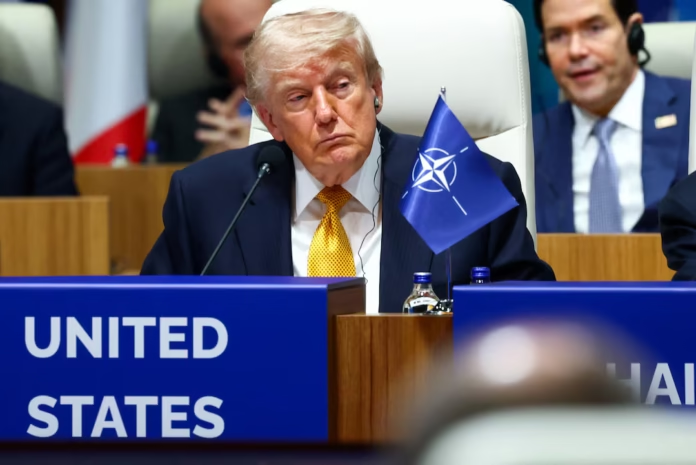
President Donald Trump escalated his dispute with Spain during the NATO summit in Ankara, publicly instructing Treasury Secretary Scott Bessent to cut off U.S. trade with the NATO ally.
Speaking alongside NATO Secretary General Mark Rutte, Trump criticized Spain as a poor alliance partner and said he did not want the United States doing business with the country.
Turning to Bessent, Trump said, “I don’t want to do any trade with them,” and told him to handle it immediately. Bessent responded, “Yes, sir.”
- Trump called Spain a “wasted cause” during the NATO summit.
- He ordered Bessent to halt trade, including visits.
- The dispute follows Spain’s refusal to commit to NATO’s new defense spending goal.
The fight centers on NATO’s new target requiring members to spend 5% of GDP on defense-related commitments. The target includes 3.5% for core military spending by 2035 and 1.5% for broader security needs.
Spanish Prime Minister Pedro Sanchez has resisted the target. Spain has also clashed with Washington over the Iran conflict, refusing to allow U.S. forces to use jointly operated bases in Spain for American strikes against Iran.
This is not the first time Trump has threatened economic action against Spain. He previously warned of tariff action and directed officials to examine a broader trade response, though no formal embargo process has been publicly launched.
Why It Matters
The dispute matters because Trump is using economic pressure to force NATO allies to take defense spending more seriously.
For Trump and his supporters, the message is straightforward: countries that benefit from American military protection must contribute their fair share. Spain’s resistance to the 5% target gives Trump a clear example of what he sees as freeloading inside the alliance.
The president has long argued that NATO countries relied too heavily on U.S. taxpayers while underfunding their own militaries. His threat against Spain is a direct extension of that burden-sharing doctrine.
- Supporters say Trump is forcing NATO allies to pay their fair share.
- Spain argues its relationship with Washington remains strong despite the dispute.
- The legal path to a full trade cutoff remains uncertain.
The challenge is that Spain is part of the European Union, which manages trade policy collectively. Any U.S. attempt to target Spain alone could quickly become a larger dispute with the entire EU.
For American businesses, the stakes are also real. The U.S. and Spain traded roughly $47 billion in goods in 2025, and Spanish investment supports jobs and companies across both economies.
Political and Public Context
Trump’s comments reflect his broader NATO strategy: pressure allies publicly, demand higher spending, and use U.S. leverage to force action.
At the Ankara summit, the president has repeatedly voiced frustration with allies over defense funding, Ukraine, Iran, and Greenland. Spain has become one of the clearest targets because of its refusal to embrace the new defense spending benchmark.
NATO Secretary General Mark Rutte tried to soften the confrontation, noting that Spain had raised defense spending to 2% of GDP last year while acknowledging that more work remains.
Spain’s government responded calmly, describing Trump’s comments as “business as usual” and saying it does not intend to change what it called its excellent relationship with Washington.
For Trump’s base, however, the confrontation may be viewed as another example of the president putting American interests first and refusing to allow allies to benefit from U.S. protection without meeting their obligations.
Economic and Global Context
A full U.S. trade cutoff with Spain would be legally and economically complicated.
Legal experts cited in the article said Trump may not have clear authority to impose a complete embargo without declaring a national emergency under the International Emergency Economic Powers Act. Even then, the threat would need to meet a legal threshold involving national security or the U.S. economy.
Other trade tools also have limits. Section 122 tariffs are capped and temporary, while Section 301 and Section 232 actions require formal investigations before penalties can be imposed.
- The U.S. and Spain traded about $47 billion in goods in 2025.
- Spain is a major exporter of olive oil, auto parts, steel, and chemicals.
- Any action against Spain could trigger a broader European Union response.
Spanish companies have invested heavily in the United States, and U.S. firms also hold major investments in Spain. That makes a total cutoff far more complex than a simple presidential order.
Trump has used trade pressure against Spain before. During his first administration, tariffs on Spanish black olives sharply reduced Spain’s share of the U.S. market.
What Happens Next
The immediate question is whether Trump’s order leads to formal action by Treasury, Commerce, or the U.S. Trade Representative.
So far, Spain and markets appear to be treating the threat cautiously, partly because similar warnings in the past did not immediately produce a full embargo.
- U.S. agencies may review possible sanctions, tariffs, or targeted restrictions.
- Spain may continue resisting the 5% NATO spending target.
- The European Union could respond collectively if Washington targets Spain directly.
For NATO, the Spain dispute is a test of how far Trump is willing to go to enforce burden-sharing demands.
For Trump, the confrontation gives him another opportunity to show voters that he is putting pressure on allies to spend more, carry more of the defense load, and stop relying on American taxpayers to underwrite European security.
