

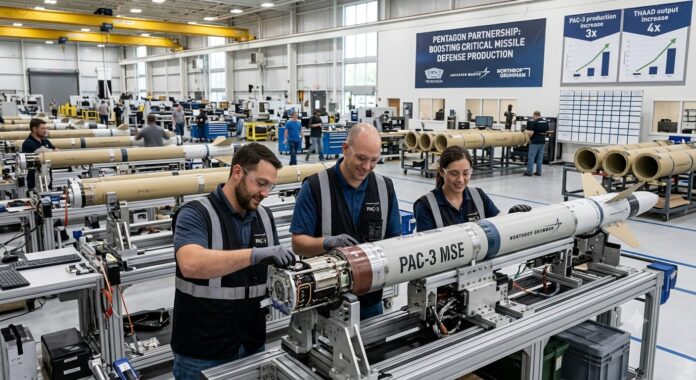
Story Highlights
- The Pentagon signed framework agreements with Northrop Grumman and Lockheed Martin to dramatically increase missile interceptor production
- PAC-3 missile production will triple and THAAD interceptor production will quadruple under the new agreements
- This expansion addresses urgent inventory concerns after significant depletion of existing stockpiles during recent military operations
- The initiative reflects a strategic commitment to maintaining robust defense capabilities and military readiness
What Happened
The Pentagon announced framework agreements with major defense contractors to substantially boost production of critical missile defense systems. The agreements, signed with Northrop Grumman and Lockheed Martin, represent a significant expansion of the nation’s interceptor manufacturing capacity at a time when military readiness remains a top priority. These framework arrangements enable the tripling of Patriot Advanced Capability-3 (PAC-3) production and the quadrupling of Terminal High Altitude Area Defense (THAAD) interceptor output.
The timing of this production expansion reflects the substantial consumption of existing inventory during recent military operations. The military has depleted approximately 80 percent of its THAAD missile inventory and roughly half of its Patriot interceptor supply following extended operations. With the military maintaining around 452 THAAD missiles and approximately 2,200 Patriot missiles in its previous inventory estimates, the production surge represents a critical step toward replenishment and enhanced strategic capabilities.
- Framework agreements signed with Northrop Grumman and Lockheed Martin for missile interceptor component production
- PAC-3 production set to triple and THAAD production set to quadruple under the new arrangements
- Significant inventory depletion occurred during recent military operations, with approximately 80 percent of THAAD missiles and roughly 50 percent of Patriot interceptors expended
- Pentagon officials emphasized the need for robust supply chains and accelerated munitions output
Why It Matters
This production expansion carries substantial implications for American military preparedness and defense strategy. The acceleration of interceptor manufacturing directly addresses legitimate concerns about maintaining adequate defensive capabilities across multiple operational theaters simultaneously. By securing framework agreements with experienced defense contractors, the Pentagon ensures that surge capacity exists to respond rapidly to emerging threats and geopolitical instability.
The expansion demonstrates a proactive approach to military readiness that prioritizes strategic foresight. Rather than allowing inventory depletion to compromise defensive capabilities, the administration moved decisively to establish agreements enabling rapid production scaling. This approach reflects an understanding that effective deterrence depends not merely on current stockpiles but on the demonstrated capacity to rapidly replenish and expand defensive arsenals. The investment in supply chain resilience and manufacturing surge capacity sends a clear message about the commitment to maintaining overwhelming military superiority.
For defense contractors and the broader industrial base, these agreements provide the stability and commitment necessary for long-term capital investment in manufacturing facilities and workforce development. The framework approach allows companies to make confident decisions about facility expansion and technology investment, knowing that demand will support these investments.
- Ensures adequate missile defense inventory levels can be maintained while supporting ongoing operations and addressing emerging threats globally
- Demonstrates commitment to military readiness and the capability to sustain multiple simultaneous operational requirements
- Provides defense contractors with framework certainty to justify capital investments in manufacturing expansion and workforce training
- Strengthens the domestic defense industrial base by securing long-term production agreements with established manufacturers
Political and Public Context
The Pentagon’s production expansion initiative reflects broader strategic priorities regarding military strength and defense posture. The administration has consistently emphasized the importance of maintaining American military dominance and ensuring the armed forces possess the equipment and systems necessary to respond decisively to security challenges. This production agreement aligns with that strategic vision by addressing a specific capability gap identified through recent operational experience.
The framework agreement approach represents sound defense management practice, allowing the military to secure production surge capacity without incurring immediate costs for full-scale manufacturing. This method provides flexibility while ensuring that contractors maintain the capability and readiness to scale production rapidly when needed. Defense officials have emphasized that building the Arsenal of Freedom requires robust and dynamic supply chains at every level of the industrial base, reflecting an understanding that military capability ultimately depends on industrial capacity and supply chain resilience.
The production expansion also occurs within the context of ongoing global tensions and regional instability. The recent depletion of inventory stocks has demonstrated the reality that sustained military operations consume significant quantities of advanced munitions and defense systems. By proactively addressing this challenge through expanded manufacturing agreements, the Pentagon demonstrates strategic foresight and commitment to ensuring that capability gaps do not constrain operational flexibility.
- Framework agreements align with administration priorities regarding military strength and defense industrial capacity
- Production expansion addresses inventory concerns revealed during recent extended military operations
- Supply chain resilience and manufacturing surge capacity represent key components of broader military readiness strategy
- The initiative reflects understanding that sustained military capability depends on robust domestic defense industrial base
Pentagon signs deal to expand missile interceptor systems productionhttps://t.co/K7Wp91rq3T
— The Hill (@thehill) August 4, 2026
What Happens Next
The implementation of these framework agreements will unfold over the coming months and years as Northrop Grumman and Lockheed Martin scale production facilities and increase manufacturing output. Both contractors have indicated their capability to execute significant production increases, suggesting that the ramping process could proceed relatively quickly compared to traditional procurement timelines. The emphasis on accelerating production suggests that initial outputs could begin flowing to military inventories within a reasonable timeframe.
Monitoring of inventory replenishment will likely become an important metric for assessing the effectiveness of the production agreements. As new interceptors come off production lines, inventory levels should begin trending upward, providing additional confidence in the military’s ability to sustain operations across multiple theaters if necessary. The success of this initiative will also inform future defense acquisition strategy regarding the balance between maintaining peacetime inventory levels and establishing surge production capacity.
Future assessments of the program’s effectiveness will consider not only the quantity of interceptors produced but also the cost efficiency achieved and the technological advancement incorporated into manufactured systems. The framework agreements provide opportunity for contractors to implement manufacturing improvements and cost reductions while scaling production, potentially improving overall defense value.
- Production scaling by Northrop Grumman and Lockheed Martin to begin immediately with inventory replenishment expected within months
- Inventory level monitoring will serve as key metric for program effectiveness and military readiness assessment
- Framework agreement success may influence future defense acquisition strategy regarding surge capacity and peacetime inventory levels
- Potential for incorporation of manufacturing improvements and cost efficiencies as production scaling proceeds
