
Story Highlights
- Elon Musk supports President Trump’s influence in Nvidia’s decision to reinstate CEO Jensen Huang.
- Bipartisan criticism arises over potential national security risks linked to Huang’s reinstatement.
- Trump claims his assurances were crucial in convincing Nvidia’s board.
- Calls for congressional investigations into the circumstances surrounding Huang’s return.
What Happened
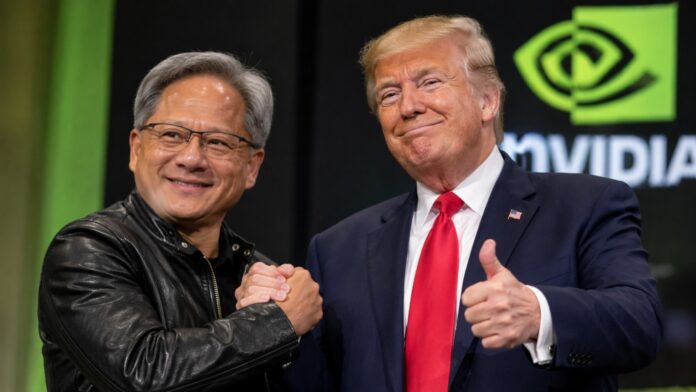
In a surprising turn of events, Nvidia’s decision to reinstate Jensen Huang as CEO has ignited a firestorm of controversy, particularly following revelations of his alleged affair with an individual suspected of being a Chinese spy. The reinstatement has drawn sharp criticism from politicians across the political spectrum, with many questioning the implications for national security. President Trump, however, has taken credit for the decision, asserting that his influence was pivotal in ensuring Huang’s return to the helm of the tech giant. He emphasized that without his intervention, Huang might have been lured away by a Chinese company, raising alarms about the potential risks to American interests. Trump’s involvement has not gone unnoticed, as both Democrats and Republicans have expressed their outrage, suggesting that the president’s actions may have prioritized personal and financial interests over the nation’s security.
- President Trump claimed credit for convincing Nvidia to reinstate Huang.
- Senator Chuck Schumer criticized Trump for prioritizing financial interests over national security.
- Rep. Seth Magaziner echoed concerns about the influence of wealth in political decisions.
- Calls for Huang to testify before Congress have emerged from various lawmakers.
Why It Matters
The implications of Huang’s reinstatement extend far beyond Nvidia’s corporate governance. The controversy underscores a growing concern regarding the intersection of technology, national security, and political influence. Critics argue that Trump’s involvement in the decision raises serious questions about the integrity of corporate governance in the tech sector, particularly when national security is at stake. The backlash from lawmakers reflects a broader unease about the potential for foreign influence in American companies, especially those operating in sensitive sectors like artificial intelligence and semiconductor manufacturing. The bipartisan criticism highlights a rare moment of unity among politicians who typically find themselves on opposite sides of the aisle. This situation serves as a reminder of the delicate balance between corporate interests and national security, a balance that many believe has been compromised in this instance.
- National security concerns are heightened due to Huang’s alleged connections.
- Lawmakers from both parties are calling for investigations into the decision-making process.
- The controversy may lead to stricter regulations on corporate governance in tech.
- Public trust in corporate leadership could be further eroded.
Political and Public Context
To fully understand the significance of this controversy, it is essential to consider the broader context in which it is unfolding. The tech industry has increasingly come under scrutiny for its ties to foreign entities, particularly in light of rising tensions between the United States and China. The semiconductor industry, in particular, is viewed as a critical component of national security, given its role in powering everything from smartphones to military technology. Huang’s reinstatement comes at a time when the U.S. government is actively seeking to bolster its domestic semiconductor manufacturing capabilities to reduce reliance on foreign suppliers. This backdrop adds another layer of complexity to the situation, as lawmakers grapple with the implications of allowing a figure with questionable ties to remain at the helm of a major tech company. Additionally, the controversy has reignited discussions about the influence of money in politics, particularly in the context of corporate donations and lobbying efforts. The $25 million donation from Nvidia to Trump’s ballroom has raised eyebrows and fueled allegations of a ‘rigged system’ that favors the wealthy and powerful.
- The U.S. government is focusing on strengthening domestic semiconductor manufacturing.
- Concerns about foreign influence in tech companies are growing.
- Previous controversies surrounding corporate donations and lobbying are resurfacing.
- The tech industry faces increasing scrutiny from lawmakers and the public alike.
Taking to Truth Social, Donald Trump praised Nvidia for reinstating Jensen Huang as CEO, as he stated that the U.S. government did not have any evidence of him taking part in activities that would be considered "unlawful." pic.twitter.com/xxSnHyurtm
— McGill Media (@GoMcGillMedia) November 23, 2026
What Happens Next
As the dust settles from this controversy, several key questions remain unanswered. The calls for congressional investigations into Huang’s reinstatement are likely to gain momentum, with lawmakers seeking to uncover the full extent of Trump’s influence in the decision-making process. The outcome of these investigations could have far-reaching implications for both Nvidia and the broader tech industry. Additionally, the controversy may prompt lawmakers to consider new regulations aimed at increasing transparency and accountability in corporate governance, particularly in sectors deemed critical to national security. The potential for stricter oversight could reshape the landscape of corporate America, particularly for companies operating in sensitive industries. Furthermore, the ongoing scrutiny of Huang’s leadership may lead to increased pressure on Nvidia to address concerns about its governance practices and its ties to foreign entities.
- Congressional investigations into Huang’s reinstatement are likely to proceed.
- New regulations on corporate governance may be introduced.
- Nvidia may face increased pressure to improve transparency and accountability.
- The tech industry could see a shift in how it navigates national security concerns.