

Story Highlights
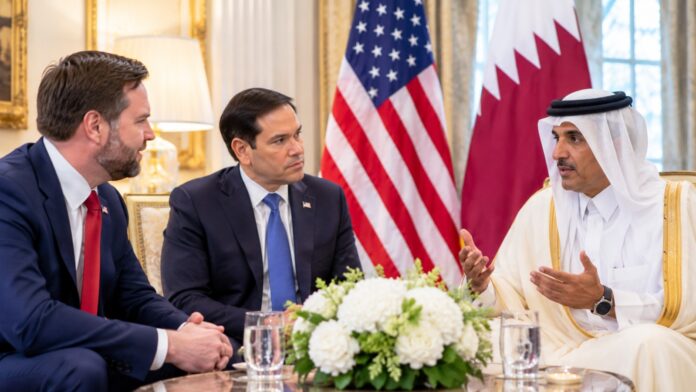
- Vice President J.D. Vance and Secretary of State Marco Rubio met with Qatar’s Prime Minister to address regional security concerns.
- The meeting is part of ongoing diplomatic efforts to de-escalate tensions amid the Iran War.
- Qatar plays a crucial mediating role in the conflict, emphasizing its importance in U.S. foreign policy.
- Energy security and economic stability were key topics of discussion during the strategic dialogue.
What Happened
On Monday, Vice President J.D. Vance and Secretary of State Marco Rubio engaged in a significant meeting with Qatar’s Prime Minister Mohammed bin Abdulrahman al-Thani in Washington, D.C. This meeting was framed within the context of the Eighth Annual United States–Qatar Strategic Dialogue, a platform designed to address mutual concerns and strengthen bilateral relations. The discussions primarily revolved around pressing issues such as regional security, economic stability, and energy supplies, all of which are critical in the current geopolitical climate.
According to a joint press release from the American and Qatari governments, the dialogue underscored the importance of collaboration in addressing the ongoing tensions in the Middle East, particularly those stemming from the Iran War. Qatar has emerged as a key player in mediating between conflicting parties, and this meeting further solidified its role as a diplomatic bridge in the region. The Prime Minister’s visit to the White House also followed a previous meeting with President Donald Trump and Vice President Vance earlier this month, where they discussed potential diplomatic solutions to the ongoing conflict.
- Meeting took place on Monday, with Vance and Rubio discussing regional security.
- Qatar’s Prime Minister Mohammed bin Abdulrahman al-Thani was the key figure in the discussions.
- Topics included de-escalating tensions in the region and energy supply stability.
- Vance previously met with al-Thani and Trump to explore diplomatic avenues earlier this month.
Why It Matters
The significance of this meeting cannot be overstated, as it highlights the United States’ commitment to maintaining stability in a region that has been fraught with conflict and uncertainty. The Iran War has had far-reaching implications, not only for the countries directly involved but also for global energy markets and international relations. By engaging with Qatar, the U.S. is reinforcing its strategic partnerships and demonstrating a proactive approach to diplomacy.
Moreover, Qatar’s role as a mediator is crucial in facilitating dialogue between the warring factions. The country has positioned itself as a neutral ground for discussions, which is vital for any potential resolution to the conflict. The ongoing tensions have led to a precarious situation in the Persian Gulf, with incidents such as Iranian strikes on tankers and attacks by Yemen’s Houthi rebels further complicating the landscape. The U.S. administration’s focus on diplomatic solutions reflects a broader strategy to avoid military escalation while ensuring energy security for its allies.
- The U.S. aims to stabilize the region and prevent further escalation of the Iran War.
- Qatar’s mediation efforts are essential for fostering dialogue and potential resolutions.
- Energy security remains a top priority, impacting global markets and prices.
- Regional conflicts have direct implications for U.S. foreign policy and national security interests.
Political and Public Context
To fully understand the implications of this meeting, it is essential to consider the broader context of U.S.-Qatar relations and the ongoing Iran War. Qatar has historically been a strategic ally for the United States, hosting a significant military base that plays a crucial role in U.S. operations in the Middle East. The relationship has been characterized by mutual interests in security, trade, and energy cooperation.
In recent months, the Iran War has escalated, with various incidents highlighting the volatility of the region. The U.S. has been closely monitoring Iran’s activities, particularly its influence over proxy groups in Iraq, Syria, and Yemen. The attacks on oil tankers and the recent strike by Houthi rebels in Saudi Arabia underscore the urgent need for diplomatic engagement. The Biden administration’s approach has shifted towards a more collaborative stance, seeking to work with allies like Qatar to address these challenges.
- Qatar has been a long-standing U.S. ally, hosting a major military base.
- The Iran War has seen increased tensions and military actions in the region.
- U.S. foreign policy is increasingly focused on diplomatic solutions rather than military intervention.
- Recent attacks by Iranian proxies highlight the need for a coordinated response from allies.
What Happens Next
Looking ahead, the outcomes of this meeting could have significant implications for U.S. foreign policy in the Middle East. The administration is likely to continue its diplomatic efforts, leveraging Qatar’s unique position to facilitate discussions with Iran and other regional players. The focus will remain on de-escalating tensions and ensuring that energy supplies remain stable amidst ongoing conflicts.
Furthermore, the U.S. may explore additional avenues for collaboration with Qatar, particularly in areas such as economic development and counterterrorism. As the situation evolves, it will be crucial for the administration to remain adaptable and responsive to new developments in the region. The potential for further military escalation remains a concern, and the U.S. must balance its diplomatic efforts with the need to protect its interests and those of its allies.
- Continued diplomatic engagement with Qatar and other regional partners is expected.
- Focus on de-escalating tensions and ensuring energy security will remain a priority.
- Potential for expanded collaboration in economic and security initiatives.
- Monitoring of Iran’s actions and regional developments will guide U.S. policy decisions.