

Story Highlights
- Smith testified that Trump was the most culpable individual in the January 6 conspiracy and that prosecutors had proof beyond a reasonable doubt in both cases against him
- The DOJ blocked Smith from discussing the classified documents case during the deposition, citing a court order from Judge Aileen Cannon
- The 255-page transcript was released on New Year’s Eve, which critics described as an attempt to minimize its political impact
What Happened
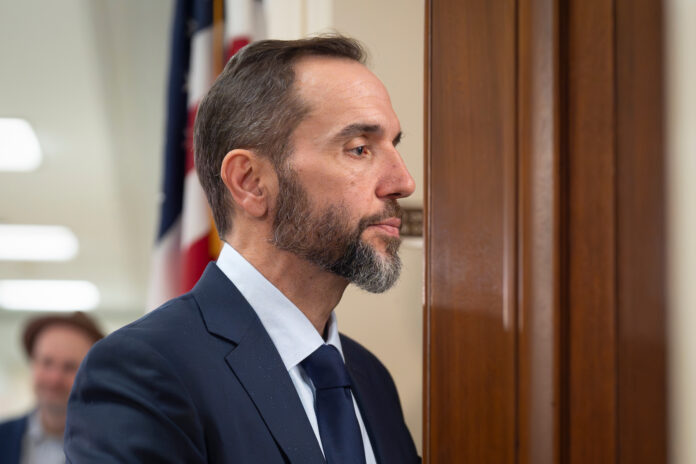
Former Special Counsel Jack Smith appeared before the House Judiciary Committee in a closed-door session on December 17, 2025. House Judiciary Committee Chair Jim Jordan released the full 255-page transcript and accompanying video on December 31, 2025 — a date that critics noted was chosen deliberately to limit public attention. Smith had sought to testify publicly, but Republicans on the committee denied that request.
The deposition covered the two criminal cases Smith brought against President Trump: the January 6 election interference case in the District of Columbia and the classified documents case in the Southern District of Florida. In his testimony, Smith offered a full and unambiguous defense of his prosecutorial decisions. He told lawmakers his team had proof beyond a reasonable doubt in both cases and firmly denied that his investigations were influenced by then-President Joe Biden, then-Attorney General Merrick Garland, or any other political figure.
Smith testified directly and repeatedly that Trump was by a significant margin the most culpable individual in the January 6 conspiracy — a conclusion he said was supported by evidence gathered independently and without political direction. He stated he would have brought the same cases regardless of the defendant’s party affiliation. On the question of Jan. 6 itself, Smith was direct: Trump bore primary responsibility for that day.
Smith’s ability to discuss the classified documents case was severely limited during the hearing. Just over an hour before his testimony began, the DOJ sent a letter to his attorneys citing a January 21, 2025 court order from Judge Aileen Cannon that barred him from discussing non-public material from Volume Two of his final report — the portion addressing the documents case. As a result, Smith was unable to answer most questions on that subject, limiting the hearing’s scope significantly.
Ranking Member Jamie Raskin responded to the transcript’s release by stating that Smith’s testimony made clear that the prosecutions were not failures — they were blocked. He pointed to the Supreme Court’s presidential immunity decision, Trump’s reelection, and Cannon’s injunction as the three mechanisms that prevented a full adjudication of the evidence Smith’s team assembled.
Why It Matters
The release of Smith’s deposition matters because it pierced the silence that has surrounded the Trump prosecutions since they collapsed without verdicts. For more than a year, the legal cases against Trump had been discussed through political framing — with Republicans characterizing them as weaponized persecution and Democrats calling them legitimate prosecutions abandoned due to political pressure. Smith’s sworn, detailed testimony under oath provides a primary source that partially displaces that competing narrative.
Smith’s assertion that sufficient evidence existed to prove Trump guilty beyond a reasonable doubt — a specific legal threshold — carries meaningful weight. He is a former federal prosecutor with decades of experience who led two of the most significant federal investigations in modern American history. His willingness to state that conclusion on the record, under oath, before a hostile Republican committee distinguishes his account from mere partisan commentary.
The episode also highlights the structural tension created by the Supreme Court’s 2024 immunity ruling, which held that a president cannot be prosecuted for official acts. Smith testified within those constraints but made clear he believed the evidence he developed was legally sufficient. The ruling, more than any prosecutorial decision, is what ultimately closed the door on accountability in both cases.
For voters assessing Trump’s second term, the deposition adds a detailed evidentiary record to a story most followed through competing partisan claims. Whether that record changes minds or simply reinforces existing views remains to be seen, but its existence as a permanent public document has significance independent of its immediate political impact.
Economic and Global Context
The release of the Smith deposition does not carry direct economic implications, but it contributes to the broader climate of institutional uncertainty and partisan conflict that has characterized the early period of Trump’s second term. Business confidence surveys and investment decisions are sensitive to political stability, and the ongoing litigation, disclosure battles, and constitutional disputes surrounding the Trump administration have created an environment that market participants continue to monitor.
Internationally, the deposition attracted attention in countries where the rule of law and democratic accountability are live political issues. Legal scholars in the United Kingdom, Canada, and Germany have pointed to the Smith case as a test of whether American democratic institutions can constrain a president who faces credible criminal allegations. The collapse of both prosecutions without verdicts has reinforced arguments in some quarters that presidential immunity in the United States now approximates impunity.
For the American legal community, the 255-page transcript represents a significant historical document. It captures one of the few detailed first-person accounts of what it was like to lead a federal prosecution against a sitting president’s predecessor who then returned to power, and the extraordinary legal and institutional barriers that prosecution encountered.
Implications
The deposition’s political afterlife is likely to be substantial. Democrats will cite Smith’s testimony in the November 2026 midterm campaigns as evidence that Trump escaped accountability not because he was innocent but because the legal system lacked the tools to reach him. Republicans will argue that the prosecutions were political in origin and that Smith’s inability to answer questions about the documents case undermines the credibility of his broader claims.
For the House Judiciary Committee, the deposition does not resolve the underlying questions that Republicans sought to examine — namely whether the investigations constituted an improper weaponization of the DOJ against political opponents. Smith’s categorical denials of political influence under oath are on the record, but the Republican members who sought the testimony have already signaled they remain unconvinced.
The long-term implications for the office of special counsel may be the most consequential. The combination of Cannon’s injunction, the immunity ruling, and the constraints imposed by the DOJ on Smith’s testimony demonstrated how many institutional mechanisms can limit such investigations. Future special counsels will inherit a precedent landscape significantly more constrained than the one Smith operated in.
Sources
