

Story Highlights
- At least 44 strikes on 45 vessels have been conducted since September 2025, killing more than 151 people
- The campaign led directly to the January 3, 2026 capture of Venezuelan President Nicolás Maduro
- Intelligence partners including the United Kingdom and the Netherlands have curtailed cooperation over concerns about how shared information is used
What Happened
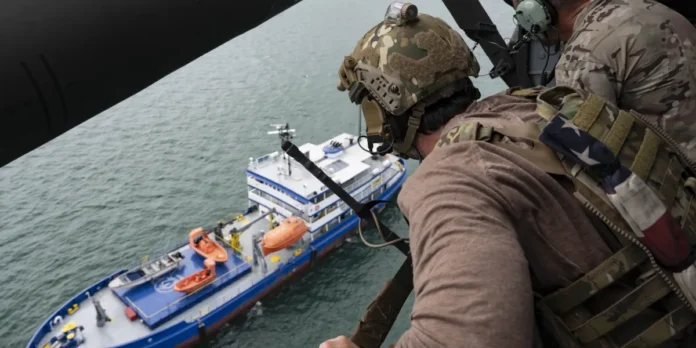
What began as a single airstrike in international waters near Venezuela on September 2, 2025 has grown into a sustained military campaign that President Donald Trump has described as essential to protecting American lives from drug traffickers. That first strike killed all 11 people aboard a vessel the administration identified as carrying members of Tren de Aragua, a Venezuelan gang that the federal government designated a foreign terrorist organization in early 2025.
The administration framed the strikes under the authority of that terrorist designation, arguing that lethal military force was appropriate against designated terrorist organizations regardless of their primary criminal activity. The Pentagon declared the U.S. was engaged in a non-international armed conflict with drug cartels, a legal characterization that drew immediate challenge from legal scholars who argued drug trafficking could not satisfy the threshold for armed conflict under international law.
The strikes expanded rapidly. By late December 2025, the military had conducted more than 35 known strikes in the Caribbean Sea and eastern Pacific, killing at least 115 people. The campaign culminated on January 3, 2026 when U.S. forces conducted a large-scale strike on Caracas, the Venezuelan capital, captured Venezuelan President Nicolás Maduro and his wife Cilia Flores, and flew them to New York to face drug trafficking charges filed in the Southern District of New York. Attorney General Pam Bondi stated that Maduro had led a corrupt government that protected illegal narcotics networks for decades.
Strikes continued after Maduro’s capture. On January 23, 2026, the first post-capture strike killed two people aboard a trafficking vessel in the eastern Pacific. As of late February 2026, the operation’s total toll reached at least 151 dead across 44 strikes involving 45 separate vessels. The administration has released video footage of numerous strikes, a communications strategy Trump began with the first operation and continued throughout.
Why It Matters
The boat-strike campaign represents the most expansive domestic use of military force in the anti-drug context in American history, and it has set precedents that will long outlast the Trump administration. Prior to September 2025, U.S. military forces operating in the anti-drug mission were authorized to interdict and seize vessels but not to conduct lethal strikes on commercial watercraft. The Trump administration’s recharacterization of traffickers as unlawful combatants changed that posture fundamentally.
Legally, the campaign has never received explicit congressional authorization. The Senate twice rejected resolutions that would have limited Trump’s authority to continue the strikes, leaving the president with de facto approval to continue operations without a formal war authorization. Critics argue this sets a dangerous precedent for future administrations to conduct lethal operations based solely on executive authority and terrorist designations.
For American families affected by drug addiction and overdose deaths, the administration has presented the campaign as a lifesaving intervention. Trump stated that each boat destroyed saves 25,000 American lives — a claim independent fact-checkers found to be without evidentiary support given the volume of drugs actually seized. The CDC reported more than 73,000 drug overdose deaths in the United States from May 2024 to April 2025, and analysts noted the math in Trump’s claims was implausible.
The capture of Maduro specifically resolved years of bipartisan frustration over the Venezuelan government’s alleged role in narcotics trafficking. Federal prosecutors had charged Maduro with leading a narco-terrorism conspiracy, and his transfer to New York for trial marked an extraordinary moment in the history of U.S. foreign policy and law enforcement.
Economic and Global Context
The anti-trafficking campaign has had measurable effects on Caribbean drug trafficking patterns. According to analysis from InSight Crime, traffickers largely stopped using go-fast boats to move cocaine along the Venezuelan coast to Caribbean islands shortly after the strikes began. The route had long served as a primary transit corridor for Colombian cocaine heading to Europe and North America. The disruption represents a genuine operational success for the administration’s stated objective.
However, analysts caution that interdiction-based approaches historically result in the balloon effect, where suppressing one route shifts traffic to others. Early indicators suggest traffickers have adapted their methods, moving to semi-submersibles and other harder-to-detect transport. The eastern Pacific strikes suggest the campaign has expanded geographically to chase those adaptations.
The creation in 2026 of the U.S.-led Shield of the Americas initiative, aimed at coordinating multinational military action against drug networks, has introduced new complications. The coalition excludes Colombia, Mexico, and Brazil — the three largest countries in the region — raising questions about whether the initiative fragments rather than strengthens the regional anti-drug architecture.
Intelligence-sharing relationships have frayed. Senior Dutch intelligence officials told a Dutch newspaper in October 2025 that the Netherlands would withhold certain information from the U.S. over concerns about how it was used. The United Kingdom similarly curtailed intelligence sharing related to suspected drug vessels, according to CNN reporting.
Implications
With the midterm elections approaching in November 2026, the Venezuela campaign will be a prominent feature of the political debate. Republicans will point to Maduro’s capture and the operational success against trafficking networks as evidence of a strong and decisive foreign policy. Democrats will emphasize the legal questions, the civilian deaths, the intelligence fallout, and the absence of congressional authorization.
For Venezuela itself, the political situation following Maduro’s capture remains deeply unstable. The administration announced it intended to oversee a transition of power, but establishing a functioning post-Maduro government in a country hollowed out by years of authoritarian rule poses enormous practical and legal challenges that the U.S. has not fully addressed.
The precedent established by the boat strikes and the Maduro capture will be studied by future administrations and foreign governments. Countries with extradition concerns or political leaders who have crossed Washington now have concrete evidence that the Trump administration is willing to use military force to bring individuals to U.S. courts. The implications for international norms and sovereign immunity are significant and unresolved.
Sources
“United States military strikes on alleged drug traffickers”
