

Story Highlights
- Dockworkers in 22 countries and across 111 ports on five continents plan a coordinated strike to halt arms shipments
- The labor action could freeze over $2 billion in freight and disrupt up to 40 percent of Mediterranean marine cargo
- More than 25 international dockworkers’ unions have joined the action, with groups in Oakland and San Francisco participating from the United States
- Workers are demanding an end to port use for military transport and calling for recognition of Palestinian statehood
What Happened
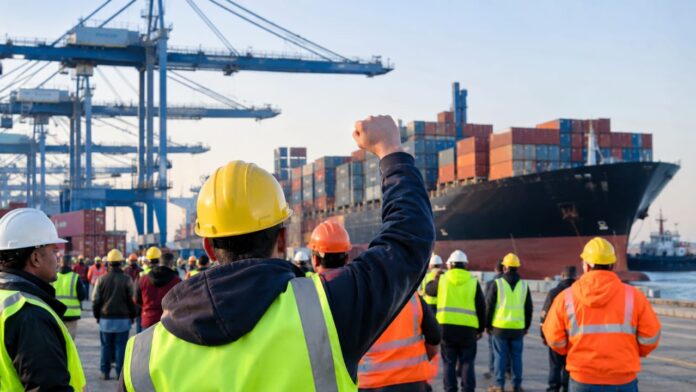
In what organizers describe as an unprecedented global labor action, dockworkers across multiple continents initiated a coordinated strike designed to prevent the movement of military cargo through international ports. The action, which drew participation from workers at 111 ports spanning 22 countries and regions across five continents, represents one of the largest coordinated labor efforts focused on foreign policy objectives. The strike was organized by an international coalition of dockworkers’ unions, with participation from more than 25 separate union organizations.
The strike originated in the Mediterranean region, where unions in Italy, France, Greece, Spain’s Basque Country, Turkey, and Morocco first called for the action in May. Subsequent months saw expansion of support, with port workers in Germany, Ireland, Portugal, Denmark, Sweden, and Australia joining the effort. The Palestinian General Federation of Trade Unions provided backing for the initiative. Although no major United States-based unions formally signed on to the action, organized groups of dockworkers in Oakland and San Francisco made plans to participate independently.
- Strike involves 111 ports across 22 countries and five continents
- Over 25 dockworkers’ unions formally participated in the coordinated action
- Mediterranean ports expected to experience disruptions of up to 40 percent of marine cargo volume
- Strike planning began in May, with Friday designated as the coordinated action date
Why It Matters
Dockworkers occupy a uniquely powerful position within global commerce and international relations. Approximately 80 percent of all international trade by volume moves through maritime shipping, making port workers essential gatekeepers of global economic flow. More significantly, military operations depend heavily on seaborne cargo delivery, as weapons, ammunition, and military equipment are frequently transported by ship rather than air. Organizers estimated that even a single day of shipping delays resulting from the strike could generate approximately $43 million in lost profit across the shipping industry.
The action demonstrates the capacity of organized labor to influence foreign policy outcomes and international military operations. Recent years have seen Europe substantially increase weapons production and imports, with the continent now importing approximately one-third of the world’s total arms supply. Port workers represent one of the few labor groups with direct leverage over the movement of such materiel. Analysts note that heightened awareness among workers regarding arms shipments and their intended destinations has generated more frequent protests and blockades, reflecting a broader desire within the labor movement to restrict military cargo transport.
- Over $2 billion in freight potentially immobilized by the coordinated action
- Mediterranean shipping disruptions could reach 40 percent of normal cargo volume
- Shipping delays estimated to cost approximately $43 million per day in lost industry profits
- Port workers control essential access to 80 percent of global international trade by volume
Political and Public Context
The strike reflects broader geopolitical tensions and labor activism surrounding military aid and international conflict. Participating unions issued formal demands that included an immediate cessation of what they characterized as genocide targeting Palestinian people, recognition of an independent Palestinian state, and an end to United States-Israeli military operations against Iran. The unions’ statement emphasized that ports must not serve as conduits for arms, ammunition, military equipment, or troop movements destined for conflict zones.
Dockworkers have a long historical tradition of labor actions extending beyond wage and benefit disputes to encompass broader political and moral objectives. The current strike follows a pattern of port worker activism aimed at influencing international affairs and humanitarian outcomes. The coordination across multiple nations and continents represents a significant escalation in the scale and scope of such efforts. Analysts and union representatives have documented increased awareness and activism among dockworkers regarding the destinations and purposes of cargo moving through their ports, suggesting a shift in labor organizing toward geopolitical concerns alongside traditional economic demands.
- Strike demands include recognition of Palestinian statehood and end to US-Israeli military operations against Iran
- Unions formally prohibited use of ports for military cargo transport
- European weapons production and imports have increased substantially in recent years
- Historical precedent of dockworker activism on political and humanitarian issues
Dockworkers strike in Europe and beyond against arms shipments, war deaths https://t.co/iqt45WuCFO
— Reuters (@Reuters) October 30, 2026
What Happens Next
The immediate outcome of the strike depends on sustained participation across the 111 participating ports and adherence to the coordinated action timeline. Shipping companies, manufacturers, and international trade entities face potential significant economic disruptions if the strike achieves its targeted scope. The maritime industry and military supply chains will likely experience measurable delays in cargo movement, with particular impact expected on Mediterranean shipping routes and ports in Europe.
Longer-term implications remain uncertain, including whether the strike action will generate policy changes regarding military cargo transport restrictions at participating ports or influence broader international decisions about arms shipments. The success or failure of this coordinated action may establish precedent for future labor activism on foreign policy issues and could inspire similar efforts at ports worldwide. The response from shipping companies, national governments, and international organizations will shape the viability of comparable future labor actions targeting military supply chains.
- Immediate impact expected on Mediterranean maritime cargo movement and scheduling
- Potential for policy discussions regarding military cargo restrictions at participating ports
- Outcome could influence future coordinated labor actions on geopolitical issues
- Response from shipping industry and governments will determine precedent for similar strikes