

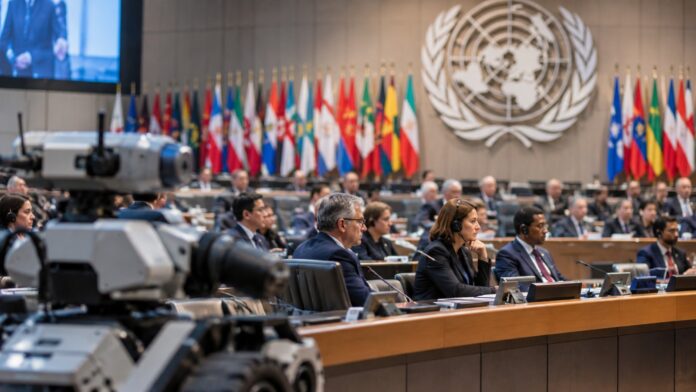
Story Highlights
- The UN conference in Geneva failed to establish binding regulations on autonomous weapons systems.
- Countries have agreed to a two-year extension to propose regulations, which may not be legally binding.
- Humanitarian organizations have called for urgent action to prevent the misuse of military AI technologies.
- The proliferation of autonomous weapons raises significant ethical and security concerns globally.
What Happened
The recent United Nations conference held in Geneva marked a pivotal moment in the ongoing debate surrounding autonomous weapons systems. Despite the pressing need for regulatory frameworks, the conference concluded without establishing legally binding rules to govern the use of these advanced military technologies. Instead, delegates from over 120 countries opted to extend discussions for an additional two years, a decision that many critics view as a failure to address the urgent challenges posed by autonomous weapons. The International Committee of the Red Cross (ICRC), a prominent humanitarian organization, had previously urged that binding regulations be drafted within a year, emphasizing the necessity of restricting the use of autonomous weapons against human targets and confining their deployment to military objectives only.
As the discussions unfolded, it became clear that the reluctance of arms-producing nations to agree on binding regulations was a significant barrier. The conference highlighted the complexities of international diplomacy in the face of rapidly evolving military technologies. The ICRC’s call for immediate action underscored the urgency of the situation, as the potential for misuse of these technologies continues to grow.
- The UN conference took place in Geneva from November 13 to November 16, 2026.
- More than 100 countries advocated for immediate binding regulations.
- Opposition came primarily from arms-producing nations, including the US, Israel, and Russia.
- The ICRC has called for a ban on the use of autonomous weapons against people.
Why It Matters
The inability of the UN to establish binding regulations on autonomous weapons systems is a significant concern for global security and humanitarian efforts. As military technologies continue to evolve, the potential for misuse and unintended consequences increases. The proliferation of autonomous weapons raises ethical questions about accountability and the potential for these systems to operate without human oversight. The implications of this technology are profound, as evidenced by recent reports indicating that a substantial number of civilian casualties in conflict zones can be attributed to drone strikes, including those involving semi-autonomous systems.
In Sudan, for instance, over 80 percent of civilian casualties in the first half of 2026 were linked to drone strikes. This alarming statistic underscores the urgent need for regulatory measures to prevent further loss of innocent lives. The lack of binding regulations could lead to increased civilian casualties in conflict zones, and countries may prioritize military advancements over humanitarian considerations.
- The lack of binding regulations could lead to increased civilian casualties in conflict zones.
- Countries may prioritize military advancements over humanitarian considerations.
- The absence of oversight could empower non-state actors and criminal groups to access autonomous weapons.
- Ethical dilemmas surrounding accountability for autonomous systems remain unresolved.
Political and Public Context
The discussions surrounding autonomous weapons systems are not new; they have been ongoing for several years as technological advancements outpace regulatory frameworks. The Geneva conference was a continuation of these discussions, yet the outcome reflects a broader trend of nations prioritizing their strategic interests over collective humanitarian concerns. The reluctance of arms-producing nations to agree on binding regulations highlights the complexities of international diplomacy in the face of rapidly evolving military technologies.
Furthermore, the use of AI in warfare is already a reality, with countries like Israel employing AI to identify and engage targets in real-time. The ongoing conflict between Ukraine and Russia has also seen the deployment of AI-driven drones, which can autonomously navigate the final stages of their missions. This context illustrates the urgency of establishing regulations that can keep pace with technological advancements.
- The discussions on autonomous weapons have been ongoing for several years.
- Countries like Israel and the US are already utilizing AI in military operations.
- The Ukraine-Russia conflict has highlighted the use of AI-driven drones in warfare.
- Humanitarian organizations continue to advocate for urgent regulatory measures.
[It will soon be too late to regulate use of autonomous weapons, warns Red Cross]
“Warning about putting ‘genie back in the bottle’ comes as UN conference fails to agree on regulation instrument“https://t.co/iTOo0hEiL9
— Norio Nakatsuji (@norionakatsuji) November 22, 2026
What Happens Next
Looking ahead, the two-year extension agreed upon by the UN member states raises several questions about the future of autonomous weapons regulation. While some nations may use this time to develop comprehensive proposals, the lack of urgency demonstrated at the recent conference suggests that meaningful progress may be slow. The potential for autonomous weapons to proliferate unchecked remains a significant concern, as experts warn that these systems could easily fall into the hands of non-state actors and criminal organizations.
The international community must grapple with the ethical implications of allowing machines to make life-and-death decisions without human intervention. As discussions continue, it will be crucial for nations to prioritize humanitarian considerations and work collaboratively to establish a regulatory framework that addresses the complexities of military AI technologies.
- Countries will have two years to propose regulations, but the effectiveness of these proposals remains uncertain.
- There is a risk of increased proliferation of autonomous weapons among non-state actors.
- Ethical discussions surrounding accountability for autonomous systems will need to be addressed.
- The international community must prioritize humanitarian concerns in future negotiations.