

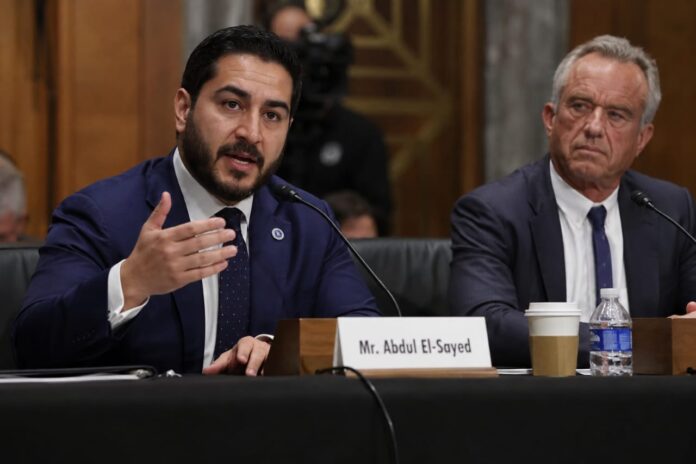
Story Highlights
- Michigan Democratic Senate candidate Abdul El-Sayed and Rep. Haley Stevens engaged in a public dispute Friday, just days before a competitive Senate race against Republican nominee Mike Rogers
- Stevens called on El-Sayed to apologize for comments linking Israel policy to Michigan’s lack of affordable schools and healthcare, and to condemn an outside PAC ad she characterized as antisemitic
- El-Sayed’s campaign denied affiliation with the controversial ad and stated that only El-Sayed and his campaign speak for him
- Despite endorsing El-Sayed after losing the primary, Stevens has largely avoided campaigning with him, and their planned joint appearance Sunday with Rep. Jim Clyburn raised questions about unity
What Happened
Michigan Democratic Senate candidate Abdul El-Sayed and his primary rival Rep. Haley Stevens publicly clashed Friday as tensions within the Democratic Party escalated ahead of a closely watched Senate race. The two candidates were expected to appear together Sunday at a Detroit church alongside South Carolina Rep. Jim Clyburn, marking a rare joint appearance since Stevens won the primary and El-Sayed secured the Democratic nomination.
The conflict centered on multiple contentious issues. Stevens demanded that El-Sayed apologize for campaign statements suggesting that Israel policy explained Michigan’s inability to afford schools, healthcare, and childcare. She also urged him to condemn an outside political action committee advertisement that she viewed as antisemitic, which featured actors in a grocery store discussing the need to redirect funds away from Israeli military aid. El-Sayed’s campaign responded by stating it had no affiliation with the advertisement created by Rebellion PAC and asserted that only El-Sayed and his campaign could speak on his behalf. Additionally, Stevens called on El-Sayed to remove an advertisement featuring far-right podcaster and former Fox News host Tucker Carlson.
- Stevens demanded El-Sayed apologize for linking Israel policy to Michigan’s inability to fund schools and healthcare
- An outside PAC advertisement featuring criticism of U.S. military aid to Israel prompted Stevens to call for El-Sayed to condemn the ad
- El-Sayed’s campaign denied any affiliation with Rebellion PAC and its advertisement
- The two Democrats planned a joint Sunday appearance with Rep. Jim Clyburn at a Detroit church, though uncertainty remained about the event’s tone
Why It Matters
The public rift between El-Sayed and Stevens underscores deep fissures within Michigan’s Democratic Party at a critical moment. The dispute reveals fundamental disagreements about foreign policy, messaging strategy, and the party’s direction. With Republican nominee Mike Rogers actively seeking to attract centrist Democratic voters, party unity becomes strategically essential. The clash also highlights the challenges of bringing together primary opponents with substantially different ideological positions and policy priorities.
The tension carries broader implications for Democratic turnout and coalition-building in a state that has proven decisive in national elections. Stevens’ comment that her household was divided—noting her fiancé intended to vote for Rogers while she supported El-Sayed—illustrated how personal political disagreements were extending into Democratic-leaning families. The dispute over antisemitism allegations and Israel policy also touched on sensitive issues that have divided progressive coalitions nationally, particularly among younger voters and Arab American communities.
- Deep divisions between the moderate and progressive wings of Michigan Democrats threaten unified opposition to Republican nominee Mike Rogers
- Disagreements over Israel policy and foreign aid messaging highlight ideological rifts that extend beyond this single race
- The public conflict may affect Democratic voter enthusiasm and turnout in a competitive Senate race
- The dispute reflects national tensions within the Democratic Party regarding foreign policy and antisemitism concerns
Political and Public Context
Michigan’s Democratic Senate primary had produced notably different candidates. El-Sayed, positioned as a progressive voice, emphasized critiques of American foreign policy and domestic economic priorities. Stevens, representing a more centrist Democratic approach, emphasized party unity and different policy priorities. Although Stevens endorsed El-Sayed after he won the nomination three months prior, the two had largely avoided campaigning together, suggesting underlying tensions remained unresolved.
The Republican strategy to attract centrist Democratic voters added urgency to Democratic concerns about party cohesion. Mike Rogers, the Republican nominee, represented an opportunity for swing voters dissatisfied with either candidate’s approach. The primary battle had highlighted genuine philosophical differences about the party’s future direction, making post-primary unity efforts particularly delicate. Stevens’ public criticism of El-Sayed’s campaign choices, particularly regarding outside advertising and messaging strategy, suggested disagreement extended beyond policy positions to tactical questions about how to effectively campaign in a general election.
- El-Sayed won the Democratic primary despite representing a more progressive approach to foreign policy and domestic priorities
- Stevens, the more moderate candidate, endorsed El-Sayed after losing the primary but maintained distance during the general election campaign
- Republican nominee Mike Rogers actively pursued centrist Democratic voters, creating incentive for Democratic unity
- The primary had revealed stark philosophical differences between candidates about party direction and priorities
Abdul El-Sayed hoped to spend the final days of Michigan's Senate race showcasing Democratic unity. Instead, he's still dealing with the fallout from his bruising primary battle against Haley Stevens over his views on Israel. https://t.co/A3QPL2SgHW
— The Washington Times (@WashTimes) October 31, 2026
What Happens Next
The Sunday appearance at the Detroit church with Rep. Jim Clyburn would test whether El-Sayed and Stevens could present a unified Democratic front. The outcome remained uncertain given Friday’s contentious exchange. Clyburn, a prominent national Democratic figure, would likely attempt to encourage party unity and focus on defeating the Republican nominee. Questions lingered about whether the candidates would address their disagreements directly, attempt to move past them, or continue public disputes.
El-Sayed’s campaign would need to navigate criticism regarding both the outside PAC advertisement and his messaging choices while maintaining support among progressive voters who formed his base. Stevens faced pressure to demonstrate party loyalty while maintaining credibility with voters who valued her concerns about antisemitism and political messaging. Both candidates would need to determine whether their shared opposition to Rogers could overcome their substantial policy differences and personal tensions as the race entered its final phase. The national Democratic Party would also watch closely to assess whether Michigan Democrats could achieve sufficient unity to compete effectively against Rogers in what remained one of the country’s most competitive Senate races.
- Sunday’s joint appearance with Rep. Jim Clyburn will test whether El-Sayed and Stevens can present unified Democratic messaging
- El-Sayed must address criticism regarding outside advertising while maintaining progressive voter support
- Stevens must balance party loyalty with her stated concerns about antisemitism and campaign messaging
- Democratic success in Michigan’s Senate race depends partly on resolving or managing the tensions between these two candidates