

Story Highlights
- Defense Secretary Pete Hegseth visited the Philippines to address Indo-Pacific allies about U.S. dedication to the region
- The administration presented a new defense framework emphasizing peace through strength and practical cooperation with ASEAN partners
- Hegseth emphasized the willingness to work with regional nations on their own terms while pursuing shared security interests
- The Philippines and other allies continue assessing U.S. commitment amid ongoing regional tensions with China
What Happened
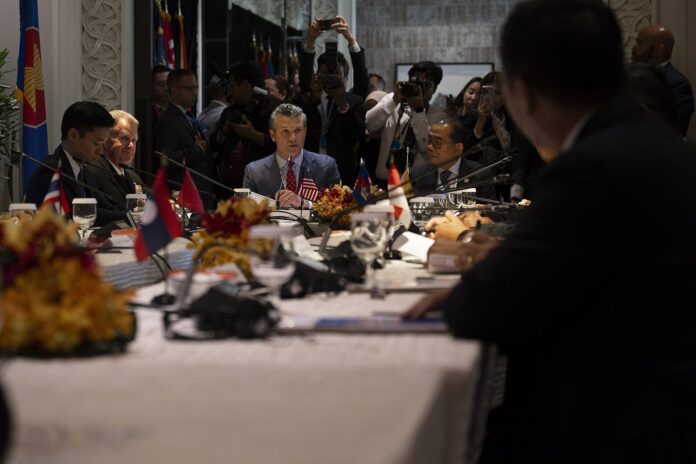
Defense Secretary Pete Hegseth traveled to Cebu, Philippines, this week to address concerns among Southeast Asian partners regarding American commitment to the Asia-Pacific region. During remarks to U.S.-Association of Southeast Asian Nations (ASEAN) defense ministers, Hegseth outlined the administration’s approach to Indo-Pacific security cooperation. He characterized the Trump administration’s strategy as strong, quiet, and clear, emphasizing that Washington stands ready to defend both its own interests and those of allied nations in the region.
The Pentagon chief presented a new defense framework intended to guide cooperation between the United States and ASEAN partners over the coming years. Hegseth stressed that meaningful security relationships require nations to train together, learn from one another, plan cooperatively, and build the confidence and competence necessary to prevent conflict. He acknowledged that perfect agreement among diverse partners is neither necessary nor realistic, but emphasized that alignment on fundamental principles creates opportunities for practical cooperation where shared security interests overlap.
- Defense Secretary Pete Hegseth addressed ASEAN defense ministers in Cebu, Philippines
- The administration introduced a new defense framework to guide U.S.-ASEAN cooperation over several years
- Hegseth characterized the approach as peace through strength with willingness to work with nations based on their individual circumstances
- Singapore will assume the ASEAN Defense Ministers’ Meeting Plus (ADMM-Plus) chairmanship, and the U.S. is prepared to work with the incoming chair
Why It Matters
The reassurance mission carries significant weight as Indo-Pacific allies continue to evaluate American resolve in the region. President Trump’s administration is signaling through this engagement that it maintains serious commitment to regional security partnerships and is prepared to invest resources and diplomatic attention in the Asia-Pacific theater. This messaging proves particularly important given ongoing regional tensions, international military activities, and the strategic importance of freedom of navigation and territorial integrity in critical sea lanes.
For the Philippines specifically, the visit and framework announcement address mounting concerns stemming from maritime and territorial disputes with China in the South China Sea and Luzon Strait. The two nations have increasingly deployed aircraft and vessels to assert their competing territorial claims. Hegseth’s description of the United States as a proud Pacific nation underscores that American security interests remain deeply invested in regional stability. The new framework provides practical mechanisms for enhanced interoperability, improved maritime domain awareness, and strengthened cooperation between U.S. and partner navies.
- Southeast Asian nations continue assessing U.S. commitment during a period of significant regional tensions and strategic competition
- The Philippines faces escalating maritime disputes with China and welcomes clearer security assurances from Washington
- Enhanced naval interoperability and maritime awareness capabilities strengthen regional security and freedom of navigation
- The framework signals that the Trump administration prioritizes sustained engagement and practical partnerships in the Indo-Pacific
Political and Public Context
Regional partners have grown increasingly attentive to American policy direction following shifts in administration priorities and focus. The Asia-Pacific region remains one of the world’s most strategically consequential areas, serving as a vital hub for global commerce, energy supplies, and security interests. China’s assertive posture in maritime disputes and its expanding military capabilities have created heightened anxiety among smaller regional nations concerned about their sovereignty and territorial integrity.
Hegseth’s trip reflects the broader Trump administration strategy of emphasizing strength and deterrence as cornerstones of regional stability. The Pentagon chief’s terminology also proved notable, as he referred to the Department of Defense using the administration’s preferred nomenclature. His approach stands in contrast to approaches that prioritize consensus-building over strength projection, instead emphasizing that credible deterrence rooted in military capability and political will serves the interests of all nations seeking peace and stability.
Observers of Southeast Asian affairs noted that Hegseth’s mere presence at the ADMM-Plus meeting and his reaffirmation of U.S. commitment carry substantial diplomatic weight. Gregory B. Poling, who oversees the Southeast Asia Program and Asia Maritime Transparency Initiative at the Center for Strategic and International Studies, indicated that the messaging was likely to receive positive reception among regional defense ministers, with the absence of concerning rhetoric itself representing an important signal at this particular moment in regional relations.
- The Asia-Pacific region remains strategically vital for global commerce, energy security, and regional stability
- China’s assertive maritime posture and military expansion drive heightened concern among regional partners
- The Trump administration emphasizes strength and deterrence as foundations for regional peace and security
- Regional observers assessed that straightforward reaffirmation of American commitment carries significant diplomatic and strategic value
What Happens Next
The defense framework presented during Hegseth’s visit is expected to provide concrete guidance for U.S.-ASEAN security cooperation over the next several years. Implementation details will likely emerge as the framework develops and as Singapore assumes leadership of the ADMM-Plus structure. The administration has signaled readiness to work closely with Singapore in its new role, suggesting that coordination mechanisms and joint initiatives will deepen in the coming months.
Questions remain regarding the scope and specificity of American security commitments, particularly regarding South China Sea disputes and the U.S. Mutual Defense Treaty with the Philippines. Regional analysts expect that clearer language on these issues may emerge through subsequent diplomatic channels and security dialogues. The framework’s success will ultimately depend on concrete actions by the Pentagon and partner militaries to enhance training, interoperability, and joint operational planning.
The visit also sets the stage for ongoing high-level engagement between American defense officials and their Indo-Pacific counterparts. Future defense ministerial meetings, military-to-military exchanges, and joint exercises will test the framework’s practical utility and reinforce the administration’s commitment to sustained regional engagement. The Philippines and other regional partners will closely monitor whether the framework translates into enhanced security capabilities and clearer deterrent postures against regional aggression.
- The new defense framework will guide U.S.-ASEAN cooperation over the next several years with implementation details to emerge
- Singapore’s assumption of ADMM-Plus chairmanship creates opportunities for enhanced coordination and joint initiatives with the United States
- Regional partners anticipate potential clarification on South China Sea issues and mutual defense commitments through future diplomatic engagement
- Joint military exercises, training programs, and interoperability improvements will serve as tangible measures of framework implementation