

Story Highlights
- A federal grand jury declined to indict former White House aide Cassidy Hutchinson on criminal charges related to her Jan. 6 testimony
- The Justice Department’s Civil Rights Division sought the indictment based on statements Hutchinson made about Trump’s actions on January 6, 2021
- The grand jury’s rejection represents another setback in DOJ prosecutions against individuals portrayed as political adversaries
- The decision does not preclude the Justice Department from attempting to bring charges against Hutchinson in the future
What Happened
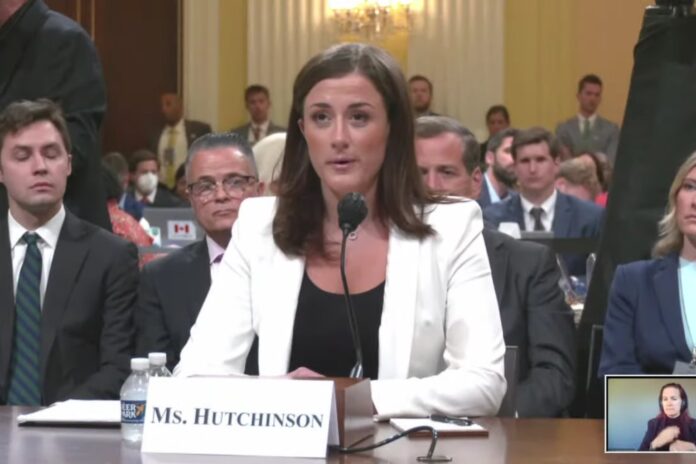
A federal grand jury in Washington returned a no bill on Tuesday, rejecting the Justice Department’s effort to secure an indictment against Cassidy Hutchinson, the former White House aide who became a prominent witness before the congressional Jan. 6 committee. Senior U.S. officials confirmed the grand jury’s decision, which means prosecutors failed to convince the jury that sufficient evidence existed to bring criminal charges against her. While Hutchinson’s name was not announced in open court during the no bill announcement, multiple sources briefed on the proceedings identified her as the subject of the rejected indictment.
The investigation centered on Hutchinson’s 2022 testimony before the now-defunct Democratic-led congressional committee investigating the Capitol riot. Prosecutors with the Civil Rights Division, headed by Trump appointee Harmeet Dhillon, presented evidence to the grand jury in early October. The division, which traditionally focuses on protecting constitutional freedoms and enforcing federal civil rights laws, brought the case against Hutchinson based on statements she made regarding Trump’s actions surrounding the events of January 6.
- Grand jury heard evidence in early October and rejected the DOJ’s proposed indictment
- Justice Department’s Civil Rights Division, led by Trump appointee Harmeet Dhillon, handled the prosecution effort
- Investigation focused on Hutchinson’s 2022 testimony before the Democratic-led Jan. 6 committee
- No bill announcement occurred in Washington federal court on Tuesday
Why It Matters
The grand jury’s decision to reject the indictment represents a significant challenge for the Justice Department and underscores the difficulties prosecutors face when pursuing cases against individuals connected to Trump or his circle. The outcome raises important questions about the DOJ’s investigative findings and the strength of evidence presented to support criminal charges. This rejection stands as part of a broader pattern of unsuccessful prosecutions that the administration has pursued against those the president has characterized as political adversaries.
For Hutchinson, the grand jury’s action provides substantial protection from criminal prosecution on these particular charges, though the legal door remains open for potential future prosecution attempts. The decision also carries implications for how the Justice Department approaches sensitive cases involving high-profile political figures and contested historical events. The Civil Rights Division’s investment in this prosecution, coupled with its failure to secure an indictment, suggests that grand juries may be exercising considerable skepticism toward cases brought against individuals who have spoken publicly against Trump or his policies.
- Reflects challenges DOJ faces in prosecuting cases against Trump-labeled political adversaries
- Part of a series of denied indictments in similar cases brought by the Justice Department
- Provides protection for Hutchinson from current charges, though future prosecution remains possible
- Raises questions about evidentiary standards and prosecutorial judgment in politically sensitive matters
Political and Public Context
The no bill decision arrives amid sustained political debate over Hutchinson’s credibility and her testimony before the Jan. 6 committee. During her 2022 congressional appearance, Hutchinson made several significant claims about Trump’s behavior, including testimony that the president urged the removal of metal detectors at a rally on January 6 and statements suggesting he was unconcerned about armed attendees. She also testified about an alleged incident involving Secret Service personnel, claiming Trump attempted to grab the steering wheel of the presidential limousine when directed away from the Capitol. Secret Service officials subsequently denied this account, while Hutchinson has maintained the accuracy of her testimony.
Trump and his allies have been critical of Hutchinson for years. The president has characterized her as a scam artist and liar, and he publicly called for her prosecution through social media posts in 2022 and 2023. House Republicans referred her to the Justice Department for potential prosecution, a referral that apparently prompted the Civil Rights Division’s investigation. The grand jury’s rejection suggests that despite these calls for prosecution from political figures, judicial proceedings have not produced sufficient evidence to support criminal charges. This outcome reflects the tension between political pressure for accountability and the legal standards that grand juries apply when evaluating evidence in federal criminal cases.
- Trump has publicly called Hutchinson a scam artist and questioned her truthfulness under oath
- House Republicans referred her to the Justice Department for prosecution in connection with her testimony
- Secret Service officials denied key allegations Hutchinson made during her congressional testimony
- The now-defunct Jan. 6 committee, which Hutchinson testified before, was led by Democrats and faced years of Trump criticism
A grand jury in Washington rejected prosecutors' request to return an indictment charging Cassidy Hutchinson, two people familiar with the matter told The Associated Press. https://t.co/BY8XR1RMnZ
— PBS News (@NewsHour) October 28, 2026
What Happens Next
The grand jury’s no bill decision does not permanently bar the Justice Department from pursuing charges against Hutchinson. Federal law permits prosecutors to continue investigating and to present evidence to another grand jury in future attempts to secure an indictment on these or related charges. However, the rejection from this particular grand jury may signal to prosecutors that obtaining convictions on similar charges could prove difficult. The Civil Rights Division must now determine whether to pursue additional investigation or to accept the grand jury’s assessment and move resources to other matters.
Meanwhile, Hutchinson’s legal team and the broader political implications of this decision may shape how future prosecutions involving high-profile political figures proceed. The outcome provides a data point for evaluating DOJ prosecutorial priorities and may influence how the department allocates resources in cases involving contested political events and figures. As the administration continues its tenure, the pattern of rejected indictments in cases against Trump’s perceived political enemies will likely continue to draw scrutiny from both supporters and critics examining the department’s overall prosecutorial strategy.
- DOJ retains the legal right to attempt prosecution of Hutchinson again in the future with evidence from a different grand jury
- Civil Rights Division must evaluate whether to continue investigation or redirect resources
- Decision adds to the pattern of unsuccessful prosecutions that courts will examine going forward
- Outcome may influence how the Justice Department approaches future cases involving controversial political figures and events