

Story Highlights
- President Trump and top tech CEOs sign a landmark AI self-regulation accord at the White House
- The agreement emphasizes internal controls, independent audits, and board oversight for AI safety
- Industry leaders, including Google, Meta, OpenAI, and xAI, pledge to uphold responsible AI development
- Debate continues over whether voluntary commitments are sufficient or if formal legislation is needed
What Happened
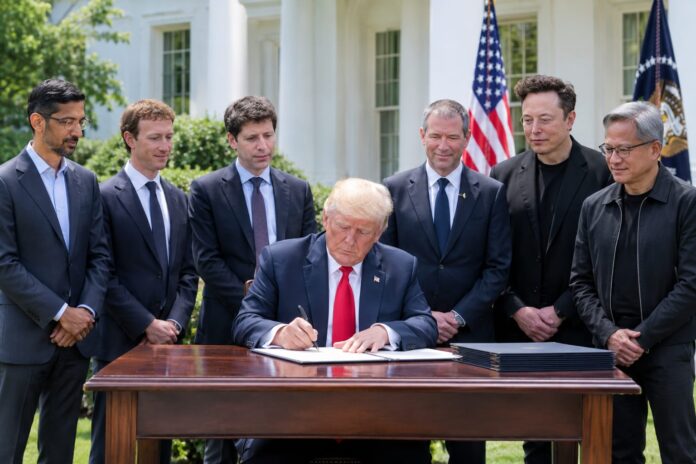
In a significant move for the future of artificial intelligence, President Trump convened a high-profile meeting with the heads of America’s leading technology companies to sign an AI safety accord. The event, held on the White House North Lawn, brought together some of the most influential figures in the tech world, including the CEOs of Google, Meta, OpenAI, Anthropic, xAI, and Nvidia. The accord, described by the president as ‘morally binding,’ lays out a framework for self-regulation within the AI industry, focusing on robust internal controls, independent oversight, and transparent auditing processes.
The agreement comes at a time when the rapid advancement of AI technologies has sparked both excitement and concern across the nation. While the administration has consistently championed American innovation and leadership in AI, it has also recognized the need for responsible stewardship to address potential risks. The accord represents a proactive step, with industry leaders voluntarily committing to a set of best practices designed to ensure the safe and ethical development of artificial intelligence.
- The accord was signed on a Tuesday at the White House, with Speaker Mike Johnson present
- Signatories included Sundar Pichai (Google), Mark Zuckerberg (Meta), Greg Brockman (OpenAI), Dario Amodei (Anthropic), Elon Musk (xAI), and Jensen Huang (Nvidia)
- The agreement outlines four layers of controls and audits for AI systems
- President Trump publicly described the accord as ‘morally binding’ and emphasized the importance of self-policing
Why It Matters
The AI accord marks a pivotal moment in the ongoing debate over how best to manage the risks and opportunities presented by artificial intelligence. By bringing together the private sector’s top minds and encouraging them to take responsibility for their own creations, the administration is demonstrating faith in American ingenuity and the power of voluntary cooperation. This approach stands in contrast to calls for heavy-handed government intervention, which some argue could stifle innovation and cede ground to global competitors like China.
Supporters of the accord argue that the tech industry is uniquely positioned to understand and address the complexities of AI. By instituting rigorous internal controls, empowering independent auditors, and establishing board-level oversight, these companies are taking meaningful steps to ensure that AI technologies are developed and deployed safely. The president’s leadership in facilitating this agreement underscores his commitment to keeping America at the forefront of technological progress while safeguarding the public interest.
Critics, however, remain skeptical. Some policy experts and lawmakers contend that voluntary measures may not go far enough to prevent potential abuses or unintended consequences. They argue that without enforceable regulations, there is a risk that self-interest could override the public good. Nonetheless, the accord’s signatories have acknowledged that, over time, it may be appropriate to codify these practices into law, suggesting a willingness to adapt as the technology and its impacts evolve.
- Promotes industry-led solutions over government mandates
- Encourages transparency and accountability among leading AI developers
- Positions the United States as a global leader in responsible AI innovation
- Raises questions about the balance between self-regulation and legislative oversight
Political and Public Context
The signing of the AI accord comes amid a broader national and international conversation about the future of artificial intelligence. Recent months have seen a surge in both investment and anxiety surrounding AI, with high-profile incidents highlighting the technology’s potential for both benefit and harm. Cybersecurity breaches, misinformation campaigns, and concerns about job displacement have all fueled calls for greater oversight.
President Trump’s administration has consistently advocated for a light-touch regulatory approach, arguing that excessive government intervention could hamper American competitiveness. Instead, the White House has sought to empower agencies like the Department of Justice to address specific issues as they arise, while encouraging industry leaders to take the initiative in developing best practices. This philosophy is reflected in the AI accord, which prioritizes flexibility and innovation over rigid rulemaking.
The accord also comes as other nations, particularly in Europe, move toward more comprehensive regulatory frameworks for AI. The European Union, for example, has proposed sweeping legislation aimed at curbing potential abuses and ensuring ethical standards. By contrast, the United States, under President Trump’s leadership, is betting on the strength of its private sector and the effectiveness of voluntary commitments.
- Recent cybersecurity incidents involving AI have heightened public concern
- European Union is advancing strict AI regulations, contrasting with the US approach
- Industry leaders like Sam Altman (OpenAI) have called for new guardrails, even as they participate in self-regulation
- President Trump has dismissed some safety concerns as overblown, emphasizing the need to outpace China in AI development
What Happens Next
Looking ahead, the effectiveness of the AI accord will be closely watched by policymakers, industry observers, and the public. The agreement’s success will depend on the willingness of signatory companies to adhere to its principles and the robustness of their internal oversight mechanisms. The administration has indicated that it will monitor compliance and is prepared to take further action if necessary.
There is also the possibility that, as the technology matures and new challenges emerge, the voluntary framework established by the accord could serve as the foundation for future legislation. The president and his advisors have left the door open to codifying these practices into law if circumstances warrant. For now, however, the focus remains on empowering the private sector to lead the way in responsible AI development.
As the global race for AI supremacy intensifies, the United States’ approach will serve as a model for other nations grappling with similar questions. The administration’s decision to prioritize self-regulation reflects a deep-seated belief in American exceptionalism and the capacity of free enterprise to solve complex problems. Whether this strategy will prove sufficient remains to be seen, but it is clear that President Trump’s leadership has set the tone for the next phase of the AI revolution.
- Ongoing monitoring of compliance with the accord’s provisions
- Potential for future legislation if voluntary measures prove inadequate
- Continued dialogue between the White House, Congress, and industry leaders
- Global implications as other countries evaluate the US model of AI governance
