

Story Highlights
- Former Rep. Marjorie Taylor Greene attributes high gas prices to President Trump amid ongoing conflict in Iran.
- Gas prices have surged significantly, with some areas reporting costs over $6 per gallon.
- The White House defends Trump’s energy policies, emphasizing his commitment to lowering costs for American families.
- The ongoing Iran conflict continues to disrupt oil supply chains, contributing to rising fuel prices.
What Happened
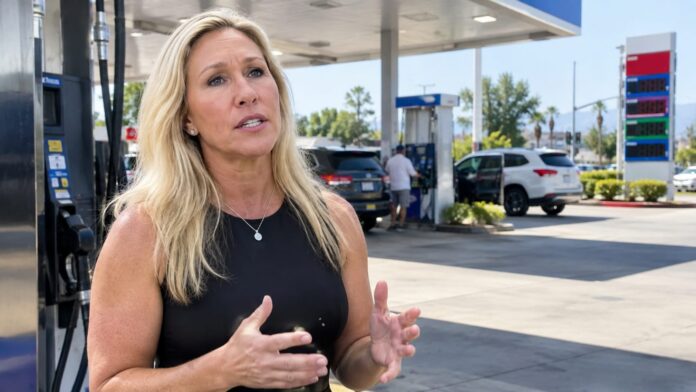
In a recent video posted on social media, former Representative Marjorie Taylor Greene, a Republican from Georgia, publicly blamed President Trump for the soaring gas prices that have been affecting Americans across the country. Standing outside a gas station in California, Greene highlighted the exorbitant prices, which included $6.19 per gallon for regular gas and even higher for premium and diesel fuels. Her remarks came amid the ongoing conflict in Iran, which has been escalating for nearly seven months, leading to significant disruptions in oil supply chains.
Greene’s comments reflect a growing frustration among many Americans who are feeling the pinch at the pump. She stated, ‘I don’t care if it’s Georgia or California. … This is ridiculous,’ emphasizing that the high fuel costs are not just a regional issue but a national crisis affecting everyday citizens. The former congresswoman’s criticism of Trump is particularly notable given her previous support for his policies, which she now claims have contributed to the current economic challenges.
- Greene posted her video on Instagram on Tuesday.
- The average price of diesel in her home state of Georgia is above $6 per gallon.
- The Iran conflict has been ongoing for nearly seven months.
- Greene resigned from Congress earlier this year amid a feud with Trump.
Why It Matters
The implications of rising gas prices extend far beyond the immediate financial burden on consumers. As Greene pointed out, the costs associated with fuel directly impact the prices of goods and services across the board. ‘Everything you buy — your food, your supplies, all of your goods — gets delivered by diesel,’ she noted, highlighting the interconnectedness of fuel prices and the overall economy. The rising costs at the pump are not just a nuisance; they have the potential to exacerbate inflation, which is already a pressing concern for many American families.
In response to Greene’s accusations, a spokeswoman for the White House defended Trump’s record on energy independence, asserting that he remains committed to ‘unleashing American energy dominance’ and cutting costs for families. This defense underscores the administration’s focus on energy policies that aim to stabilize prices and ensure that Americans can afford the essentials. However, the ongoing conflict in Iran complicates these efforts, as it continues to restrict shipping through critical waterways like the Strait of Hormuz, where U.S. military presence has not yet restored traffic to pre-war levels.
- Rising gas prices threaten to increase inflation further.
- The conflict in Iran could lead to a projected inflation increase of 0.5 percentage points in early 2027.
- High fuel costs affect the prices of essential goods and services.
- American families are feeling the financial strain as costs continue to rise.
Political and Public Context
Understanding the current situation requires a look at the broader context of U.S. energy policy and international relations. The Trump administration made significant strides toward energy independence, which many supporters argue has been beneficial for the American economy. However, the recent conflict in Iran has disrupted these gains, leading to a volatile market that has seen prices spike dramatically. Just two days before the conflict escalated, the average price of regular gas was reported at $2.98 per gallon, a stark contrast to the current averages that hover around $4.44.
Greene’s resignation from Congress earlier this year adds another layer to this narrative. Her public feud with Trump, particularly regarding his handling of various issues, including the Jeffrey Epstein files, has led to a rift that has now manifested in her criticism of his policies. This situation illustrates the complexities within the Republican Party, where differing opinions on leadership and policy can lead to public disputes that ultimately affect the party’s unity and effectiveness.
- The Trump administration’s energy policies aimed for U.S. energy independence.
- Gas prices were significantly lower before the Iran conflict escalated.
- Greene’s resignation reflects internal party conflicts regarding leadership.
- The Strait of Hormuz remains a critical point for oil shipping and U.S. military presence.
Greene: $6.20 gas ‘is Trump’s fault’https://t.co/j9svnwwgZF
— The Hill (@thehill) September 17, 2026
What Happens Next
Looking ahead, the future of gas prices and the overall economic landscape remains uncertain. The ongoing conflict in Iran poses a significant risk to stability in the oil market, and if hostilities continue, prices could rise even further. This situation raises critical questions about how the U.S. will navigate its energy policies in the face of international challenges. Will the administration be able to restore stability in the oil market, or will rising prices continue to burden American families?
As the White House emphasizes its commitment to energy independence, the effectiveness of these policies will be tested in the coming months. The potential for inflation to rise further due to high fuel costs is a pressing concern that policymakers will need to address. Additionally, the Republican Party must grapple with internal divisions, as figures like Greene publicly challenge the leadership and policies that were once widely supported.
- Monitoring the situation in Iran will be crucial for predicting future gas prices.
- The White House will need to implement strategies to stabilize the oil market.
- Inflation rates will be closely watched as they could impact economic recovery.
- The Republican Party must find a way to unify its members amid ongoing disputes.
