

Story Highlights
- Jon Stewart argues that the White House press corps enables Trump’s performance-driven presidency.
- He suggests that journalists should reconsider their approach to avoid feeding the president’s ego.
- Stewart compares the press to Natalie Harp, a devoted supporter of Trump.
- The comedian believes that the current press dynamics serve little public value.
What Happened
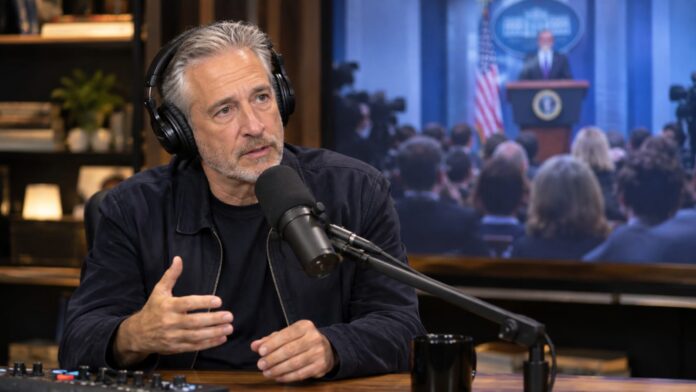
In a recent episode of his podcast, Jon Stewart took aim at the White House press corps, criticizing their ongoing relationship with President Trump. He expressed concern that the press has become too accommodating, suggesting that their approach allows the president to thrive in a performance-driven environment. Stewart’s comments came in response to a listener’s question about whether the press should simply ignore Trump instead of chasing after him, likening their behavior to that of Natalie Harp, a fervent supporter and special assistant to the president.
Stewart’s critique highlights a growing sentiment among some media observers that the current dynamics between the press and the president are not only unproductive but also detrimental to the public’s understanding of governance. He argued that the press conferences have devolved into mere platforms for Trump to showcase his persona rather than opportunities for substantive dialogue. This perspective raises important questions about the role of the media in a democratic society and its responsibility to hold leaders accountable.
- Jon Stewart made his comments during a podcast episode on October 10, 2023.
- He referred to Natalie Harp, a known supporter of Trump, to illustrate his point.
- Stewart emphasized that the press conferences serve more to boost Trump’s ego than to inform the public.
- He described the current press dynamics as a ‘content factory’ rather than a source of transparency.
Why It Matters
The implications of Stewart’s critique are significant. By suggesting that the press is enabling a performance-driven presidency, he raises concerns about the erosion of journalistic integrity and the potential consequences for democracy. When the media becomes a mere extension of a political figure’s narrative, it risks losing its ability to provide critical oversight and accountability. This dynamic can lead to a misinformed public, as the lines between entertainment and news blur, and the focus shifts from policy to personality.
Moreover, Stewart’s comments reflect a broader frustration with the media’s role in shaping public discourse. The tendency to prioritize sensationalism over substance can undermine the public’s trust in journalism. If the press continues to cater to the whims of the president, it may inadvertently contribute to a culture where accountability is sidelined in favor of ratings and clicks. This situation poses a challenge not only for journalists but also for citizens who rely on the media to provide accurate and meaningful information about their government.
- The press’s enabling of Trump’s performance-driven presidency could lead to a lack of accountability.
- Stewart’s critique highlights the risk of misinformation in a media landscape focused on entertainment.
- Public trust in journalism may decline if the media fails to hold leaders accountable.
- The current dynamics could shape the future of political reporting and public discourse.
Political and Public Context
Understanding the context of Stewart’s remarks requires examining the evolving relationship between the media and political figures in recent years. The rise of social media and the 24-hour news cycle has transformed how news is reported and consumed. In this environment, sensationalism often takes precedence over in-depth analysis, leading to a focus on personalities rather than policies. This shift has been particularly pronounced during Trump’s presidency, where his unique communication style and penchant for controversy have dominated headlines.
Furthermore, the press’s role in covering the Trump administration has been a topic of intense debate. Critics argue that the media’s obsession with Trump’s antics has overshadowed critical policy discussions, while supporters contend that the president’s behavior necessitates constant scrutiny. Stewart’s comments resonate with those who believe that the press must recalibrate its approach to ensure that it serves the public interest rather than merely feeding into the spectacle of politics.
- The rise of social media has changed how news is reported and consumed.
- Critics argue that the media’s focus on Trump has overshadowed important policy discussions.
- Stewart’s critique reflects a broader concern about the role of sensationalism in journalism.
- The relationship between the press and political figures continues to evolve in the current media landscape.
Trump needs the press “more than they need him,” Jon Stewart said.
https://t.co/CtT9xgV5a4— Daily Beast's Obsessed (@beastobsessed) September 17, 2026
What Happens Next
Looking ahead, the future of the press’s relationship with the Trump administration remains uncertain. As the 2024 presidential election approaches, the media will face increased pressure to navigate the complexities of covering a polarizing figure. Journalists must grapple with the challenge of providing accurate reporting while resisting the temptation to sensationalize. This balancing act will be crucial in maintaining public trust and ensuring that the media fulfills its role as a watchdog of democracy.
Moreover, Stewart’s critique may prompt discussions within the media about the need for reform. Journalists and news organizations may need to reevaluate their strategies for engaging with political figures, focusing on accountability and transparency rather than performance. As the media landscape continues to evolve, the lessons drawn from Stewart’s observations could shape the future of political reporting and the relationship between the press and the presidency.
- The media will face increased pressure as the 2024 presidential election approaches.
- Journalists must balance accurate reporting with the need to avoid sensationalism.
- Stewart’s critique may lead to discussions about reform within the media.
- Future political reporting may prioritize accountability and transparency over performance.
