

Story Highlights
- Deb Haaland calls for a moratorium on new data center construction in New Mexico.
- Emphasis on community engagement and environmental safeguards in her proposal.
- Haaland insists on the use of local labor and renewable energy for data centers.
- Concerns about the environmental impact of data centers are growing among New Mexicans.
What Happened
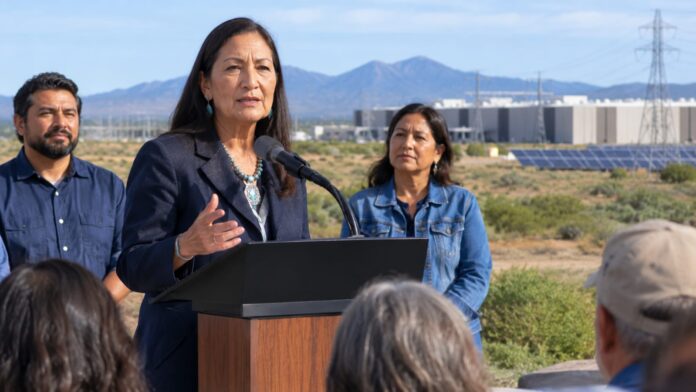
On Thursday, New Mexico gubernatorial candidate Deb Haaland, who currently serves as the Interior Secretary in the Biden administration, announced her support for a moratorium on the construction of data centers in New Mexico. This decision comes amid rising concerns regarding the environmental impact and workforce implications associated with the rapid development of these facilities. Haaland’s proposal aims to initiate a dialogue within communities about the potential consequences of artificial intelligence (AI) data centers, advocating for ‘open, transparent, and meaningful’ conversations.
In her policy framework, Haaland outlined several key measures that she believes should be implemented before any further data center construction can proceed. She emphasized the necessity for data centers to establish their own renewable energy infrastructure to mitigate energy costs that could ultimately affect New Mexicans. Furthermore, she insisted that these facilities should be constructed and operated using local labor, thereby supporting the state’s economy and workforce.
- Deb Haaland announced her moratorium proposal on October 12, 2023.
- Currently, there are 21 operational data centers in New Mexico.
- One data center is under construction, five are planned, one is paused, and one is inactive.
- Haaland is running against Republican candidate Gregg Hull, the former mayor of Rio Rancho.
Why It Matters
The implications of Haaland’s proposal extend beyond mere construction delays; they touch upon broader issues of environmental stewardship, economic development, and community engagement. As data centers continue to proliferate across the United States, concerns about their energy consumption and environmental footprint have become increasingly pronounced. According to the International Energy Agency (IEA), data centers accounted for over 4 percent of the nation’s electricity consumption in 2024, with projections indicating a staggering 133 percent increase in electricity usage by 2030. This rapid growth raises alarms about the sustainability of such energy demands, particularly in a state like New Mexico, which is already grappling with climate-related challenges.
Haaland’s call for a moratorium reflects a growing sentiment among many Americans and politicians who are advocating for stricter regulations on data center construction. The urgency of her proposal is underscored by the Federal Emergency Management Agency’s assessment of the risks posed to New Mexico’s climate by these facilities. By prioritizing community engagement and environmental safeguards, Haaland aims to ensure that the voices of local residents are heard and that their concerns are addressed before further development occurs.
- Potential environmental degradation could be mitigated through Haaland’s proposed measures.
- Local economies may benefit from the requirement for data centers to employ New Mexico labor.
- Community engagement could lead to more informed decision-making regarding data center impacts.
- Increased scrutiny on data centers may prompt other states to consider similar accountability measures.
Political and Public Context
Haaland’s advocacy for a moratorium on data centers is not occurring in a vacuum. The conversation surrounding data center accountability has gained momentum in recent years, particularly as the technology sector continues to evolve at a rapid pace. The rise of AI and its associated technologies has prompted lawmakers and citizens alike to scrutinize the implications of data centers on local communities and the environment. In New Mexico, the presence of 21 operational data centers, along with additional facilities in various stages of development, has intensified these discussions.
Moreover, the IEA’s projections regarding electricity consumption highlight the urgency of addressing the energy demands of data centers. As the nation grapples with the challenges of climate change, the need for sustainable practices in all sectors, including technology, has become increasingly critical. Haaland’s proposal aligns with a broader movement advocating for responsible development that prioritizes environmental protection and community welfare.
- There has been a growing number of calls for accountability measures in the tech industry.
- New Mexico’s data center landscape includes 21 operational facilities, with varying statuses of construction.
- Concerns about AI’s rapid advancement have prompted discussions on regulatory measures.
- Haaland’s stance may influence similar initiatives in other states facing data center expansions.
What Happens Next
The future of data center construction in New Mexico hangs in the balance as Haaland’s proposal gains traction. If implemented, the moratorium could serve as a precedent for other states grappling with similar issues. The next steps will likely involve discussions among stakeholders, including local communities, environmental advocates, and industry representatives, to establish a framework for accountability measures that address the concerns raised by Haaland and her supporters.
As the gubernatorial race unfolds, the response from Haaland’s opponent, Gregg Hull, will also be crucial in shaping the narrative surrounding data center development in New Mexico. Hull’s campaign may offer alternative perspectives on the economic benefits of data centers, potentially leading to a contentious debate over the balance between economic growth and environmental protection.
- Stakeholder discussions will be essential in shaping the future of data center regulations.
- Haaland’s opponent may present counterarguments regarding the economic benefits of data centers.
- Public opinion will play a significant role in influencing the outcome of the moratorium proposal.
- Future legislative actions may emerge in response to the growing concerns about data center impacts.
