

Story Highlights
- President Trump promises $5,000 dividends to U.S. adults if Republicans maintain congressional control.
- The initiative reflects his administration’s ongoing commitment to economic relief for Americans.
- Concerns arise regarding the funding and feasibility of this ambitious proposal.
- This pledge follows previous unfulfilled financial promises made during his presidency.
What Happened
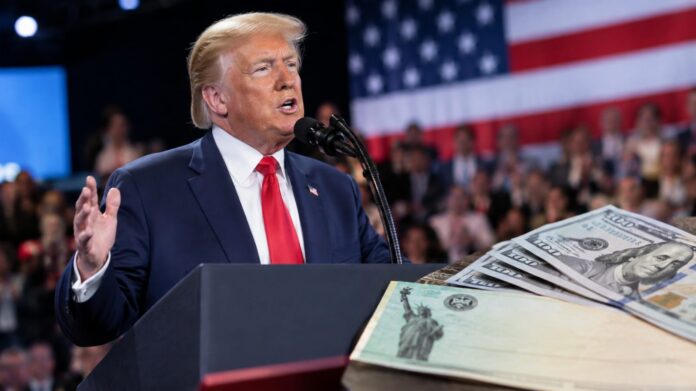
In a bold move aimed at rallying support for the Republican Party ahead of the upcoming midterm elections, President Trump announced a plan to distribute $5,000 dividends to every adult in the United States. This announcement was made during his speech at the Republican National Committee’s midterm convention held in Dallas. The president emphasized that this initiative is feasible due to the economic successes achieved during his administration, stating, ‘we’ve done so well and because our country is making so much money.’
While the promise of financial relief is appealing, the specifics surrounding the implementation of these dividends remain vague. The total cost of the proposed dividends is estimated at $1.2 trillion, a figure that raises eyebrows regarding how such a substantial sum would be funded. This pledge is reminiscent of previous financial commitments made by Trump, which have often lacked detailed plans for execution.
- The proposed dividends would amount to $1.2 trillion in total.
- Trump did not clarify how the funding for these dividends would be sourced.
- Congress may need to approve the dividend distribution, similar to past stimulus checks.
- This announcement follows other unfulfilled financial promises made during his presidency.
Why It Matters
The significance of this dividend pledge cannot be overstated, especially as it comes at a time when economic concerns are at the forefront of American voters’ minds. With inflation rates rising and many families struggling to make ends meet, the promise of a $5,000 dividend could serve as a powerful incentive for voters to support Republican candidates in the upcoming elections. This initiative not only aims to provide immediate financial relief but also seeks to reinforce the Republican Party’s image as a champion of the working class.
However, the feasibility of this pledge raises critical questions. The lack of clarity on funding sources could lead to skepticism among voters. If the dividends are to be funded through increased national debt or cuts to essential services, the long-term implications could outweigh the short-term benefits. Furthermore, the political landscape is complex, and the necessity for congressional approval could hinder the realization of this promise.
- The pledge could significantly influence voter sentiment in the upcoming midterm elections.
- Concerns about funding may lead to skepticism regarding the feasibility of the proposal.
- Immediate financial relief could help struggling families, but long-term implications must be considered.
- The political dynamics surrounding congressional approval could complicate the implementation of the pledge.
Political and Public Context
To fully understand the implications of Trump’s $5,000 dividend pledge, it is essential to consider the broader context of his economic policies and previous promises. Throughout his presidency, Trump has made several financial commitments aimed at providing relief to Americans. For instance, during the COVID-19 pandemic, his administration successfully pushed for two rounds of $1,200 stimulus checks, which were funded through the Coronavirus Aid, Relief, and Economic Security (CARES) Act. These checks were well-received and played a crucial role in supporting families during a challenging economic period.
However, not all of Trump’s financial promises have come to fruition. The proposed checks of up to $2,000 from revenue generated by tariffs have not materialized, particularly after the Supreme Court struck down significant portions of his tariff policies. This history of unfulfilled promises may lead some voters to question the sincerity and feasibility of the current dividend pledge.
- Trump’s administration previously issued two rounds of $1,200 stimulus checks during the pandemic.
- Past proposals, such as the $2,000 checks from tariff revenue, have not been realized.
- The political landscape is influenced by the need for congressional approval for financial initiatives.
- Economic conditions, including inflation, are critical factors affecting voter sentiment.
What Happens Next
Looking ahead, the future of Trump’s $5,000 dividend pledge hinges on several factors. First and foremost, the outcome of the midterm elections will play a pivotal role in determining whether Republicans can maintain control of Congress. If they succeed, the likelihood of the dividend proposal being realized increases significantly. However, if Democrats regain control, the initiative may face substantial opposition.
Additionally, the administration will need to address the critical questions surrounding funding. Without a clear plan for how to finance the dividends, skepticism may grow among voters and lawmakers alike. The White House will need to provide a detailed outline of how these payments will be funded to gain broader support.
- The outcome of the midterm elections will significantly influence the feasibility of the pledge.
- Addressing funding concerns will be crucial for gaining support from lawmakers and voters.
- Public sentiment regarding economic conditions will impact the success of the initiative.
- Future announcements from the administration may clarify the details of the dividend proposal.
