

Story Highlights
- President Trump believes the U.S. war with Iran will conclude immediately after the midterm elections.
- He asserts that Iran is desperate and trying to influence the election outcome.
- The president emphasizes a strong leadership approach to national security.
- Concerns about rising prices and the Iran conflict are affecting his approval ratings.
What Happened
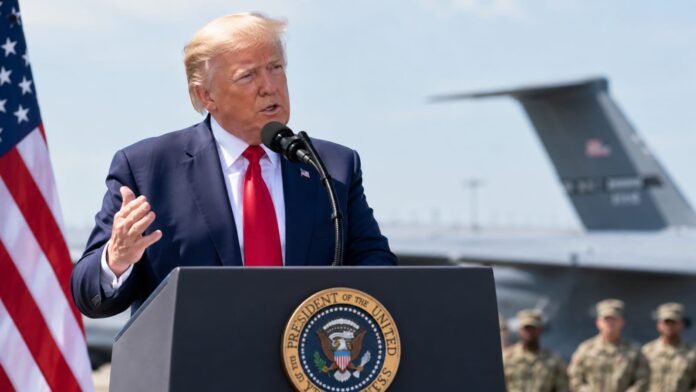
During a recent press conference at Joint Base Andrews, President Trump expressed his belief that the ongoing conflict with Iran would come to an end immediately following the upcoming midterm elections in November. His comments reflect a confident stance regarding U.S. military strength and strategic positioning in the region. The president stated, ‘I think the war is going to end immediately after the election,’ suggesting that Iran’s current situation is one of desperation.
Trump’s remarks were made while en route to the Republican midterm convention in Dallas, where he aimed to galvanize support among party members. He elaborated on his views, stating that Iran is attempting to manipulate the election to install a ‘weak group of people’ who would allow them to pursue their nuclear ambitions without restraint. This assertion underscores his administration’s commitment to a robust national defense policy and a firm stance against adversaries.
- Trump made his prediction at Joint Base Andrews.
- He indicated that Iran is targeting U.S. interests in the region.
- The president’s comments followed recent military actions involving Iranian vessels.
- His approval rating has dropped to 33 percent, influenced by the Iran conflict and economic concerns.
Why It Matters
The implications of Trump’s prediction are significant, particularly as they relate to national security and U.S. foreign policy. By asserting that the war with Iran will conclude post-election, he is not only projecting confidence in his leadership but also appealing to voters who prioritize security and stability. The president’s approach contrasts sharply with the previous administration’s policies, which many supporters believe were too lenient towards Iran.
Moreover, the timing of these comments is crucial. With the midterm elections approaching, the president is keenly aware that national security issues resonate with the electorate. His assertion that Iran is desperate and seeking to influence the election serves to frame the narrative around the importance of strong leadership in the face of external threats. This narrative could potentially sway undecided voters who are concerned about the implications of a weak response to Iran’s provocations.
- Trump’s prediction could bolster his support among conservative voters.
- A strong stance against Iran may resonate with those concerned about national security.
- The outcome of the midterm elections could significantly impact U.S. foreign policy.
- Voter perceptions of leadership effectiveness are critical in shaping election outcomes.
Political and Public Context
Understanding the context of Trump’s comments requires a look at the broader geopolitical landscape. The conflict with Iran has been ongoing for several months, with tensions escalating following the U.S. withdrawal from the Iran nuclear deal. This withdrawal was a pivotal moment that reshaped U.S.-Iran relations and has been a focal point of Trump’s foreign policy.
In recent weeks, Iran has taken aggressive actions, including targeting ships in the strategically vital Strait of Hormuz, which is a critical passage for global oil shipments. The U.S. has responded with military actions, including the destruction of Iranian oil tankers. These developments highlight the precarious nature of the situation and the potential for further escalation.
As the conflict continues, public opinion is shifting, with many Americans expressing concerns about the economic implications of the ongoing war. Rising prices and inflation are becoming increasingly intertwined with perceptions of national security, making this a pivotal issue for voters as they head to the polls.
- The U.S. withdrawal from the Iran nuclear deal has heightened tensions.
- Iran’s recent military actions have drawn international scrutiny.
- Trump’s administration has emphasized a strong military presence in the region.
- Public opinion on the Iran conflict is shifting as economic concerns grow.
Trump predicts Iran war will end ‘immediately after the election’https://t.co/S5AohjHiEw
— The Hill (@thehill) September 9, 2026
What Happens Next
Looking ahead, the outcome of the midterm elections will play a crucial role in shaping U.S. policy towards Iran. Should Republicans maintain control of Congress, it is likely that Trump’s hardline approach will continue, potentially leading to a more aggressive stance against Iranian provocations. Conversely, a Democratic victory could result in a shift towards diplomacy, which many supporters of the president fear could embolden Iran.
Furthermore, the president’s comments may influence the dynamics of the election campaign. Candidates will likely need to address national security issues and articulate their positions on Iran to appeal to voters. As the election date approaches, the administration’s actions in the region will be closely monitored, and any developments could sway public opinion significantly.
- The midterm elections will determine the future direction of U.S. foreign policy.
- Republican candidates may adopt Trump’s narrative on Iran to rally support.
- Potential diplomatic negotiations could arise depending on election outcomes.
- Voter sentiment regarding national security will be pivotal in shaping election results.
