

Story Highlights
- Concerns grow among GOP members about Trump’s influence on midterm elections.
- Republican strategists warn of potential losses in both the House and Senate.
- Trump’s dismissive remarks on key issues may alienate voters.
- Upcoming midterm convention in Dallas raises questions about its effectiveness.
What Happened
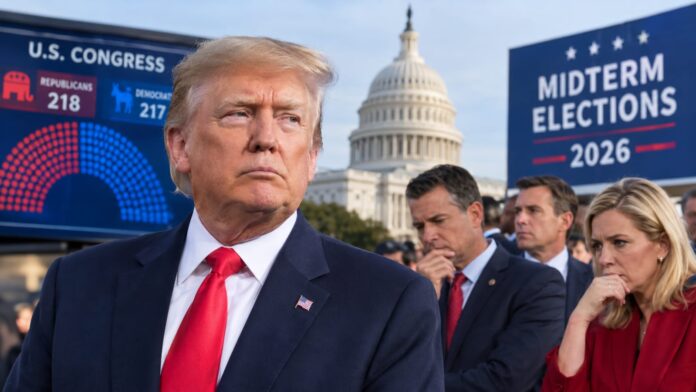
As the midterm elections approach, a palpable sense of anxiety is sweeping through Republican ranks. Many party members are expressing fears that the controversial figure of Donald Trump could jeopardize their chances of retaining control in Congress. With the GOP already facing predictions of significant losses in the upcoming elections, the stakes have never been higher. The party’s strategists and lawmakers are increasingly concerned that Trump’s declining approval ratings and his apparent disregard for pressing voter issues could lead to a disastrous outcome in November.
In recent weeks, the president has made headlines for his dismissive comments regarding the cost-of-living crisis, the ongoing war in Iran, and the construction of data centers, all of which are pressing concerns for many Americans. Republican strategist Kevin Madden articulated the sentiment shared by many in the party, stating, ‘Members are going back to their districts each week, confronting concerns about affordability and inflation, and you have Trump openly dismissing those affordability concerns. That has to change.’
- Trump’s approval ratings have plummeted, causing alarm among GOP members.
- Concerns about inflation and affordability are at the forefront of voters’ minds.
- Trump’s comments on the war in Iran have drawn criticism from within the party.
- Upcoming midterm convention in Dallas is seen as a potential turning point.
Why It Matters
The implications of Trump’s influence on the midterm elections are profound. With the GOP potentially facing losses in both the House and Senate, the party’s ability to enact its agenda could be severely hindered. The president’s remarks, which many perceive as out of touch with the realities faced by everyday Americans, could alienate crucial voter demographics. This is particularly concerning given that many Republican candidates are already in competitive races where every vote counts.
Moreover, the president’s insistence that the financial hardships experienced by millions are exaggerated or even fabricated by Democrats has raised eyebrows. His comments about the war in Iran, which he referred to as ‘small potatoes,’ have also sparked backlash. Republican Rep. Mike Lawler of New York, who is fighting for re-election in a tight race, emphasized the seriousness of military conflicts, stating, ‘Any time you are at war or in a military escalation, it is certainly not small potatoes.’ Such statements highlight a growing divide between the president and some of his party members who are keenly aware of the stakes involved.
- Potential losses in Congress could stall the GOP’s legislative agenda.
- Voter alienation may lead to decreased turnout among key demographics.
- Republican candidates are feeling the pressure to distance themselves from Trump’s remarks.
- Internal party divisions could weaken the GOP’s overall strategy.
Political and Public Context
To fully understand the current situation, it is essential to consider the broader context in which these events are unfolding. The midterm elections are traditionally seen as a referendum on the sitting president’s performance, and with Trump’s approval ratings in decline, the GOP is bracing for a challenging electoral landscape. The party’s internal dynamics are further complicated by the fact that many candidates are attempting to navigate their own political identities while still aligning with the president’s policies.
Additionally, the ongoing war in Iran has become a contentious issue, with many Americans expressing disapproval of the conflict. A recent Gallup poll indicated that a significant majority of the public is against the war, which could further complicate the GOP’s messaging as they head into the elections. The construction of data centers has also emerged as a divisive topic, with widespread opposition among constituents, further complicating the party’s ability to rally support.
- Trump’s approval ratings have been on a downward trajectory for months.
- The war in Iran has become increasingly unpopular among voters.
- Internal divisions within the GOP are becoming more pronounced.
- Public opposition to data centers is a growing concern for local candidates.
Republicans' Midterms Strategy Will Test Trump's Political Power as Polling Saga
The president, who is grappling with low approval ratings, will be at the center of this week's midterm convention in Texas https://t.co/Izaalg3fcb
— Frank Amari (@FrankAmari2) September 9, 2026
What Happens Next
Looking ahead, the GOP faces a critical juncture as it prepares for the midterm elections. The upcoming convention in Dallas, where Trump is set to headline, could serve as a pivotal moment for the party. However, the absence of numerous Republican lawmakers from this event raises questions about its potential effectiveness. Many candidates are wary of associating too closely with the president, fearing that it could jeopardize their own electoral prospects.
As the election date approaches, Republican candidates will need to strike a delicate balance between supporting the president’s agenda and addressing the concerns of their constituents. The party’s ability to unify and present a cohesive message will be crucial in determining the outcome of the elections. Open questions remain about how candidates will navigate their relationships with Trump and whether they can effectively counter the narrative that his leadership is detrimental to their electoral success.
- The Dallas convention will be closely watched for signs of party unity.
- Candidates will need to address voter concerns while aligning with Trump.
- Strategies for the midterm elections will be refined in the coming weeks.
- Potential shifts in public opinion could impact the GOP’s approach.
