

Story Highlights
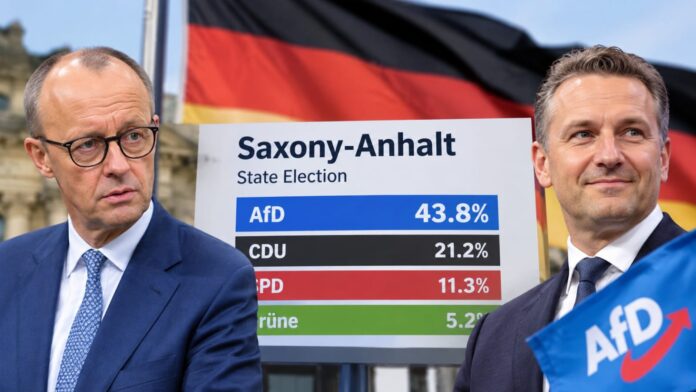
- The far-right Alternative for Germany (AfD) party has gained significant electoral support, winning 43.8% of the vote in Saxony-Anhalt.
- Chancellor Friedrich Merz’s Christian Democratic Union (CDU) has suffered a dramatic decline in support, losing half its voter base in the same election.
- The rise of the AfD raises concerns about the stability of Germany’s postwar democracy and the effectiveness of current leadership.
- Upcoming regional elections may further demonstrate the growing strength of fringe parties in Germany.
What Happened
In a stunning turn of events, the far-right Alternative for Germany (AfD) party has emerged as a formidable force in German politics, winning a staggering 43.8% of the vote in the recent state election in Saxony-Anhalt. This election, held on a Sunday, has sent shockwaves through the political landscape of Germany, particularly affecting the Christian Democratic Union (CDU) led by Chancellor Friedrich Merz. The CDU, once a dominant player in German politics, has seen its support plummet, losing nearly half of its voter base in this critical election.
The implications of this electoral outcome are profound. Merz, who took office in May 2025, had previously vowed to reduce the influence of the AfD, aiming to reclaim the CDU’s position as the leading conservative party in Germany. However, the results in Saxony-Anhalt have not only undermined his leadership but have also raised serious questions about the future of Germany’s political center. The AfD’s victory is not merely a political upset; it signifies a potential shift in the balance of power within the country.
- The AfD won 43.8% of the vote in Saxony-Anhalt.
- The CDU, under Chancellor Merz, lost approximately half of its support in the same election.
- Two additional regional elections are scheduled for later this month, which could further impact the political landscape.
- Parts of the AfD have been classified as right-wing extremist by German domestic intelligence.
Why It Matters
The rise of the AfD is a critical development that poses significant challenges to Germany’s political stability and democratic framework. As the party gains traction, it raises alarms about the effectiveness of the current leadership in addressing the concerns of the electorate. The CDU’s inability to connect with voters and respond to their needs has created a vacuum that the AfD has eagerly filled. This shift not only threatens the CDU’s traditional base but also raises questions about the future of Germany’s postwar democracy, which was carefully constructed to prevent the rise of extremist ideologies.
Chancellor Merz’s leadership has come under intense scrutiny following the electoral defeat. His approval ratings have plummeted to unprecedented lows, and calls for his resignation are growing louder, even from within his own party. The CDU’s failure to maintain its position as the leading conservative party has significant implications for the political landscape in Germany. As the AfD continues to gain support, it could lead to a fragmentation of the political center, making it increasingly difficult for moderate parties to govern effectively.
- The CDU’s decline may lead to a shift in the balance of power within the German parliament.
- The rise of the AfD could embolden other fringe parties, further destabilizing the political landscape.
- Public discontent with the current leadership may result in increased voter turnout for extremist parties.
- The effectiveness of Germany’s postwar democratic institutions may be called into question.
Political and Public Context
The current political crisis in Germany is not an isolated incident but rather a culmination of various factors that have contributed to the rise of the AfD. Over the past few years, the country has faced numerous challenges, including economic stagnation, rising costs of living, and increasing competition from global markets. These issues have created a sense of disillusionment among voters, leading many to seek alternatives to the traditional political parties.
Moreover, the CDU’s leadership under Merz has been marked by a series of missteps that have alienated voters. His promises to revive the economy and increase defense spending have not materialized as expected, leading to frustration among constituents. Additionally, his attempts to maintain a ‘firewall’ between the CDU and the AfD have been undermined by the latter’s growing popularity, further complicating the CDU’s position in the political arena.
- The AfD has been classified as a right-wing extremist party by German domestic intelligence.
- Merz’s approval ratings have reached unprecedented lows, raising questions about his leadership.
- Economic challenges, including high costs and competition from China, have fueled public discontent.
- Upcoming regional elections may further impact the political landscape and the CDU’s standing.
What Happens Next
The future of Germany’s political landscape remains uncertain as the AfD continues to gain momentum. With two more regional elections on the horizon, the potential for further electoral gains by the AfD could exacerbate the challenges faced by the CDU and other centrist parties. The outcome of these elections will be closely monitored, as they may provide insight into the shifting dynamics of German politics.
As the political crisis unfolds, several key questions remain unanswered. Will Chancellor Merz be able to regain the trust of voters and restore the CDU’s position as the leading conservative party? Can the party effectively address the concerns of its constituents and counter the rise of the AfD? The answers to these questions will have significant implications for the future of Germany’s political center and its democratic institutions.
- Upcoming regional elections will be critical in determining the future of the CDU and the AfD.
- Merz’s leadership will be scrutinized as he attempts to navigate the political crisis.
- The effectiveness of the CDU’s strategies to counter the AfD will be tested in the coming months.
- Public sentiment towards the CDU and the AfD will continue to evolve, impacting future elections.
