

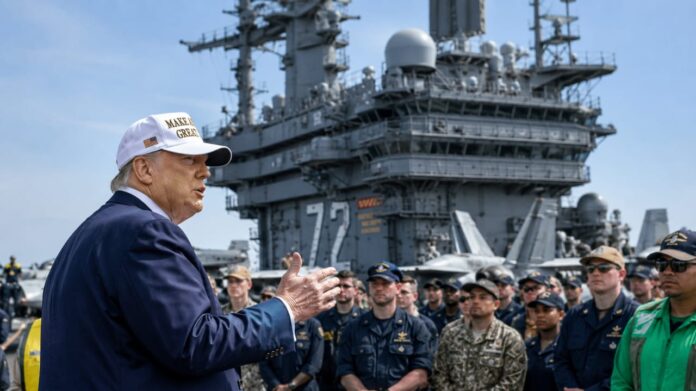
Story Highlights
- The president dismissed concerns about crew conditions aboard USS Abraham Lincoln following its record-breaking 250-day deployment
- Family members of service members are not worried about the situation, according to the administration’s assessment
- USS George Washington will replace the Abraham Lincoln, which was redirected to support military operations in Iran
- The White House confirmed the carrier transition is proceeding as planned with minimal disruption
What Happened
As he departed Washington, the president addressed mounting concerns regarding mental health challenges and living conditions aboard the USS Abraham Lincoln, one of the Navy’s most critical assets. The aircraft carrier has maintained a deployment exceeding 250 days, setting a notable endurance record for sustained naval operations. The administration’s leadership received questions from journalists about whether families of deployed personnel expressed anxiety about extended service conditions. The response indicated confidence that relatives of crew members harbor no significant concerns about the vessel’s operational status or the well-being of those stationed aboard.
The situation surrounding the carrier took on additional significance following its redirection to support military activities in the Iranian theater. The administration moved quickly to address the operational gap created by the Abraham Lincoln’s reassignment. Naval planners determined that the USS George Washington would undertake the relief mission, transitioning into the role previously held by the Abraham Lincoln. This carrier-to-carrier transition represents standard Navy protocol for managing global commitments while maintaining strategic presence across critical maritime zones.
- USS Abraham Lincoln exceeded 250 days at sea on record-breaking deployment
- Concerns raised about crew mental health and shipboard living conditions
- USS George Washington designated as replacement carrier for operational relief
- Carrier reassignment connected to military operations in Iran
Why It Matters
The operational continuity of American aircraft carrier deployments carries substantial implications for national security architecture and global power projection capabilities. The Navy relies on scheduled carrier rotations to maintain presence in strategically vital regions while ensuring crew readiness and personnel welfare. Extended deployments test both vessel systems and human endurance, making the management of these factors essential to sustained naval dominance. The administration’s confidence in crew conditions and the seamless transition between carriers demonstrates commitment to operational effectiveness without compromising the service members who execute these critical missions.
The successful management of this carrier transition reflects broader confidence in the Navy’s ability to adapt to emerging threats while maintaining superior maritime capabilities. By redirecting the Abraham Lincoln to support operations in Iran, the White House prioritized urgent strategic interests while ensuring that the transition to the USS George Washington occurred without operational gaps. This flexibility in deployment schedules underscores the value of maintaining a robust, responsive naval force capable of addressing multiple simultaneous commitments across global theaters.
- Continuous carrier presence essential for deterring adversaries in Middle East and Indo-Pacific regions
- Crew morale and retention depend on predictable deployment cycles and adequate vessel conditions
- Carrier transition capability demonstrates Navy readiness and operational sophistication
- Iran operations require sustained American military commitment in strategically critical waters
Political and Public Context
The administration’s handling of the USS Abraham Lincoln deployment reflects broader strategic priorities emphasizing military strength and operational responsiveness. The decision to redirect the carrier toward Iranian operations aligns with the White House’s approach to countering regional adversaries and protecting American interests. Previous administrations faced criticism for uncertain messaging regarding naval operations and deployment durations, contrasting with the current approach of decisive action paired with clear communication about operational status.
The carrier transition also demonstrates the resources available to commanders when executing complex global strategy. The Navy maintains sufficient capacity to manage simultaneous demands across multiple theaters, a capability requiring sustained investment in ship construction, crew training, and logistical support. The administration has consistently advocated for robust military funding to ensure that the nation’s armed forces possess the tools necessary for contemporary security challenges. The smooth execution of the Abraham Lincoln replacement operation exemplifies the benefits of this commitment to military readiness and capability.
- Previous administrations faced scrutiny over unclear carrier deployment communications
- Iran operations represent continuation of assertive American Middle East engagement
- Navy capacity reflects years of investment in shipbuilding and personnel training programs
- Defense budget priorities prioritize maintaining operational carrier presence globally
Trump shrugs off concerns about conditions on USS Abraham Lincoln, says deployment has been 'not nearly long enough' https://t.co/RFBBf65Uif pic.twitter.com/n15IUvPNxf
— New York Post (@nypost) August 14, 2026
What Happens Next
The USS George Washington will proceed with preparations to assume the operational responsibilities vacated by the Abraham Lincoln in the coming weeks. Naval logistics teams are coordinating the transition of command, personnel rotation, and supply chain continuity to ensure uninterrupted American maritime presence in the region. The Abraham Lincoln will conduct necessary maintenance, crew rest, and readiness assessments before returning to operational status for future deployments. This cycle represents standard naval practice enabling sustained global operations without degrading vessel capabilities or crew effectiveness.
The administration will likely continue monitoring the carrier transition to confirm timely relief and uninterrupted strategic presence. Future deployment cycles will reflect lessons learned from the extended Abraham Lincoln mission, potentially informing adjustments to rotation schedules or crew support protocols. The successful execution of this transition sets a template for managing future operational redirections when strategic circumstances demand rapid reallocation of assets. The Navy’s ability to execute such changes with minimal operational disruption reinforces confidence in American maritime dominance across contested waters.
- USS George Washington advancing toward deployment zone in coming weeks
- Abraham Lincoln scheduled for maintenance, crew rest, and readiness evaluations
- Navy reassessing deployment rotation schedules based on extended mission data
- Strategic presence in Middle East and Persian Gulf waters to remain uninterrupted during transition period
