

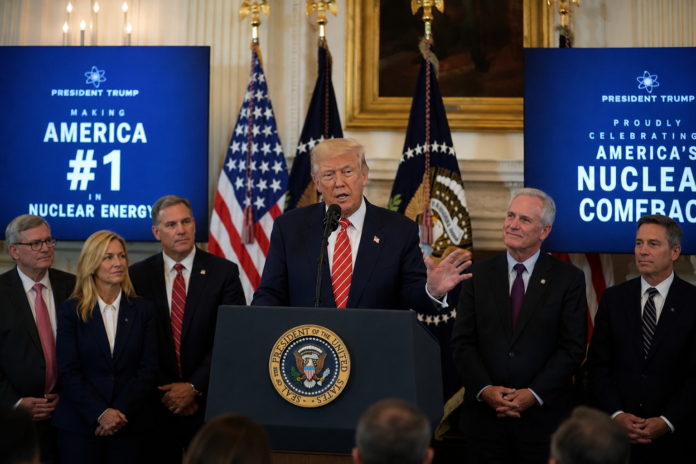
President Trump hosted nuclear energy executives at the White House on Friday to celebrate a major milestone in his administration’s push to revive American nuclear power, announcing that four companies had achieved reactor criticality ahead of his self-imposed Fourth of July deadline. The event capped fourteen months of regulatory changes designed to accelerate nuclear construction, part of a broader goal to quadruple the nation’s nuclear capacity by 2050. The announcement highlights energy policy as a defining priority for the administration even as other crises, including the ongoing conflict with Iran, dominate headlines.
Story Highlights
- Four nuclear startups, Antares, Deployable Energy, Aalo, and Valar, achieved reactor criticality ahead of Trump’s July 4 deadline
- The milestone follows executive orders Trump signed in May 2025 aimed at quadrupling U.S. nuclear capacity from 100 to 400 gigawatts by 2050
- Trump was joined by Energy Secretary Chris Wright and Interior Secretary Doug Burgum at the Oval Office event
- Democratic lawmakers have criticized the executive orders for reducing Nuclear Regulatory Commission oversight and public input
What Happened
President Trump convened nuclear industry executives in the Oval Office on Friday to mark what his administration billed as a historic milestone for civilian nuclear energy in the United States. The event centered on an announcement that four separate companies operating under a Department of Energy pilot program had successfully achieved reactor criticality, the point at which a nuclear reaction becomes self-sustaining, ahead of the July 4 target Trump had set more than a year earlier.
The milestone traces back to a series of four executive orders Trump signed in May 2025 directing the Department of Energy to authorize at least three advanced pilot reactors to reach criticality by the nation’s 250th anniversary. The orders also instructed the Nuclear Regulatory Commission to streamline its licensing process, establishing fixed deadlines for license evaluations and reconsidering aspects of its radiation exposure model. According to Trump, the original target of three successful reactors was exceeded, with four companies, Antares, Deployable Energy, Aalo, and Valar, each reaching criticality by the deadline. Aalo’s reactor reportedly achieved the milestone in the early hours of July 4 itself.
“Most believed the goal was impossible, but I’m delighted to say that four companies succeeded in meeting that deadline,” Trump told reporters at the event, calling the companies “four of the greatest in the world at this subject.” He was joined by Energy Secretary Chris Wright and Interior Secretary Doug Burgum, along with executives from the participating nuclear firms. Wright noted that the United States had ceded much of its global nuclear leadership to Russia and China in recent decades, adding that “President Trump said enough of that.”
The Oval Office event also touched on the administration’s broader nuclear ambitions, including a goal of increasing total U.S. nuclear energy production from roughly 100 gigawatts to 400 gigawatts, and a Defense Department directive to deploy advanced microreactors at military installations. The announcement came in the same week as a separate and more controversial U.S.-Saudi Arabia nuclear cooperation deal, which Trump said would be contingent on Saudi Arabia normalizing relations with Israel as part of the Abraham Accords framework.
Trump also used the event to address unrelated economic pressures, telling reporters that he would not let rising gas prices or persistent inflation affect his decision-making regarding the ongoing conflict with Iran, and that he was “not in a hurry” regarding the political calendar tied to upcoming elections.
Why It Matters
The nuclear milestone represents a tangible policy achievement for an administration that has staked significant political capital on reviving domestic energy production across multiple sectors. For an industry that had been largely dormant in the United States for several decades, the successful criticality demonstrations mark a meaningful technical validation of a regulatory strategy built around compressed timelines and reduced federal review requirements.
For American consumers and businesses, expanded nuclear capacity carries direct implications for electricity costs and grid reliability, particularly as demand from artificial intelligence data centers continues to strain existing power infrastructure. The administration has explicitly tied its nuclear push to the surging electricity needs of AI development, positioning nuclear power as a strategic resource alongside its national security applications.
For policymakers and regulators, the achievement raises ongoing questions about the tradeoffs between accelerated deployment and traditional oversight mechanisms. Critics, including Democratic Representative Salud Carbajal of California, have argued that the executive orders underpinning this progress reduced public input and Nuclear Regulatory Commission oversight in ways that could carry long-term safety or environmental consequences, even as supporters counter that decades of regulatory delay had left the United States lagging behind international competitors.
The nuclear announcement also matters as a counterpoint to the administration’s messaging during a period dominated by international crises. By highlighting a domestic policy win tied to energy independence and technological leadership, the White House sought to demonstrate forward momentum on priorities beyond the ongoing conflict with Iran and the trade dispute with the European Union unfolding simultaneously.
Economic and Global Context
The push to quadruple U.S. nuclear capacity to 400 gigawatts by 2050 represents one of the most ambitious energy infrastructure targets set by any recent administration. Achieving that goal would require a dramatic acceleration in reactor construction relative to the pace of the past several decades, during which the United States built relatively few new nuclear facilities compared to nations like Russia and China, both of which have expanded their nuclear export and construction programs domestically and abroad.
The Energy Department’s Nuclear Energy Launch Pad initiative, which produced this week’s criticality milestones, reflects a broader strategy of using smaller, modular reactor designs that can be built and tested more quickly than traditional large-scale nuclear plants. Officials have credited this approach with helping shorten development timelines that have historically stretched well over a decade for conventional reactors.
Globally, the announcement fits into a broader geopolitical competition over nuclear technology leadership, an area where the Trump administration has framed continued American dominance as a matter of both economic competitiveness and national security. The concurrent U.S.-Saudi Arabia nuclear cooperation deal, tied to conditions involving the Abraham Accords, illustrates how nuclear technology exports have become intertwined with broader diplomatic objectives in the Middle East.
Retired nuclear plants restarting operations and existing facilities increasing their power output are also part of the administration’s broader strategy, according to Energy Department updates, suggesting that new construction represents only one component of the effort to expand nuclear capacity in the years ahead.
Implications
In the near term, the four companies that achieved criticality will move toward further testing and eventual commercial operation, a process that will offer a clearer picture of how quickly this new generation of advanced reactors can actually contribute meaningful electricity to the national grid. Industry analysts will be watching closely for how these pilot projects translate into broader deployment across additional sites.
For the Nuclear Regulatory Commission, continued implementation of the streamlined licensing framework established under last year’s executive orders will remain a point of scrutiny, particularly from congressional Democrats who have raised safety and oversight concerns. Upcoming regulatory deadlines tied to the original executive orders will offer further tests of how the balance between speed and oversight plays out in practice.
For utilities and data center operators facing surging electricity demand, expanded nuclear capacity offers a potential long-term solution to grid capacity constraints, though the timeline for these newly validated reactor designs to reach full commercial scale remains uncertain. Businesses in the AI and technology sectors, which have driven much of the recent growth in electricity demand, are likely to watch these developments closely as they plan future data center investments.
For voters, the nuclear announcement offers the administration a concrete talking point on energy policy heading into future political contests, even as the White House simultaneously manages more volatile situations involving Iran and European trade relations that carry more immediate economic consequences for American households.
Sources