

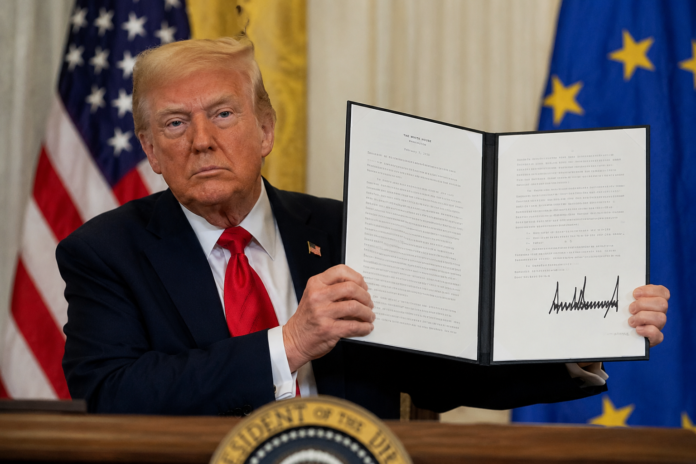
President Donald Trump announced on Friday that his administration will launch a formal investigation into the European Union’s trade practices, accusing Brussels of unfairly targeting American technology companies with billions of dollars in fines. The move came a day after the EU fined Google $1 billion for alleged antitrust violations, pushing Trump to invoke Section 301 of the Trade Act of 1974 and threaten fresh tariffs on European goods. The dispute injects new uncertainty into transatlantic trade relations at a moment when tensions had appeared to be easing.
Story Highlights
- Trump ordered a Section 301 investigation into EU trade practices after Google was fined 890 million euros ($1 billion) for alleged antitrust violations
- Trump said EU fines against Apple, Meta, Amazon and Google now total tens of billions of dollars, calling the practice “illegal and highly discriminatory”
- The president said the United States “is not a ‘PIGGYBANK’ for Europe” and vowed a “substantial tariff” in response
- The dispute follows a pattern of EU enforcement actions against U.S. tech firms under the bloc’s Digital Markets Act
What Happened
On Friday, Donald Trump wrote on Truth Social that his administration would “immediately” open an investigation into the European Union’s treatment of American technology firms. The announcement followed the European Commission’s decision to fine Google 890 million euros, roughly $1 billion, after regulators concluded the company had abused its dominant market position by steering consumers toward its own services through Google Play and its search engine, disadvantaging competitors.
Trump used the post to list a running total of penalties he says Europe has extracted from American businesses, citing a $15 billion fine against Apple, $3 billion against Meta, and $2.5 billion against Amazon, in addition to the new Google penalty, which he said brought Google’s cumulative total above $18 billion. He described the pattern as beginning “during the first year of the Sleepy Joe Biden Administration” and said it would not be allowed to continue under his watch.
The president said the investigation would proceed under Section 301 of the Trade Act of 1974, a statute that permits the president to impose tariffs and other trade restrictions if an investigation determines that a foreign government has engaged in unfair or discriminatory trade practices. Trump has increasingly relied on Section 301 as his legal vehicle of choice for imposing tariffs after the Supreme Court struck down a separate set of levies he had imposed earlier this year under a different statutory authority.
Trump’s threat comes as the European Commission, led in competition matters by officials in Brussels, has signaled it intends to intensify enforcement of its digital rulebook throughout 2026 rather than retreat in the face of American pressure. EU officials have publicly acknowledged the political risk of continuing to fine U.S. tech giants while trying to avoid a full-blown trade war with Washington, particularly given the broader diplomatic relationship tied to European security matters.
Apple, Google, Meta and Amazon have not issued detailed public responses to Trump’s latest threat, though all four companies have separately challenged EU fines through the bloc’s court system in the past, with mixed results. Google has previously lost significant legal battles over its Android practices and other antitrust matters dating back more than a decade.
Why It Matters
The fight over EU fines strikes at the heart of a broader disagreement between Washington and Brussels over how to regulate the world’s largest technology companies. For years, the European Union has positioned itself as the global leader in digital regulation, using its Digital Markets Act and antitrust authority to impose financial penalties that Trump and many Republicans view as a backdoor tax on American innovation. This latest escalation signals that the administration intends to treat regulatory fines as a trade issue rather than a purely legal one.
For American businesses, particularly the handful of dominant tech firms named in Trump’s post, the stakes are significant. Continued EU enforcement could mean billions more in penalties, forced changes to business practices in the European market, or both. A Section 301 investigation and subsequent tariffs, if imposed, could also reshape how these companies plan their European operations and pricing structures going forward.
For everyday Americans, the dispute carries indirect consequences. Tariffs imposed on European goods in retaliation could raise costs for imported products ranging from automobiles to specialty foods and pharmaceuticals, effects that often land on consumers rather than foreign exporters. At the same time, supporters of Trump’s approach argue that allowing European regulators to extract large fines from U.S. companies without pushback effectively subsidizes European government revenue at America’s expense.
The dispute also has implications for the broader technology policy debate inside the United States, where lawmakers remain divided over whether the federal government or individual states should take the lead on regulating artificial intelligence and digital platforms. Trump’s defense of U.S. tech companies abroad occurs even as some of his own administration’s positions on domestic tech regulation remain unsettled.
Economic and Global Context
The scale of EU fines against U.S. tech companies has grown substantially over the past several years. Trump’s tally, citing more than $18 billion in cumulative Google penalties alone, reflects a string of enforcement actions dating back to a 2011 antitrust case over Android that remains unresolved in European courts. Apple previously absorbed a 13 billion euro fine tied to back taxes owed in Ireland, an amount that visibly affected its quarterly earnings per share. Meta has faced hundreds of millions of euros in fines over its Facebook Marketplace service and prior penalties tied to data protection violations.
Global markets have shown sensitivity to the broader trade relationship between Washington and Brussels, particularly as the Trump administration has used Section 301 investigations as a recurring tool since the Supreme Court invalidated an earlier tariff regime. Investors have generally reacted cautiously to renewed trade friction, wary that tit-for-tat tariff escalation could disrupt supply chains for goods moving across the Atlantic.
The European Commission, for its part, has framed its enforcement actions as necessary to preserve competition and consumer protection within its digital single market, arguing that dominant American platforms would otherwise face no meaningful check on anticompetitive behavior. European officials, including the bloc’s competition chief, have acknowledged operating under political pressure from Washington but have signaled no intention of abandoning the enforcement framework built over the past several years.
This dispute unfolds against a backdrop of other active trade tensions, including ongoing negotiations over automobile tariffs, agricultural market access, and digital services taxes that several European governments have separately pursued. Any new tariffs stemming from the Section 301 investigation would add another layer to an already complex web of transatlantic economic friction.
Implications
In the near term, the Section 301 investigation will proceed through the U.S. Trade Representative’s office, a process that typically takes months before any formal tariff action is imposed. That timeline gives both sides room for negotiation, though Trump’s public rhetoric suggests he is prepared to move quickly if he concludes the EU has not changed course.
For the EU, the choice will be whether to continue current enforcement levels against U.S. tech firms and risk tariffs on European exports, or to moderate its regulatory posture to avoid a broader trade confrontation. European officials have previously indicated they view maintaining the integrity of the Digital Markets Act as a priority, suggesting Brussels may not back down easily.
For American businesses and consumers, the practical effects will depend on how far the dispute escalates. A negotiated resolution could leave current EU fines in place while establishing new guardrails for future enforcement. A more confrontational path could mean new tariffs affecting a range of European imports, with downstream effects on prices in the United States.
Congressional Republicans have generally supported Trump’s aggressive posture toward the EU on tech regulation, while some Democrats have expressed concern that retaliatory tariffs could hurt American consumers more than European regulators. As the investigation unfolds, both the tech industry and trade policy watchers will be monitoring whether this becomes a defining trade dispute of the administration’s second term.
Sources
Trump Threatens New EU Tariffs After Google Hit With $1 Billion Fine
