

President Donald Trump’s Department of Homeland Security escalated its campaign to control state election systems on Friday, with Secretary Markwayne Mullin threatening election officials nationwide with prison time and fines if they refuse to run voter rolls through a federal database ahead of the 2026 midterms. The warning came a day after Trump delivered a primetime address reviving unproven claims of fraud in past elections, marking one of the most aggressive federal efforts yet to reshape how states administer voting. Critics, including voting rights advocates and at least one federal judge, say the underlying legal authority for the push remains in serious doubt.
Story Highlights
- DHS Secretary Markwayne Mullin said states that don’t run voter rolls through the SAVE database could lose federal election security funding and face criminal penalties
- Mullin claimed DHS identified more than 250,000 alleged noncitizens on voter rolls in California, New Jersey, Nevada, and Pennsylvania, without detailing how DHS obtained the data
- A federal judge has already blocked DHS from using the SAVE database for this purpose, calling the repurposing improper
What Happened
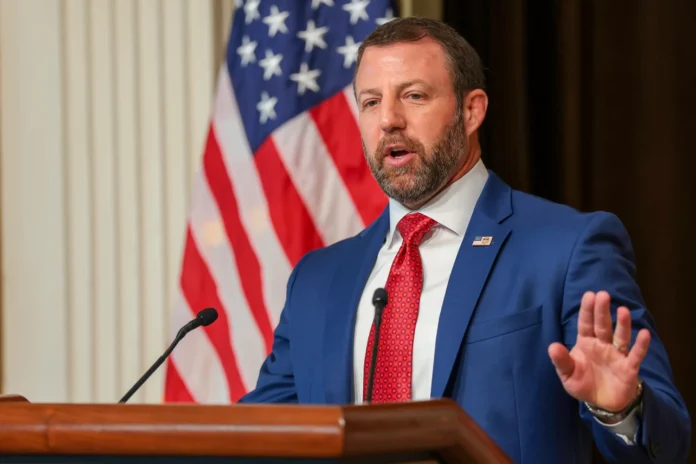
Homeland Security Secretary Markwayne Mullin held a press conference on Friday, July 17, laying out what he called mandatory election security requirements for states. Speaking one day after President Trump addressed the nation from the East Room of the White House to relitigate disputed claims about the 2020 election, Mullin said states must now run their voter registration lists through the Systematic Alien Verification for Entitlements database, known as SAVE, to check for noncitizens and continue receiving federal reimbursement to help run elections.
Mullin said DHS would use the database to scrub voter rolls for ineligible voters, including noncitizens and deceased individuals, both before and after the midterms. He claimed the department had preliminarily found more than 250,000 noncitizens on registration lists in California, New Jersey, Nevada, and Pennsylvania, though he did not explain how DHS accessed those states’ voter data or provide evidence that any of the flagged individuals had actually cast a ballot. Election experts have noted that many states sell or publish portions of their voter files, which could account for DHS obtaining the information without direct state cooperation.
The secretary went further than earlier funding threats, warning that election officials who decline to cooperate could face financial penalties or, in his words, prison time. He cited existing federal law that carries penalties of up to five years and $250,000 in fines for illegal voter registration or illegal voting, suggesting those statutes could be used against officials who fail to act on information DHS provides them. Mullin framed the effort as protecting election integrity, saying foreign adversaries have demonstrated the capability to alter voter registration systems.
The threat is separate from an earlier move by the Federal Emergency Management Agency, which said in a new grant notice that it would withhold 20 percent of Homeland Security Grant Program funding, worth more than $200 million nationally, from states that don’t certify compliance with the administration’s election security requirements. States must also agree to manually audit 5 percent of ballots and phase out electronic voting systems in favor of hand-marked paper ballots to access the full funding.
Complicating the administration’s plan, a federal court order currently blocks DHS from using the SAVE database to police most state voter rolls, a restriction Mullin’s announcement appears to disregard. Rick Hasen, a UCLA law professor who directs the Safeguarding Democracy Project, has said the administration is using whatever levers of federal power it has to influence how states conduct the 2026 elections, which fall under state and congressional authority under the Constitution.
Why It Matters
The dispute strikes at one of the most sensitive fault lines in American governance: the balance between federal oversight and state control of elections. The Constitution assigns responsibility for administering elections primarily to the states, and Congress has historically played only a limited, funding-based role. Mullin’s threat to tie federal money and potential criminal liability to compliance with a specific database represents a significant expansion of executive branch leverage over a process the founders deliberately decentralized.
For state election officials, many of whom are already navigating tight budgets and aging infrastructure, the financial stakes are substantial. The Homeland Security Grant Program supports far more than voting-related work; it funds cybersecurity upgrades, counterterrorism planning, and emergency response capabilities. Losing a fifth of that funding could force states to make difficult tradeoffs between election security and other public safety priorities, potentially undermining the very security goals the administration says it is pursuing.
There is also a credibility question hanging over the entire initiative. Studies conducted over the past two decades have consistently found voter fraud, including noncitizen voting, to be exceedingly rare in the United States. Mullin’s claim that more than 250,000 noncitizens are on voter rolls in just four states, without corroborating evidence that any of them voted, echoes previous administration claims that were later walked back or found to rely on flawed data matching. If the SAVE database proves as unreliable as critics warn, states that comply could see eligible citizens wrongly flagged and potentially removed from rolls just months before a competitive midterm election.
For voters themselves, the controversy risks further eroding public confidence in the electoral process, regardless of which side is ultimately proven correct. Repeated high-profile assertions of fraud, even when unsubstantiated, have been shown in prior election cycles to reduce trust in results among segments of the electorate. That dynamic could shape turnout and post-election disputes in November.
Economic and Global Context
The funding fight unfolds against the backdrop of a $1.064 billion Homeland Security Grant Program for fiscal year 2026, the primary vehicle through which the federal government helps states and major urban areas prepare for terrorism and other threats. DHS’s threat to withhold 20 percent of that funding, or roughly $200 million in aggregate, would fall unevenly across states depending on population and existing security needs, with larger states like California and Pennsylvania facing the largest dollar losses if they refuse to comply.
The cost of the administration’s specific technical demands is also significant. Independent estimates suggest transitioning the nation’s election infrastructure to align fully with the voluntary federal voting equipment standards the administration is pushing, including a move away from barcode and QR code ballots toward hand-marked paper systems, could cost as much as $2.7 billion nationwide. States that lack the budget flexibility to make those upgrades quickly could find themselves penalized regardless of their willingness to cooperate.
Pennsylvania offers an early case study. State officials there say the federal government is already withholding nearly half of the state’s allocated Homeland Security dollars from the prior funding cycle, a signal that the financial consequences of noncompliance are not merely theoretical but are already being felt. Other states, including Maine, have indicated they may simply forgo smaller election security grants, worth roughly $130,000 in Maine’s case, rather than comply with what they view as federal overreach.
Internationally, the episode adds to a broader narrative of eroding institutional trust that foreign adversaries have sought to exploit in prior election cycles. Intelligence officials across administrations have warned that public disputes over the legitimacy of American elections, even when domestically generated, can be amplified by foreign disinformation campaigns seeking to weaken confidence in democratic institutions.
Implications
In the near term, expect a wave of legal challenges from state attorneys general and voting rights organizations, building on the existing court order that already restricts DHS’s use of the SAVE database for this purpose. Litigation is likely to focus on whether the administration can lawfully condition federal grant funding on compliance with election procedures that fall outside DHS’s traditional statutory authority.
State election officials, particularly those in Democratic-led states named by Mullin, face a difficult choice between accepting federal oversight they view as improper or risking funding losses and threatened legal exposure. Some may pursue a middle path, participating in narrower data-sharing arrangements while resisting the broader compliance package tied to voting equipment and ballot design changes.
For voters, the coming months will likely bring continued public confusion as competing claims about election integrity circulate ahead of the midterms. Local election offices may face increased scrutiny and workload as they respond to information requests from DHS while also managing routine list maintenance obligations they already perform under existing law.
For congressional Republicans, the episode offers a rallying point, with several members and committees already amplifying Mullin’s claims in public statements. Democrats and nonpartisan election law experts, by contrast, are likely to intensify efforts to codify state authority over elections and to challenge the legal basis for federal funding conditions in court before the November midterms arrive.
Sources
