

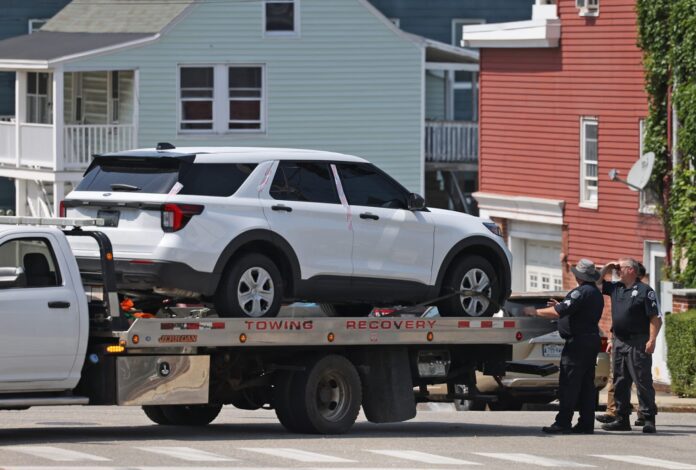
President Donald Trump has ordered U.S. Immigration and Customs Enforcement to resume vehicle stops nationwide, reversing a Department of Homeland Security directive issued just a day earlier that had paused most such stops following two fatal shootings of non-target drivers in Maine and Texas. The reversal came after intense pushback from prominent MAGA-aligned voices who argued the pause signaled weakness on immigration enforcement. The episode has reignited scrutiny of ICE tactics and thrust the debate into a closely watched Maine Senate race.
Story Highlights
- DHS ordered ICE to suspend most non-urgent vehicle stops on Tuesday following fatal shootings in Biddeford, Maine, and Houston, Texas
- Trump reversed the pause Wednesday via Truth Social, calling traffic stops one of ICE’s “most important and effective” tools
- Neither victim, Colombian national Johan Sebastián Durán Guerrero nor Mexican national Lorenzo Salgado Araujo, was the intended target of the operations that killed them
- Maine Republican Sen. Susan Collins, facing a competitive reelection race, had urged the pause and later said stops should remain halted until investigations conclude
What Happened
The controversy began after ICE agents fatally shot two men within roughly a week of each other, neither of whom was the actual target of the enforcement operation underway. In Houston, agents surveilling a property for a different individual shot and killed Lorenzo Salgado Araujo after mistaking his vehicle for the one they were tracking. Six days later, in Biddeford, Maine, agents attempting to serve a removal order on someone else pulled over a car driven by Johan Sebastián Durán Guerrero, a 25-year-old Colombian national. According to the Department of Homeland Security, an officer opened fire after Durán Guerrero allegedly tried to flee the scene. Neither incident involved officers wearing body cameras.
The Biddeford shooting triggered protests across Maine and drew a public response from Republican Sen. Susan Collins, who said she contacted DHS Secretary Markwayne Mullin directly to press for a halt to non-urgent vehicle stops while the shootings were investigated. On Tuesday, DHS issued internal guidance instructing ICE’s Enforcement and Removal Operations division to largely suspend such stops, with exceptions for serious criminal targets, while additional tactical training was conducted. Border czar Tom Homan described the move publicly as a short-term pause rather than a policy change.
The pause did not last a full day. Trump, described by sources as furious over both the directive and the backlash it generated from his base, posted on Truth Social Wednesday morning declaring that ICE could not surrender the traffic stop as an enforcement tool, warning that doing so would benefit criminals. He instructed agents to be “judicious, fair and smart” but to resume the practice. The White House confirmed the post effectively overturned the DHS memo. Mullin subsequently said he and the president were “on the same page,” and ICE field offices issued verbal clarifications that stops remained available in the toolkit.
Why It Matters
The episode illustrates the tension inside the administration between operational caution following fatal errors and the political imperative to maintain aggressive deportation numbers. ICE has reportedly been operating under pressure to reach roughly 2,000 arrests per day, and internal data shared with reporters showed arrests in Maine alone had more than quadrupled between early June and early July. That pace, sources say, has strained officers and increased the likelihood of rushed or high-risk stops involving people who are not the actual enforcement targets.
For families of the victims, the reversal closes off what had briefly looked like a policy correction. Durán Guerrero’s father told reporters his son had come to the United States to build a future for his family and left behind a wife and young daughter. The Maine Immigrants’ Rights Coalition noted he had been authorized to work in the country and held a Social Security number, complicating the administration’s public framing of the incident.
Politically, the reversal exposes Collins to a difficult balancing act. She is seeking reelection in a race widely seen as pivotal to Senate control, and her public break with the administration on this issue, followed by the president’s swift override, puts her in the position of having asked for restraint that was denied within a day.
Economic and Global Context
While this story is primarily a domestic law enforcement and immigration matter, it carries broader implications for the administration’s mass deportation program, which remains a signature second-term priority. The push for higher daily arrest numbers has been tied to congressional funding increases for ICE operations approved in recent budget cycles, and the agency continues to face criticism over the pace at which body cameras have been deployed to field officers, a gap officials have blamed on funding delays.
The shootings also arrive amid a broader wave of scrutiny over ICE conduct nationally, following earlier fatal incidents in the Minneapolis area in January involving agents and drivers who were not enforcement targets. Civil rights organizations and immigrant advocacy groups argue the pattern reflects systemic risk in high-volume, quota-driven enforcement, a claim the administration disputes.
Implications
In the near term, expect continued protests in Maine and Texas, along with calls from Democratic lawmakers for independent investigations into both shootings. DHS has pledged to accelerate body camera deployment, though a firm timeline has not been provided. Whether that rollout proceeds quickly may shape how future incidents are investigated and publicly perceived.
For Collins, the coming months will test whether her attempt to moderate on ICE tactics helps or hurts her standing with Maine voters in a race Democrats view as winnable. For the administration, the swift reversal signals that arrest-volume targets will continue to take precedence over operational pauses, even after fatal errors, unless political pressure shifts dramatically. Congressional Democrats are likely to use both incidents to press for hearings on ICE training standards and accountability measures, though prospects for binding legislative action remain uncertain given divided control of Congress.
Sources