
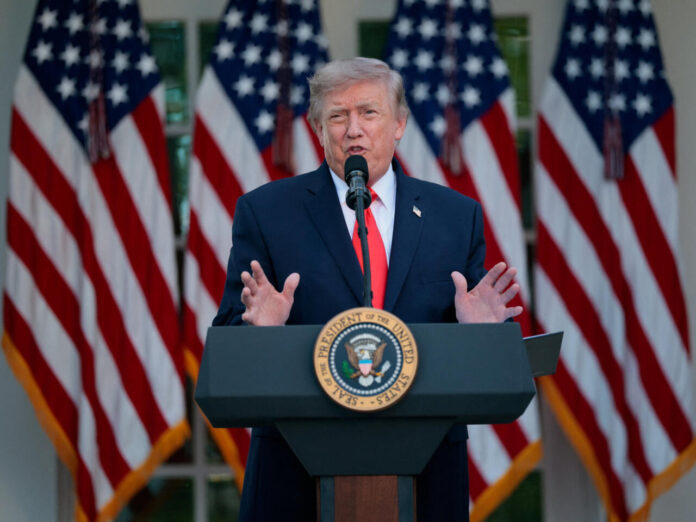
President Trump will deliver a primetime address Thursday at 9 p.m. focused on elections, with the White House suggesting he may revisit long-debunked claims about his 2020 defeat as he pushes Republicans to pass tighter federal voting rules ahead of November’s midterms. The speech comes as Trump has intensified attacks on mail-in voting and state election processes, including recent unsubstantiated fraud allegations tied to a Los Angeles mayoral primary. Democrats and some election officials say the address risks further undermining public confidence in an electoral system that has repeatedly withstood scrutiny.
Story Highlights
- Trump will deliver a primetime address Thursday at 9 p.m. focused on elections, ahead of the November midterms.
- Trump has renewed unsubstantiated fraud claims tied to a Los Angeles mayoral primary, prompting a federal fraud investigation announced last month.
- Multiple audits, including some led by Trump’s own former attorney general, have found no significant fraud in the 2020 election.
- FBI agents raided Fulton County, Georgia, election offices earlier this year, seizing 2020 election materials.
What Happened
President Trump is scheduled to deliver a primetime address Thursday night that the White House says will focus on elections, with Trump suggesting to reporters this week that the speech will include “really big” content, though he offered few specifics. The address comes as Trump has escalated calls for Republicans to pass tighter federal voting rules ahead of the November midterm elections, an effort tied to legislation known as the Save AMERICA Act, which would mandate voter identification requirements and sharply restrict mail-in voting nationwide.
Trump’s renewed focus on elections follows a pattern dating back to 2016, when he first refused to commit to accepting the outcome of that year’s election against Democrat Hillary Clinton. After winning that race, he convened a voting integrity commission intended to substantiate claims of widespread voter fraud that he said cost him the popular vote; the commission disbanded without finding evidence of such fraud. Following his 2020 loss to Democrat Joe Biden, Trump again alleged cheating, focusing particularly on Biden’s narrow victory in Georgia, despite numerous audits and reviews, including some conducted by Republican officials and Trump’s own then-attorney general, finding no significant fraud occurred.
Earlier this year, FBI agents raided election offices in Fulton County, Georgia, seizing materials related to the 2020 election. Tulsi Gabbard, then serving as Trump’s director of national intelligence, traveled to Atlanta to oversee execution of the search warrant. Last week, Trump removed the remaining members of the federal Election Assistance Commission, a bipartisan panel that had resisted his administration’s efforts to impose new voting requirements, further consolidating administration influence over federal election infrastructure ahead of the midterms.
Trump’s most recent fraud allegations center on California, where he has criticized the state’s mail-in voting system and slow vote-counting process. During a Monday interview with Newsmax, Trump claimed Republican candidate Spencer Pratt lost his primary bid for Los Angeles mayor because of fraud, pointing in part to the pace of California’s vote tabulation. Federal prosecutors announced last month that they were opening fraud investigations in the state after Trump drew attention to the claim, though no evidence of systemic fraud has been publicly presented.
The Thursday address is scheduled as Trump simultaneously manages an intensifying military conflict with Iran and continued fallout from recent fatal shootings involving Immigration and Customs Enforcement officers, meaning the elections speech will compete for public attention with several other major administration storylines unfolding in the same week.
Why It Matters
Trump’s continued focus on unsubstantiated election fraud claims carries significant implications for public trust in democratic institutions ahead of a pivotal midterm cycle that will determine control of Congress. Repeated amplification of fraud allegations that have not been substantiated by any credible audit risks further eroding confidence in electoral outcomes among a segment of voters, regardless of the actual integrity of the underlying processes.
The push for the Save AMERICA Act, with its voter identification and mail-in voting restrictions, represents a substantive policy effort that could materially affect how millions of Americans vote in November, particularly in states that have relied heavily on mail-in ballots to expand access. Election administrators and voting rights advocates have expressed concern that sweeping federal restrictions could disproportionately affect elderly, disabled and rural voters who depend on mail-in options.
The removal of the Election Assistance Commission’s remaining members eliminates a bipartisan check that had previously resisted some of the administration’s election policy proposals, raising questions about who will oversee the implementation of any new federal voting requirements and whether adequate safeguards remain in place to prevent partisan influence over election administration.
The Fulton County raid and ongoing California fraud investigations also signal a broader pattern of federal law enforcement resources being directed toward Trump’s specific fraud claims, a dynamic that critics argue blurs the line between legitimate law enforcement inquiry and politically motivated investigation, while supporters contend it reflects necessary scrutiny of election integrity concerns.
Economic and Global Context
While election administration is primarily a domestic governance matter, sustained disputes over voting rules and fraud claims can have economic implications tied to state and local government spending, as election offices are forced to allocate resources toward audits, investigations, and compliance with any new federal mandates that emerge from legislation like the Save AMERICA Act.
International observers have periodically commented on the state of U.S. democratic institutions amid recurring disputes over election legitimacy, with implications for how allied democracies and international election-monitoring organizations characterize the health of American electoral processes. Sustained domestic disputes over election integrity can factor into broader global assessments of democratic stability in the United States.
Business and civic organizations focused on voter access have also weighed in on debates over mail-in voting restrictions, with some warning that sweeping changes implemented close to a major election cycle could create administrative confusion and increase costs for state election offices tasked with rapidly adjusting procedures.
The timing of the primetime address, arriving amid an active war with Iran and domestic controversy over ICE enforcement tactics, means the speech’s economic and political reception will likely be shaped by how it interacts with these other major storylines competing for public and congressional attention this week.
Implications
In the immediate term, the content of Thursday’s address will determine how directly Trump revisits 2020 election claims and how explicitly he ties the speech to the push for the Save AMERICA Act. Congressional Republicans will be watching closely, as many have shown reluctance to fully embrace renewed fraud claims while still supporting stricter voting requirements on policy grounds.
For Democrats and voting rights groups, the speech is likely to prompt swift public rebuttals emphasizing the extensive record of audits finding no significant fraud in 2020, a message Maryland Governor Wes Moore previewed this week when he said Americans are “exhausted” by rehashed election disputes.
For state election officials, particularly in California and Georgia, continued federal scrutiny tied to Trump’s claims will likely mean ongoing engagement with federal investigators and potential legal challenges over the scope of federal authority to intervene in state-run election processes.
For voters heading into the midterms, the address adds another data point in an already contentious debate over election administration that is likely to remain a defining feature of American political discourse through November.
Sources