

Story Highlights
- President Trump renewed his push for U.S. control of Greenland during the NATO summit in Ankara.
- Danish Prime Minister Mette Frederiksen said Greenland is “not for sale” and vowed to defend Danish territory.
- NATO Secretary General Mark Rutte said Trump has a point about keeping China and Russia out of the Arctic.
What Happened
President Donald Trump reignited his campaign for American control of Greenland during the NATO summit in Ankara, arguing that the Arctic territory is critical to U.S. and global security.
Speaking alongside NATO Secretary General Mark Rutte, Trump said Greenland “should be controlled by the United States” and described the island as strategically important for “the protection of the world.”
Trump argued that Greenland is more important to Washington than Copenhagen because of its location in the Arctic, where Russia and China have expanded their presence.
- Trump said Greenland is vital to American security interests.
- Denmark rejected the idea and said the territory is not for sale.
- The dispute added fresh tension inside NATO during a high-stakes summit.
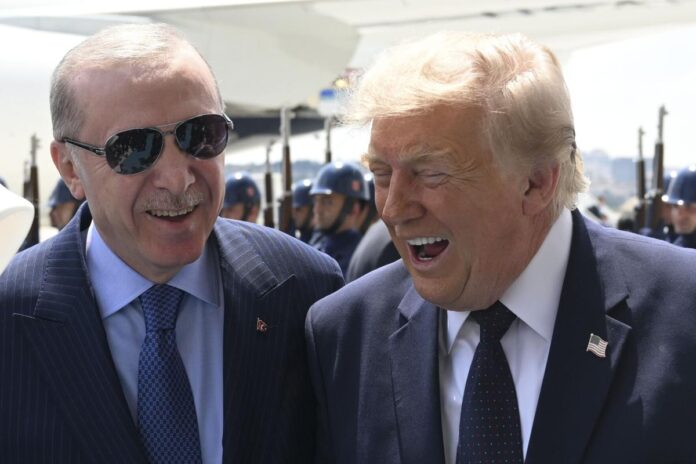
The president also suggested that European resistance to his Greenland position has damaged his relationship with NATO. In a meeting with Turkish President Recep Tayyip Erdogan, Trump said the pushback was one reason he had become frustrated with the alliance.
Danish Prime Minister Mette Frederiksen responded firmly, saying Greenland is “not for sale.” Asked whether Denmark would defend the territory militarily if necessary, she said Denmark is ready to defend every inch of NATO, including its own territory.
Rutte tried to calm the dispute while acknowledging the strategic issue behind Trump’s argument. He said Trump “absolutely has a point” about preventing Chinese and Russian influence in the Arctic, though he did not endorse U.S. acquisition of Greenland.
Why It Matters
The Greenland dispute matters because it places a major strategic disagreement at the center of NATO politics.
For Trump and his supporters, the push reflects a clear national-security calculation. Greenland sits in a key Arctic position, has important mineral resources, and could become even more valuable as great-power competition intensifies.
Trump’s argument is that the United States cannot allow Russia or China to gain influence in a region that affects North American defense, Atlantic security, and future Arctic shipping routes.
- Supporters say Trump is thinking ahead on Arctic security.
- Greenland is strategically located between North America and Europe.
- The island has rare earth minerals and other resources important to defense and technology supply chains.
For Denmark, however, Trump’s position is a direct challenge to sovereignty. Greenland is a semiautonomous Danish territory, and Copenhagen has repeatedly rejected any suggestion that it can be purchased or transferred.
The dispute also raises a broader question for NATO: how the alliance handles internal disagreements when the disagreement involves territory controlled by one ally but coveted by another.
Political and Public Context
Trump has raised the Greenland issue repeatedly since his first term, but the latest comments came during an especially sensitive NATO summit.
The alliance is already managing disputes over defense spending, Ukraine, Iran, and European troop commitments. By bringing Greenland back into the discussion, Trump added another pressure point to an already tense diplomatic setting.
Trump also suggested the U.S. could reduce troop levels in Europe if allies continue pushing back. That warning raises the stakes because American forces remain central to NATO’s defense posture, especially as tensions with Russia continue.
For Trump’s base, the message is likely to be viewed as another example of the president putting American strategic interests first.
For European leaders, the concern is that territorial pressure on Denmark could weaken alliance unity at the very moment NATO is trying to project strength.
Economic and Global Context
Greenland’s importance is not only military. The territory holds major deposits of rare earth minerals and other critical resources needed for technology, energy, and defense production.
As global competition over critical minerals grows, Greenland has become more strategically valuable. The island’s location also matters as melting ice opens new Arctic shipping routes.
Russia has expanded Arctic military infrastructure, while China has sought greater scientific and economic access to the region. Those developments give Trump’s security concerns real weight, even as his proposed solution remains deeply controversial.
- Greenland is central to future Arctic competition.
- Rare earth minerals make the territory economically important.
- Russia and China’s Arctic activity has increased Western concern.
The dispute also connects to NATO’s defense spending debate. Trump has been pressing European allies to meet higher spending targets, and new figures cited in the article show some countries still struggling to meet even the older 2% benchmark.
The Pentagon is also reviewing U.S. troop levels in Europe, making Trump’s comments about possible reductions more significant.
What Happens Next
In the near term, the dispute is likely to continue as a diplomatic flashpoint between Washington and Copenhagen.
Trump has reportedly ruled out using military force to obtain Greenland, which means the fight is likely to remain political, diplomatic, and strategic rather than military.
- Denmark and Greenlandic officials are expected to continue asserting sovereignty.
- NATO may look for a compromise focused on Arctic security cooperation.
- The U.S. could push for expanded military access or basing arrangements short of control.
Rutte’s effort to create a “good process” may become important if NATO tries to address Trump’s security concerns without endorsing a territorial transfer.
For Trump, the Greenland push reinforces a broader foreign policy message: the United States must act aggressively to secure strategic territory, block China and Russia, and protect long-term American interests in the Arctic.
